From the letters hiding under a Featherweight’s bed to the cams tucked in a 401A’s drawer, here’s how to tell the few vintage sewing machines worth money from the many that aren’t, before you sell one, service it or let it go.
Read through to #1 for the one number that settles whether to sell it or keep it.
You press the pedal and the motor answers with that low, steady hum, the needle bar bobbing the way it always has. Somebody on Facebook says machines like this bring a thousand dollars. Somebody else says twenty. Both are right, about different machines. The difference shows up in three places: the badge, two little letters stamped into the metal, and whatever is rattling around in the drawer. You can check all three at the kitchen table before anyone makes you an offer.
#17 The Featherweight 221 in its little black case
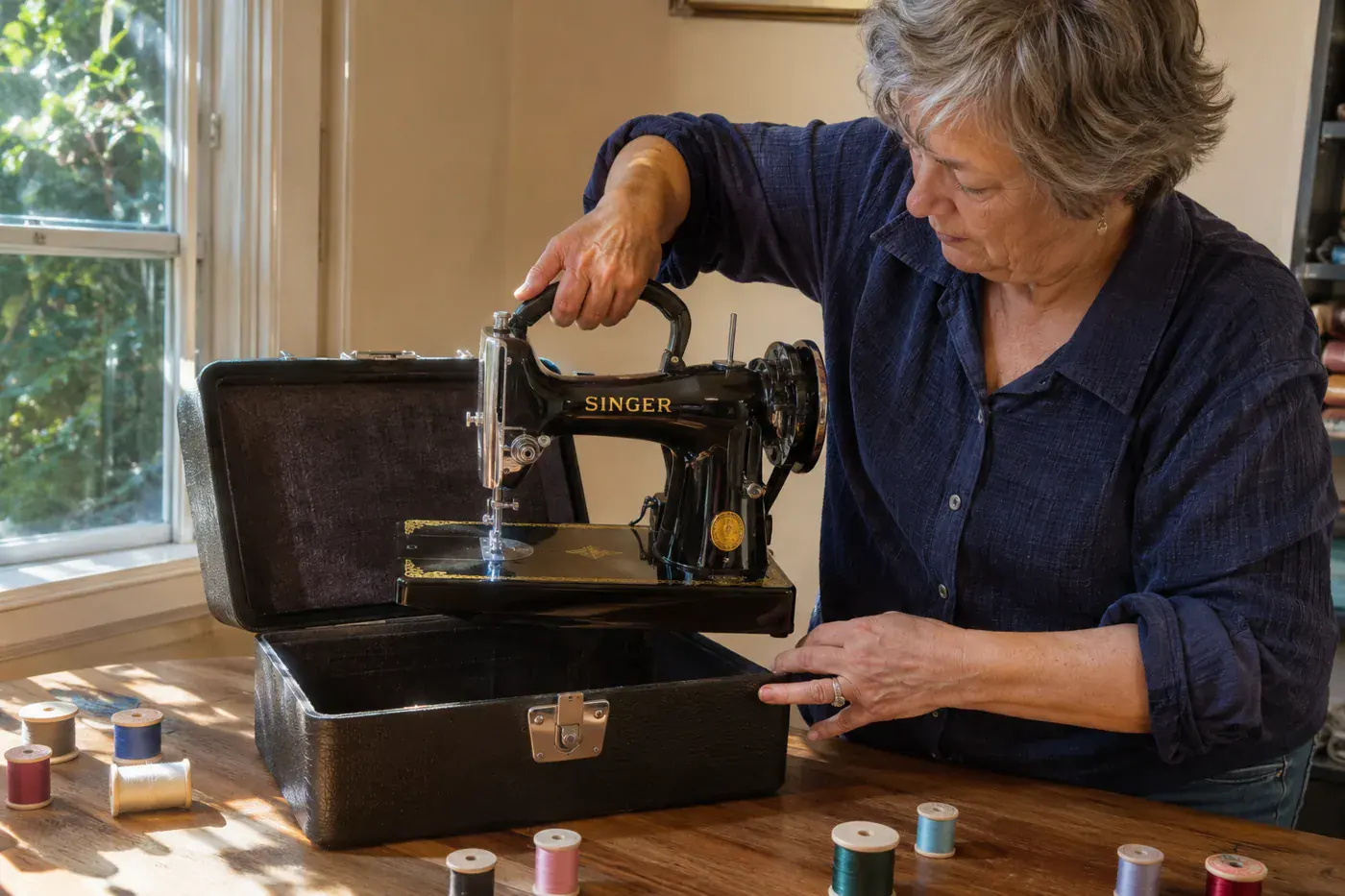
Start with the small black machine in the small black case, the one you can lift with one hand. It weighs only about 11 pounds. Greg Edbauer restores machines for the Vintage Sewing Club in Norway, Michigan, and he told The Daily News that Featherweights “are light, and built to be carried.”
That’s a big part of why they sell. Carole Meeker, an antiques dealer at AntiqBuyer.com, puts it in plain dollars: “I sell most Singer 221 Featherweights in the $595-$750 and up price range.” Machines that sew well but show “loss to the gold decals, or scratches, or chipped paint” sell at the low end.
Color moves the price, too. A 2026 value guide from Vintage Green Antiques puts a working black 221 with its original case at $300 to $700. It puts a white or beige one at $800 to $1,500. Those are guide figures, not sales, but look at the gap. The white one’s range starts above where the black one’s ends.
The machines Meeker calls the most sought-after are the “Expo models … produced in very limited quantities” for the Texas Centennial, Chicago’s Century of Progress and San Francisco’s Golden Gate expositions. If you think yours might be one, call a Featherweight specialist before you list it.
Date a Featherweight by its letters and paint – AD to AM: 1933 to 1957, built in Elizabethport, New Jersey – EE to EW: 1947 to 1968, built in Kilbowie, Scotland – Tan 221J: St. Johns, Quebec, 1960 to 1962. The tan paint has no protective clear coat, so it chips and discolors more easily – White 221K: about 1963 to 1970, roughly 150,000 made
#16 The treadle in the oak cabinet
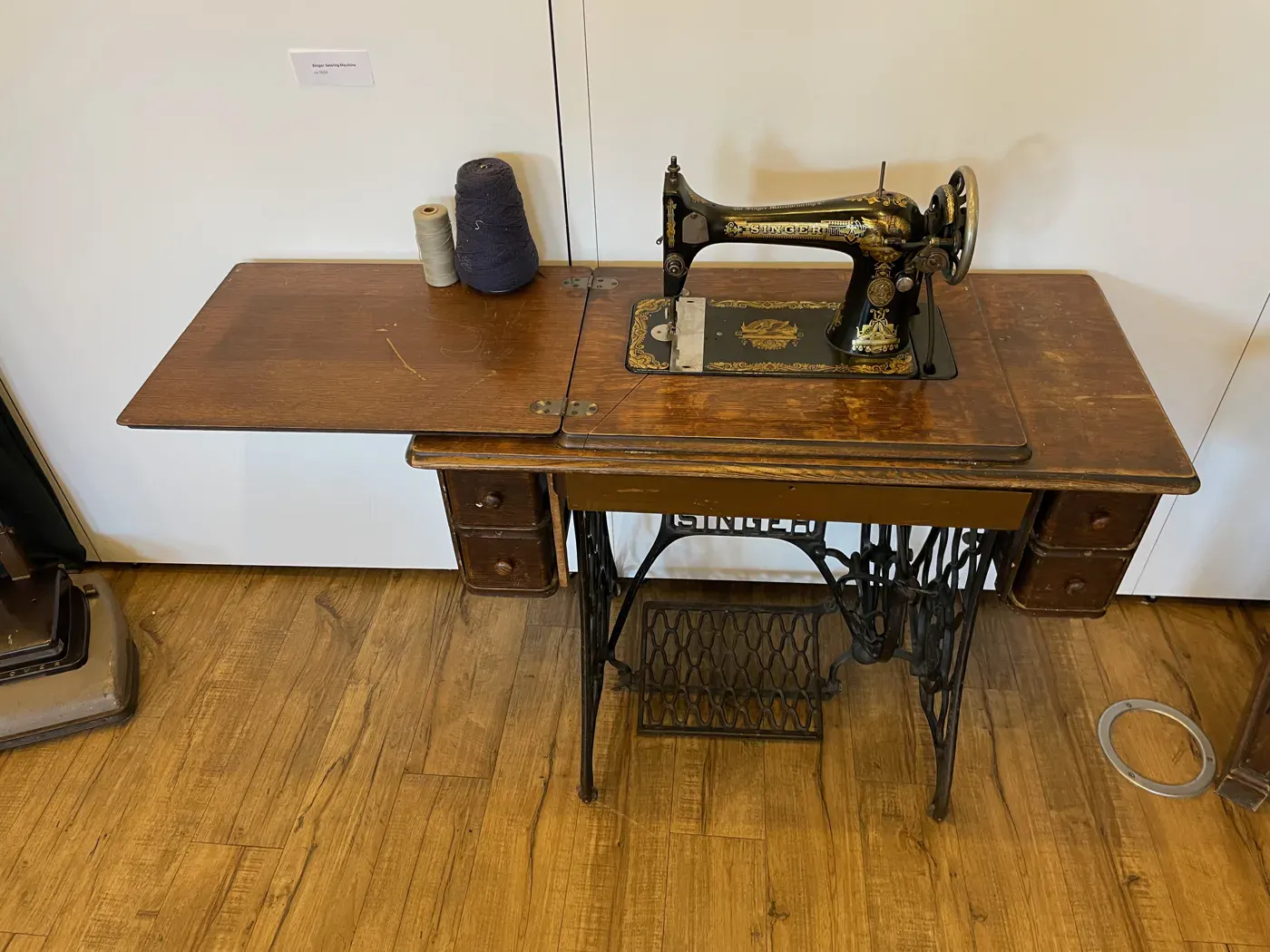
You can probably still feel the rhythm in your feet: rock the iron pedal, nudge the wheel toward you, and the belt takes over. A great many of these machines survived, and that’s the trouble when you sell one.
AntiqBuyer’s value page says later treadles have sold at auction for as little as $10 and commonly bring under $100. Most buyers want something decorative, it says, and few are sewing machine collectors. D.A. Brumleve, who wrote the value guide for the International Sewing Machine Collectors’ Society, says a pretty machine with a beautiful cabinet may well have decorative value to those buyers.
Among the common oak-cabinet treadles people inherit, one usually brings more than most: a working Model 66, the one collectors call the Red Eye. The Vintage Green guide puts a Red Eye with sharp decals at $200 to $400. A 1910 Red Eye in a quarter-sawn oak cabinet went to auction in Indianapolis in 2018 with an estimate of $100 to $200. Rarer, more ornately decorated pre-1900 treadles can bring even more.
Splitting the treadle sewing machine into pieces rarely pays. The same guide puts a pre-1900 head on its own at $25 to $75 and an iron stand at $20 to $60.
Before you put a price on yours, look at sold listings for the same model. On eBay, search the model, then tick “Sold” under “Show Only” in the left-hand column. What buyers actually paid shows in green.
#15 The hand-crank machine nobody wants to ship
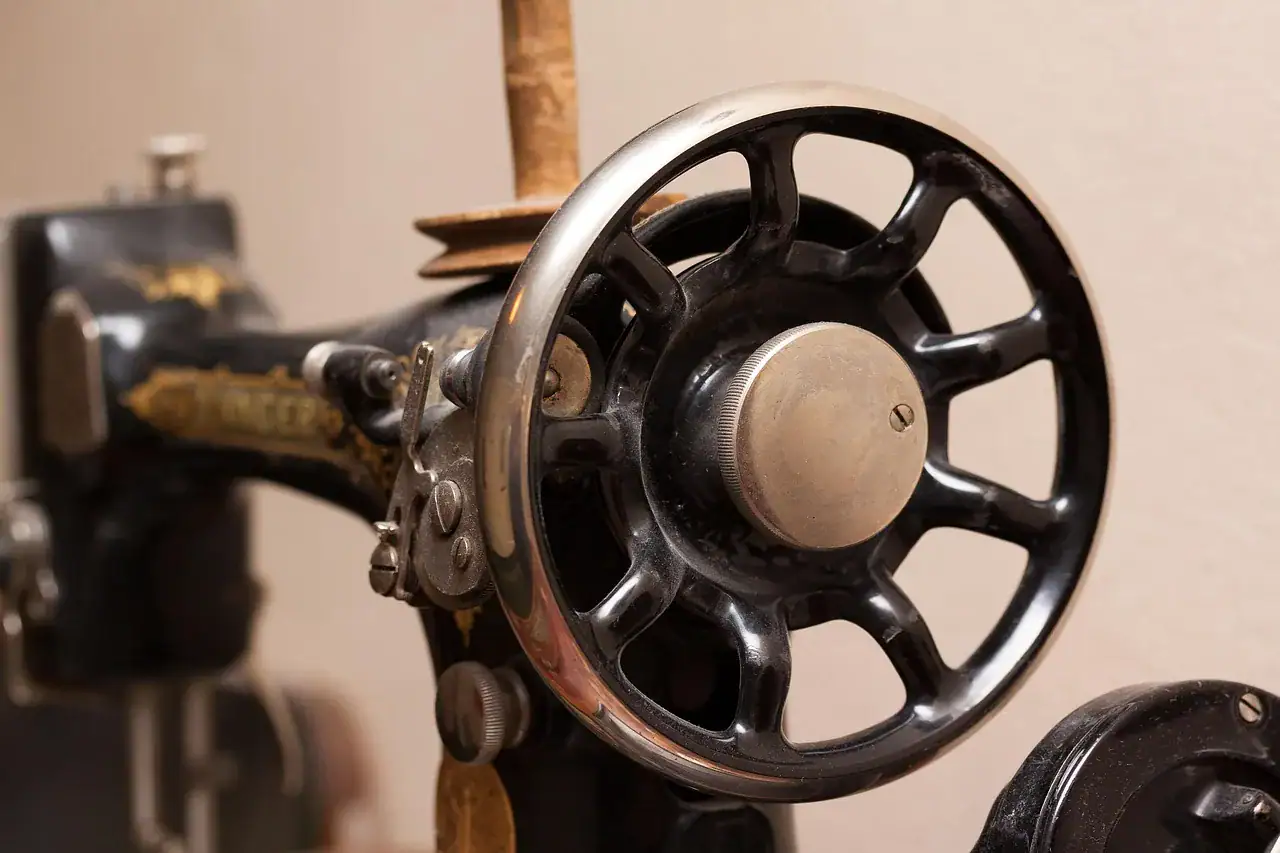
Don’t let anyone wave off the crank model as a curiosity. A former online seller of vintage machines recalled their own past sales on Reddit’s r/Antiques:
“Not that long ago, I sold hand crank sewing machines on eBay and they regularly went for over $200/each plus buyer paid shipping.” (former online seller of vintage machines, r/Antiques)
Notice the last three words. Pungo Living Home, a site that buys and ships vintage machines, says a Singer 15-90 weighs 35 pounds and calls these machines “a 35 or 40 pound hunk of cast iron.” Its double-boxing method can take “upwards of 2 hours” and about $20 to $25 in materials. It won’t buy machines shipped in their cases, because “8 out of 10 times, the case is damaged.”
That shipping is no small charge. In 2026, a 40-pound box sent coast to coast by USPS Ground Advantage costs $147.90 at the counter, or $132.66 online. So if you’re selling a hand crank sewing machine to someone far away, pack the machine and the case separately, or find a buyer who’ll carry it out to the car. And check completed sales before you count on that $200. “Not that long ago” isn’t a date.
#14 The Featherweight whose bed slides off
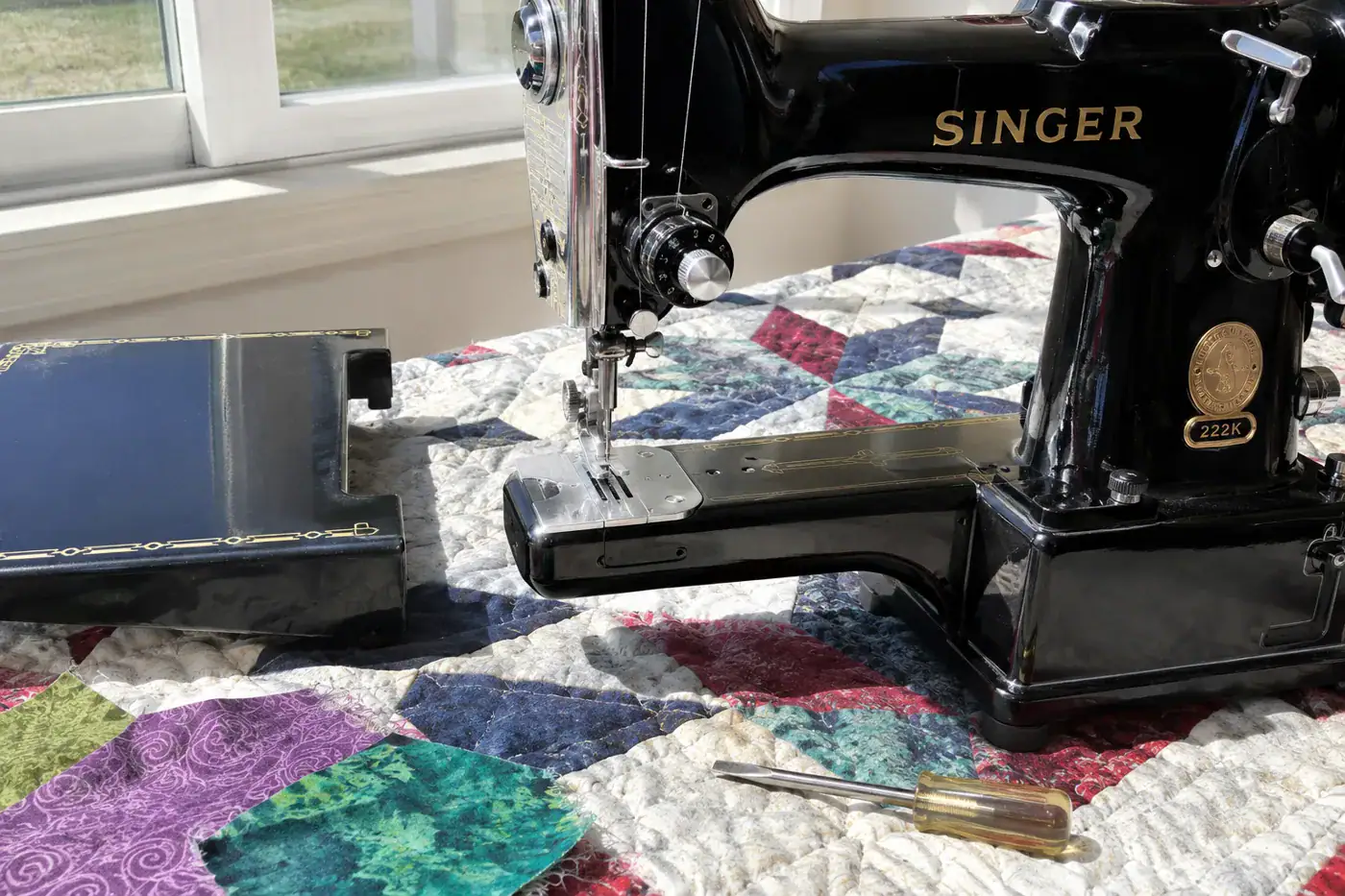
Try to slide off the flat bed extension. If it comes away and leaves a narrow arm you could slip a sleeve over, you have a Singer 222K free arm, and you should stop and get a second opinion before you take any offer.
Meeker puts it simply: “The difference between the 221’s and the 222’s is the ‘Freearm’ feature.” Then the part that matters: “Freearm 222 Featherweights typically sell for two to three times more than a typical 221.“
The two machines look nearly identical in the case. The 222K’s serial letters run EJ through ES, from 1953 to 1961, but EJ shows up on some 221s too, so the removable bed is the only sure test. Going by that dealer’s serial tables, there’s roughly one 222K for every fifteen 221s.
There’s a reason you rarely see one at an American estate sale. It was made in Scotland for buyers outside the US, from about 1953 to about 1961. If yours came over from Britain or anywhere else abroad, that’s a hint worth following.
Price guides are more cautious than Meeker. Vintage Green’s puts a working 222K in its original case at $600 to $1,200. Between a guide’s figure and a dealer’s sales, there’s room for a mistake of several hundred dollars.
#13 The drawer of attachments and buttonholers
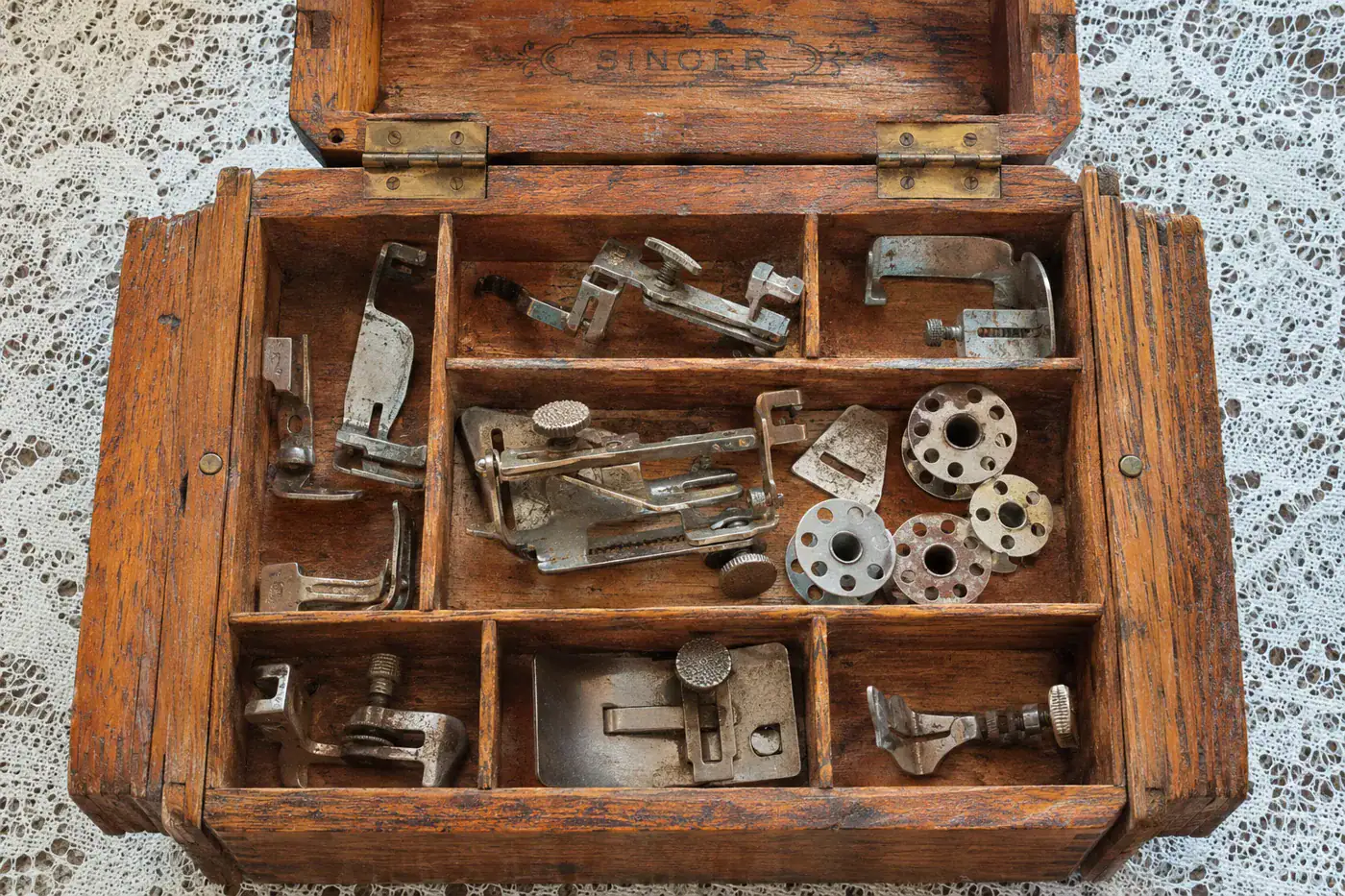
Pull the drawer and listen. That clink of metal feet, bobbins and odd little gadgets is money, and it’s the part most people toss in a bag for the thrift store.
Singer’s own value page says a working foot pedal, an intact case and all original accessories can boost value significantly. An old Necchi blog tracked how much, on real eBay sales around 2009. The same model, the Supernova, sold three ways:
- With just its case and foot pedal: $26.01
- With a full set of cams: $66
- Serviced, with cams and “a ton of accessories”: $150
The prices are old. The jump from top to bottom is the lesson. The same machine brought nearly six times as much with everything in the drawer.
Some of what’s in there sells on its own. Singer’s oak “puzzle box” of attachments, the one stamped with the 1889 patent, went to an estate auction in Mount Pleasant, South Carolina, in 2024 with an estimate of $200 to $300. It measures about 6.5 by 3.25 by 3.25 inches and weighs a pound and a half, so it ships for very little. Most eBay sellers ask about $30 to $74 for one, while complete, refinished boxes are listed at $189 to $279. Those are asking prices, and one live auction sat at $20.50 after six bids.
Keep the extras with any machine that sells for hundreds. That means the case, the foot pedal and every attachment, including a buttonholer in its own box. One Featherweight dealer sells a cleaned, tested Singer Buttonholer in its original case, with 9 cams and the manual, for $79.95. List it by name in the ad, so a buyer searching for one finds yours. If the machine itself is a common treadle, the puzzle box may be the one piece worth mailing across the country.
#12 Finding and reading the serial number
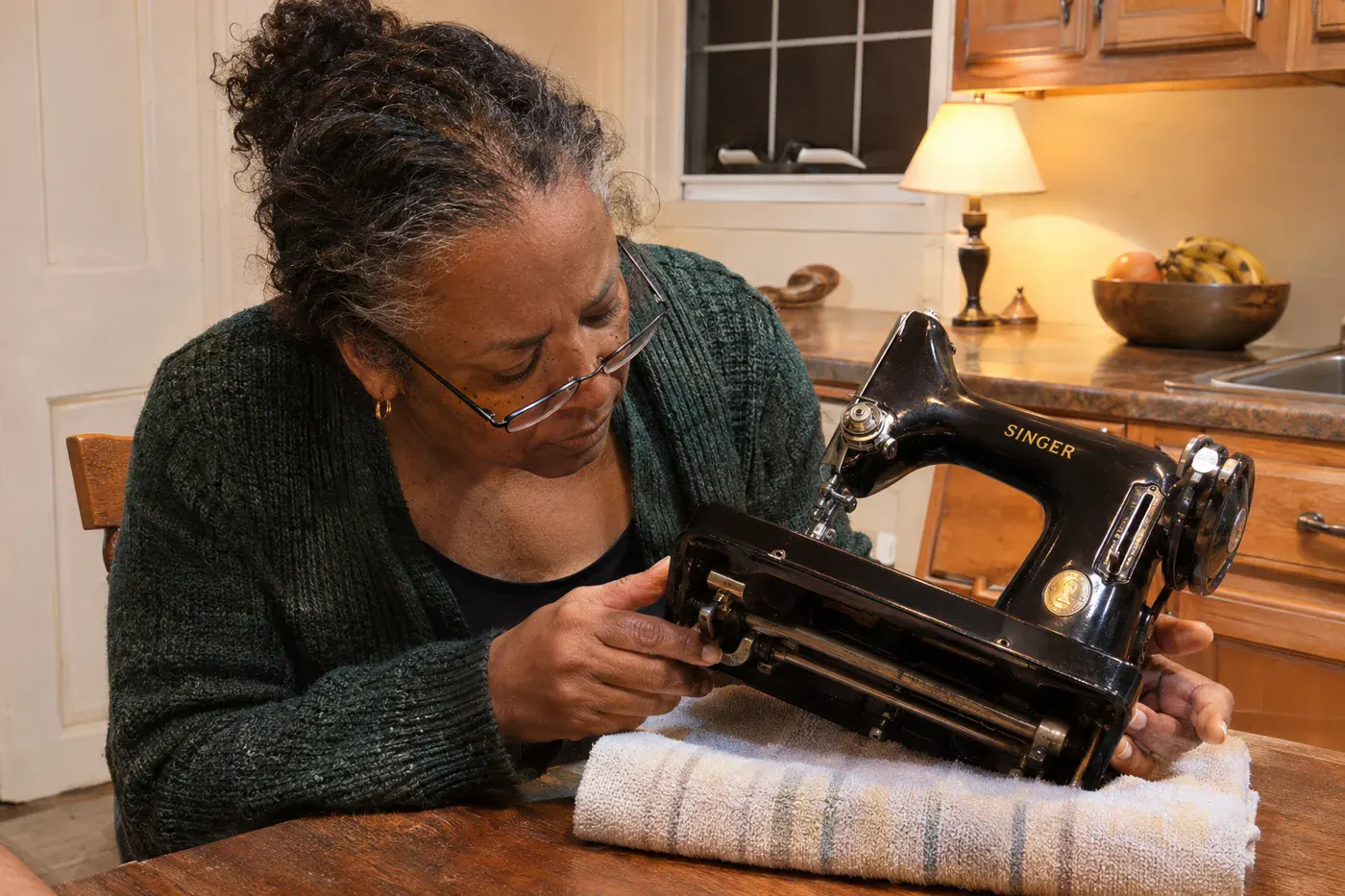
A serial number won’t hand you a price. It gives you a date and a factory, and the value comes from what those tell you the machine is. First, find it.
Where the serial number hides – Treadle or hand-crank machine: on the throat plate or the bed, up to 8 digits – Older electric: on the right-hand side, two letters followed by six numbers – Featherweight: tip it gently back and look under the bed near a corner, on a raised part of the casting – Machines from the 1960s on: the model number is on the front or side
The “221” painted on a Featherweight’s front is the model number, not the serial.
Once you have the letters and digits, the collectors’ society keeps Singer’s dating tables by factory and letter series. One warning from them: the dates are when Singer allotted that batch of numbers, “NOT the actual date of manufacture.” Your machine was likely built a little later.
The letters can fool you. Very early Singers have no letter at the front at all, and The Quilting Room with Mel says that a W in front means a White machine, not a Singer.
And if the number is tiny, slow down. AntiqBuyer’s rule of thumb is that a machine from before 1870 by any maker, with a serial under 5,000, would be desirable. Above 50,000 counts as late and common. Brumleve adds that the first practical machine came in 1851, and the closer to that year yours was made, the more it’s likely worth.
#11 The Kenmore with the long model number
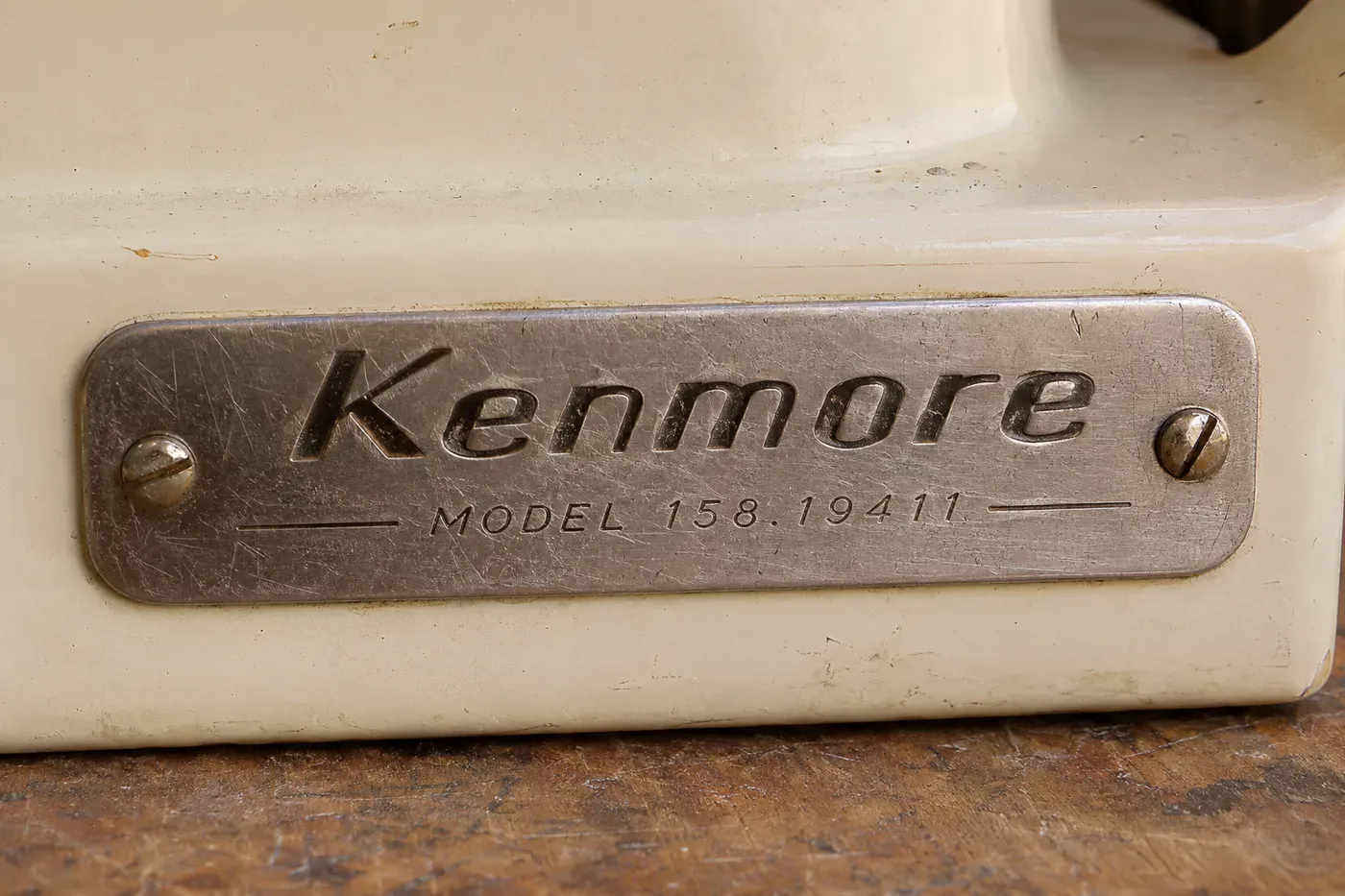
Sears never built a sewing machine. Stitchmend, a repair site, puts it flatly: “Kenmore was never a manufacturer.” The first three digits of the model number tell you who did. You’ll find the full number on the base plate or inside the front access panel.
| First three digits | What they tell you |
|---|---|
| 117 | Built by White in the USA, about the 1930s to the 1950s |
| 148 | Built in Japan, commonly credited to Soryu |
| 158 | Built in Japan, 1960s and 1970s |
| 385 | Built by Janome, 1965 to 2013 |
The 158s are the ones people ask about. TX Antique Mall’s guide puts a late-1970s 158-12310 at $150 to $250, and the 158.1941 and 158.1340 at $150 to $200. Those are guide figures, so check sold listings for your exact number.
If your Sears machine is older and says Minnesota or Franklin, it came from other makers too. Charles Law, writing for the collectors’ society, says the Franklin built by Domestic was “an almost exact copy of the Singer Model 27/127.” Sears was selling Singer lookalikes a century ago.
#10 The “DeLuxe” tag on a no-name machine
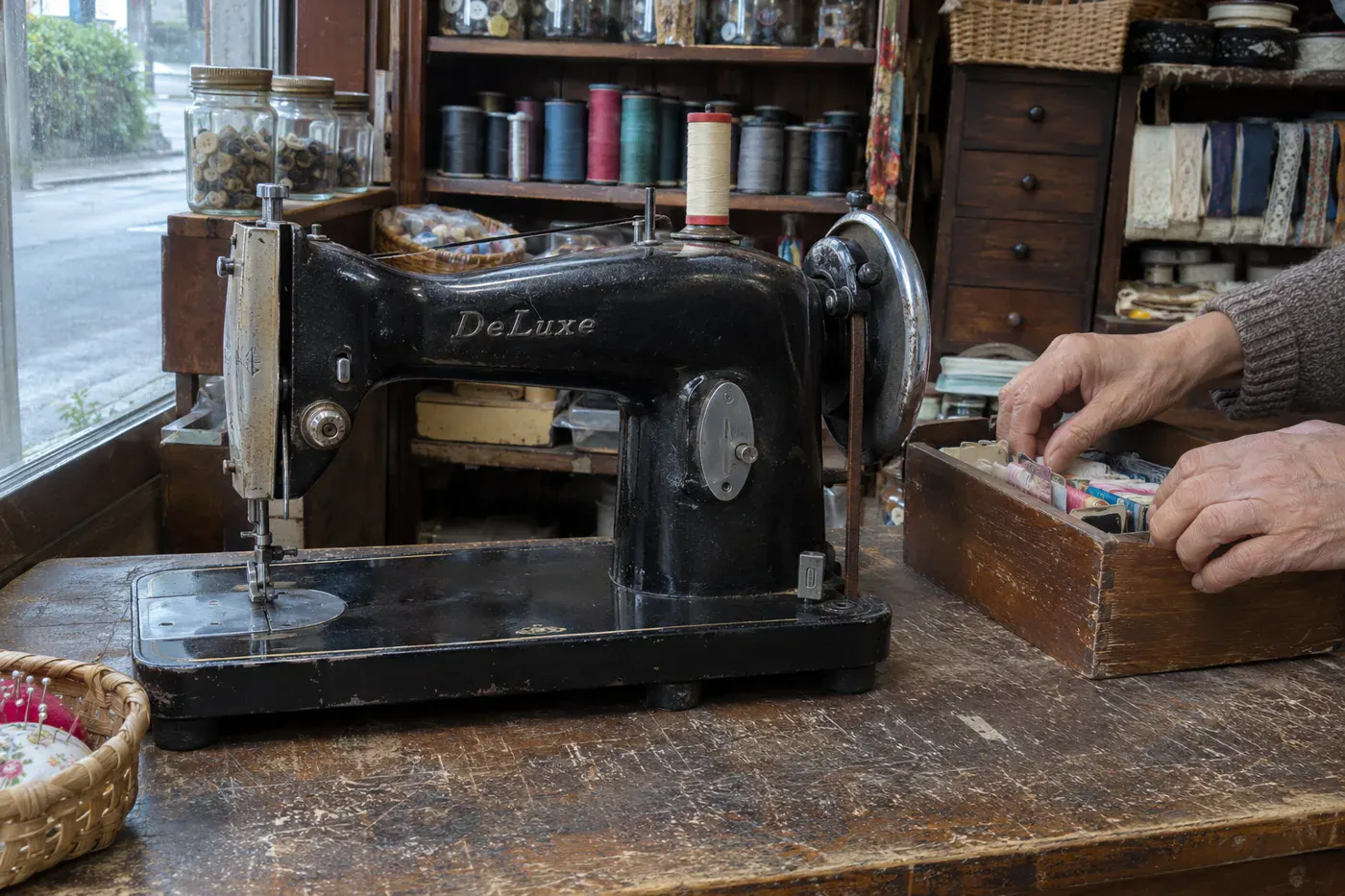
Look for one word on the front: DeLuxe. The Quilting Room with Mel says that tag is usually the giveaway that a machine was imported. After World War II, the US gave Japanese makers the Singer 15 design, and companies including Juki and Brother built close copies, often under American-sounding names.
Two more tells: “Made in Japan” on the badge or the bed, and a maker’s stamp underneath when you tip it up.
Brumleve doesn’t soften what that means for the price: “As a rule, machines made of plastic and machines made in Japan command garage sale prices.“
What the price leaves out is how they sew. Mel says many of these copies run “smoother” than the Singers they were copied from. If yours stitches a clean seam, put it in the keep pile and stop apologizing for it.
#9 The heavy Pfaff 130 still in its cabinet
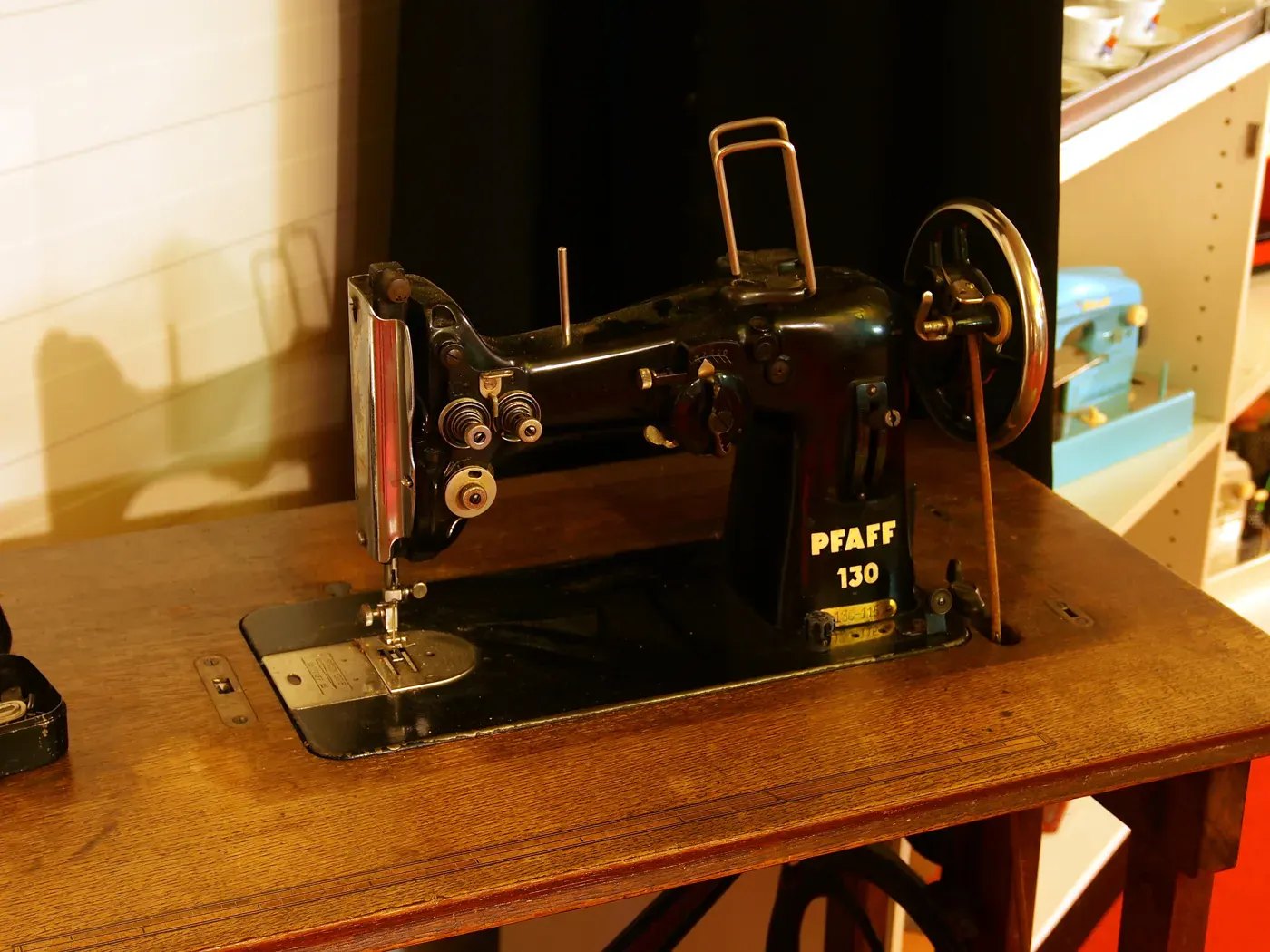
Don’t lift the head out to make it easier to sell. Katy Willis, writing for Wealthy Single Mommy, gives a range: “A clean, working Pfaff 130 without a cabinet brings $200 to $300. The same machine mounted in its original cabinet typically sells for around $400.” That’s a guide, not a sale, but it puts the cabinet at roughly $100 to $200 of the price.
The Pfaff 130 earned its following the hard way. Sewing Is Cool says the first one came out in 1932, production ran into at least the 1960s, and it was built of metal throughout to handle heavy fabrics, leather included.
Sell the two together, and sell close to home. A cabinet is no fun to ship.
#8 The Swiss Bernina with every presser foot
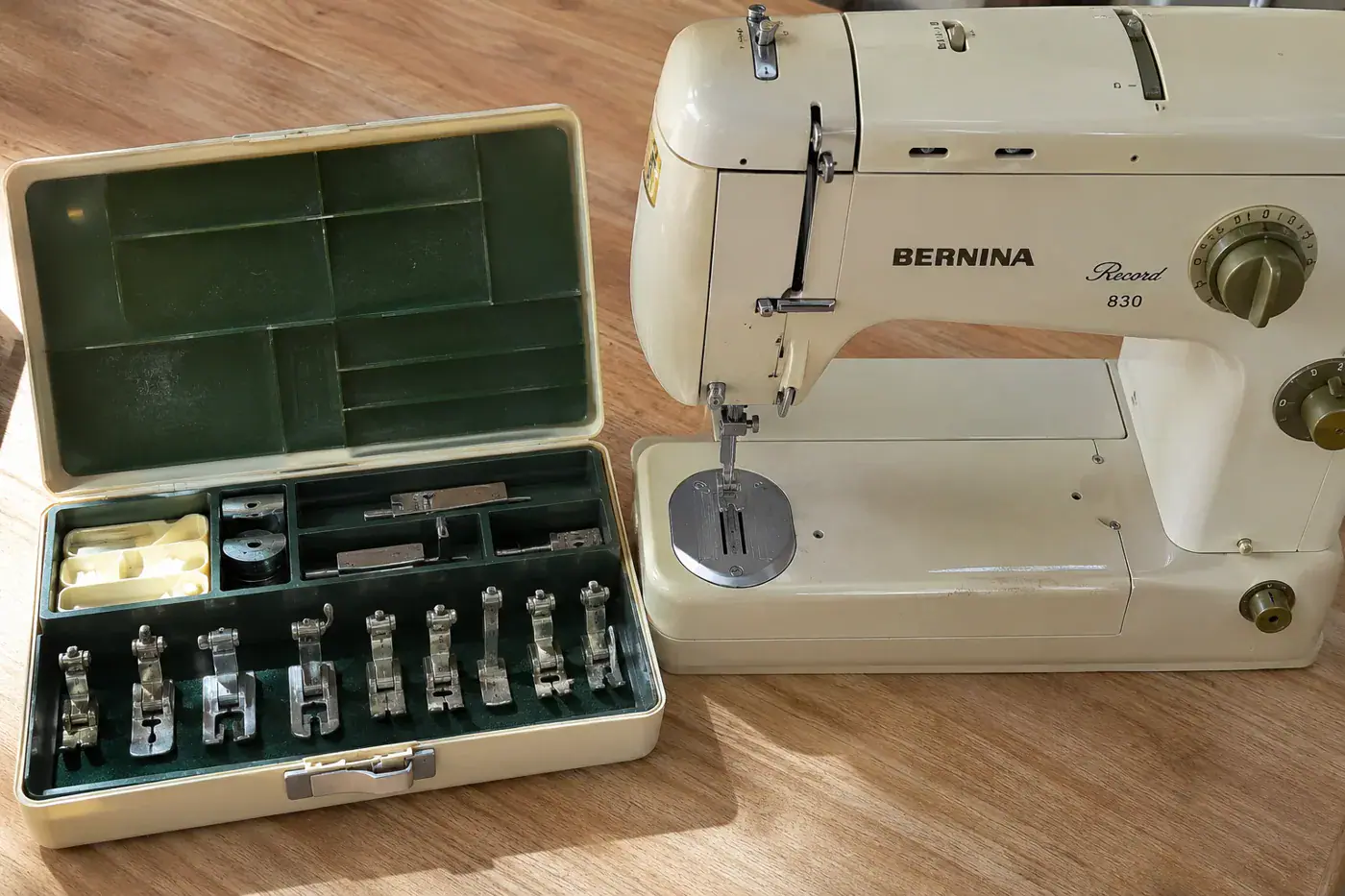
Open the accessory box and count the feet before you list a Bernina Record 830. Magnetic Hoop’s guide to the Record says 12 “is the magic number for many collectors”. A fully equipped 830, with its original case, knee lift, extension table, accessory box and bobbins, “can command a notable premium.”
The 830 was made from 1971 to 1982. Magnetic Hoop puts clean, serviced machines between $400 and $1,000, and says “complete sets often cross the $550 threshold.” Its blunt summary: “buyers want the whole package, not just the machine.”
The 930 Record follows the same rule. Willis’s guide puts a 930 that still has its case, a pedal that works and every one of its feet at $700 to $1,000.
If you’re short a few feet, say exactly which ones in the listing. If you’re short the knee lift, check under the cabinet before you give up on it.
#7 The olive-green Grasshopper and its folding case
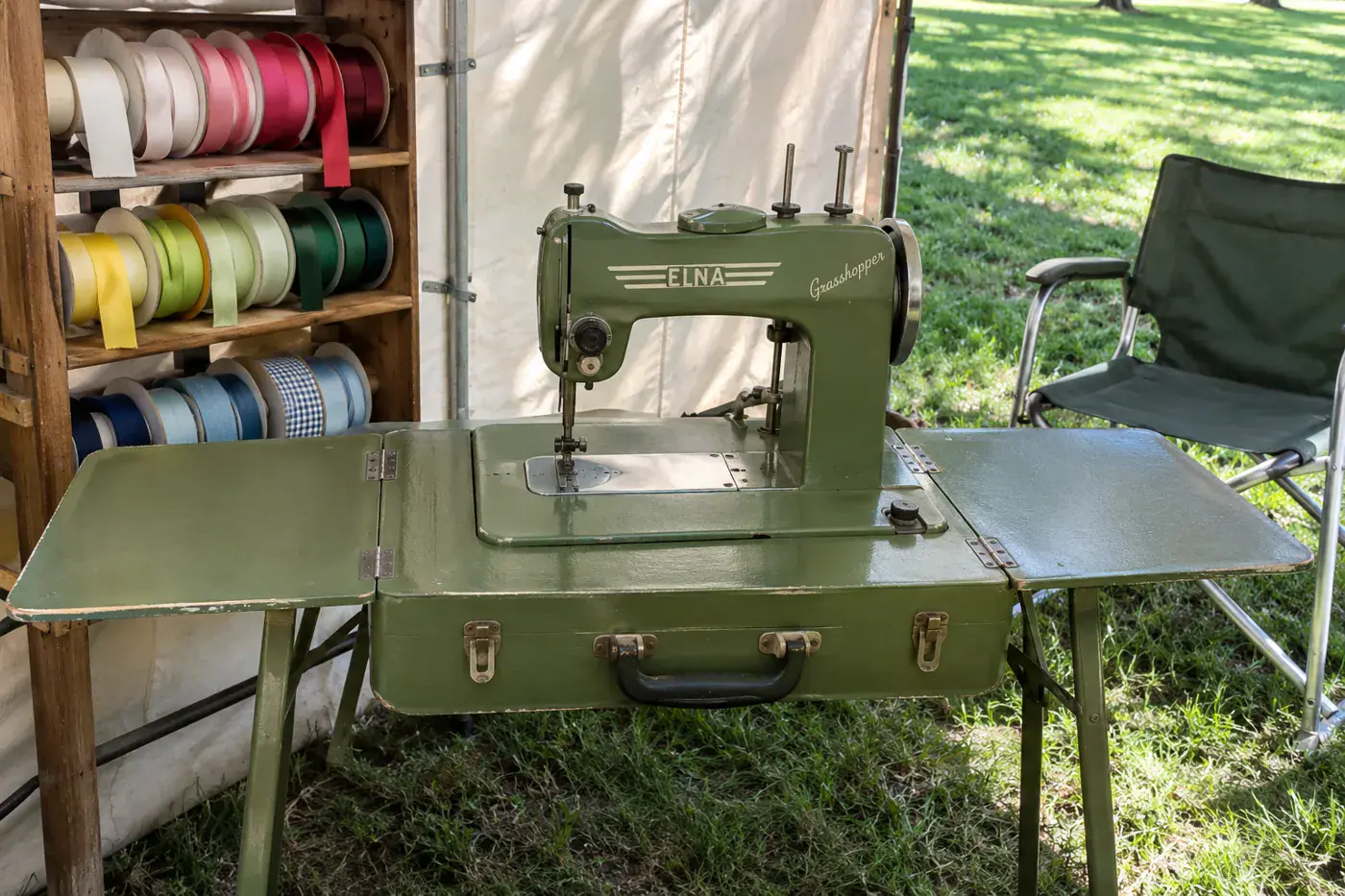
If the case unfolds into a little table, you may have an Elna #1, the machine Americans nicknamed the Grasshopper. Willis puts clean, working Grasshoppers with their original green carry case at $200 to $400. That’s a guide range.
The case counts because it’s part of the machine. Sylvia Lanza, writing for the collectors’ society, says it “looked like an ammunition case, but unfolded to form a flat-bed table.” Without it, you’re selling a machine with nothing to sew on.
The ammunition look is no accident. Lanza says the Elna #1 was built from 1940 to 1952 by Tavaro, a Swiss armaments maker, from a design by Ramon Casas, a refugee from the Spanish Civil War. Its “bright olive green” gave it the nickname.
One catch before you list it. The 1952 Elna Supermatic was also green and also free-arm. Read the badge and the model name, so you don’t sell a Supermatic as a Grasshopper or the other way round.
#6 The Singer 401A and its box of cams
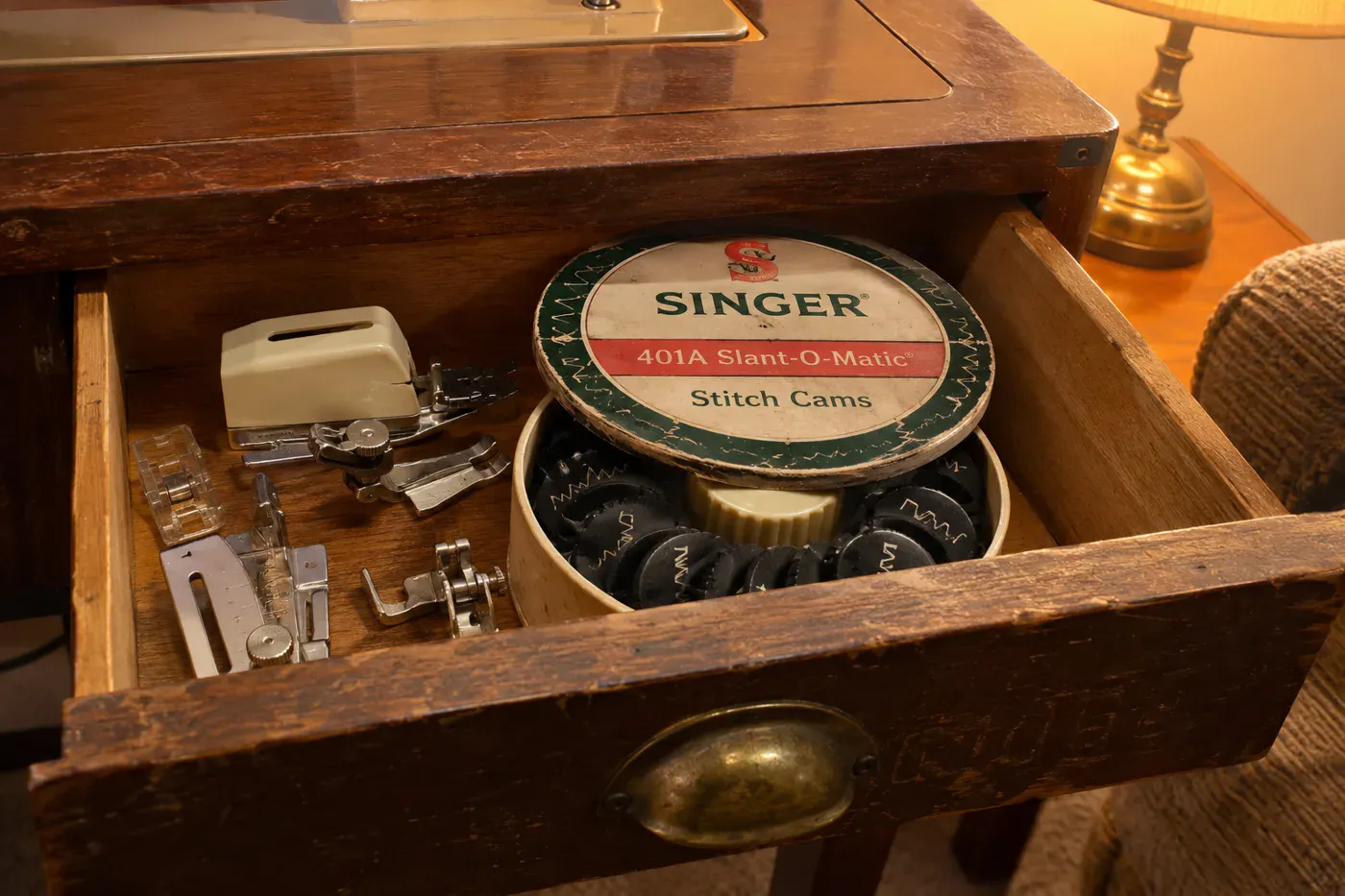
If the drawer holds a box of little round discs, you probably have a Singer 401A Slant-O-Matic, and those discs are the cams for its fancy stitches. Silver Bobbin says Singer built it from 1956 to 1961 and calls it “the last all-metal machine Singer sold.”
It cost $59.50 in 1960. Silver Bobbin says you can often find one for $100 to $150, depending on condition and the wooden cabinet. Willis’s guide goes higher, but only for the whole outfit: “A 401A in cabinet with full cam set and accessories typically brings $200 to $400.“
We ran that 1960 price through the government’s consumer price index. $59.50 then is about $647 in 2025 dollars. Even the top of Willis’s range is well under what the machine cost new.
Silver Bobbin adds that a polished, uncracked wooden cabinet can raise the price. So wipe down the cabinet, count the cams, and photograph them fanned out next to the machine.
#5 The rusty, seized machine priced like it’s rare
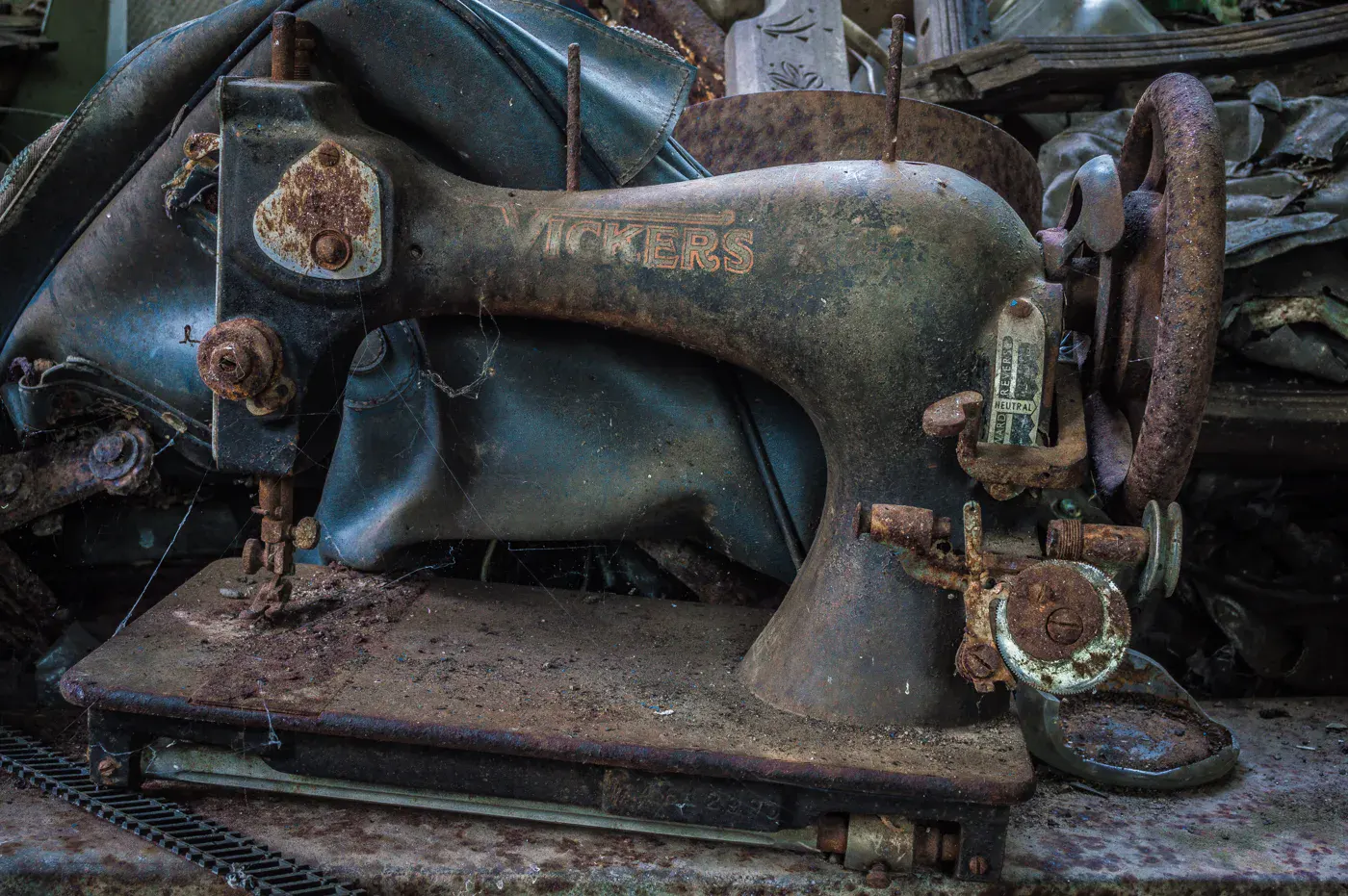
You’ve seen it at a yard sale: a seized, rust-freckled head with no cabinet, priced like it’s something rare. A vintage machine collector on Reddit has tried telling sellers the bad news:
“They look completely baffled when I explain that these old machines were made by the millions and are NOT rare.” (vintage machine collector, r/vintagesewing)
Brumleve says the same in calmer words. Most 20th-century machines “were made in the millions, and most survive in great numbers,” and “very, very few will bring thousands.” Here’s where the Vintage Green guide puts common mass-produced Singers, and these are working ones:
| Singer model | Working, guide range |
|---|---|
| 15-91 | $50 to $150 |
| 99 or 99K | $75 to $200 |
| 201 | $100 to $300 |
A rusty one sells as a parts machine, and that’s a real market. Brumleve says collectors and people who sew both “seek out broken or incomplete machines in order to restore a better example.”
Some repair shops buy machines in any condition. DH Sewing in Miami is one. It asks for photos with the model and serial numbers clearly visible, plus your asking price, and it won’t take machines from out of town. Call the repair shops near you and ask whether they do the same.
Before you write “seized” in the ad, try one thing. Stitchmend says a handwheel that won’t turn is sometimes just the bobbin winder engaged. Slide the spindle firmly to the left until it clicks. If the wheel still won’t move, leave it alone. Forcing a truly locked wheel can bend the hook.
#4 Fresh gold decals on an old black machine
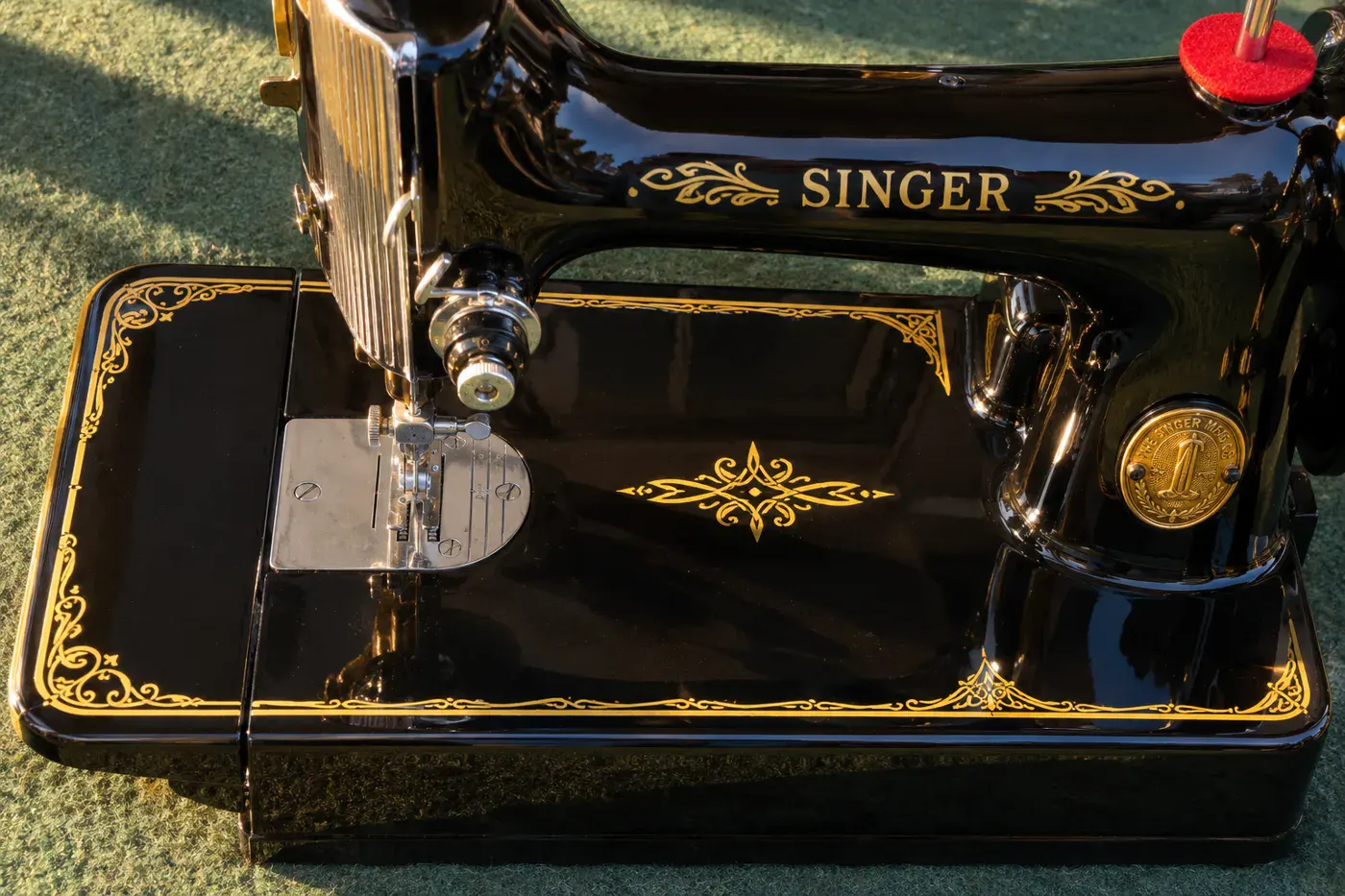
Perfect, shiny gold on a 70-year-old machine deserves a second look. Keeler Sales sells reproduction Featherweight decals, $24.95 for the AD-series set, and describes them as waterslide decals “designed for machines being repainted.” The same page gives the tell: they “must be protected with clear coat.”
So if the gold on a 221 sits under a fresh, glassy layer, you may be looking at a repaint. That isn’t always bad news for the price. Singer-Featherweight.com, a Featherweight specialist, has sold professionally repainted 221s and 222Ks for $2,350 to $4,275, while it lists an original-finish 221 in good working order at $1,595. Ask whether it’s original or repainted before you buy, and if you’re the one selling, say so in the ad.
Worn original gold is already in the price. The Vintage Green guide says flaking, worn or scratched decals cut value by 40 to 60 percent, and Meeker sells Featherweights with decal loss at the low end of her range. Describe yours honestly and let the buyer decide.
If you’re thinking of painting one to keep, a former sewing machine mechanic commenting on TikTok had the gentlest word on it: “It doesn’t make it sew better; but the memories made with it are PRICELESS!!!“
#3 The $10 machine on the thrift-store floor
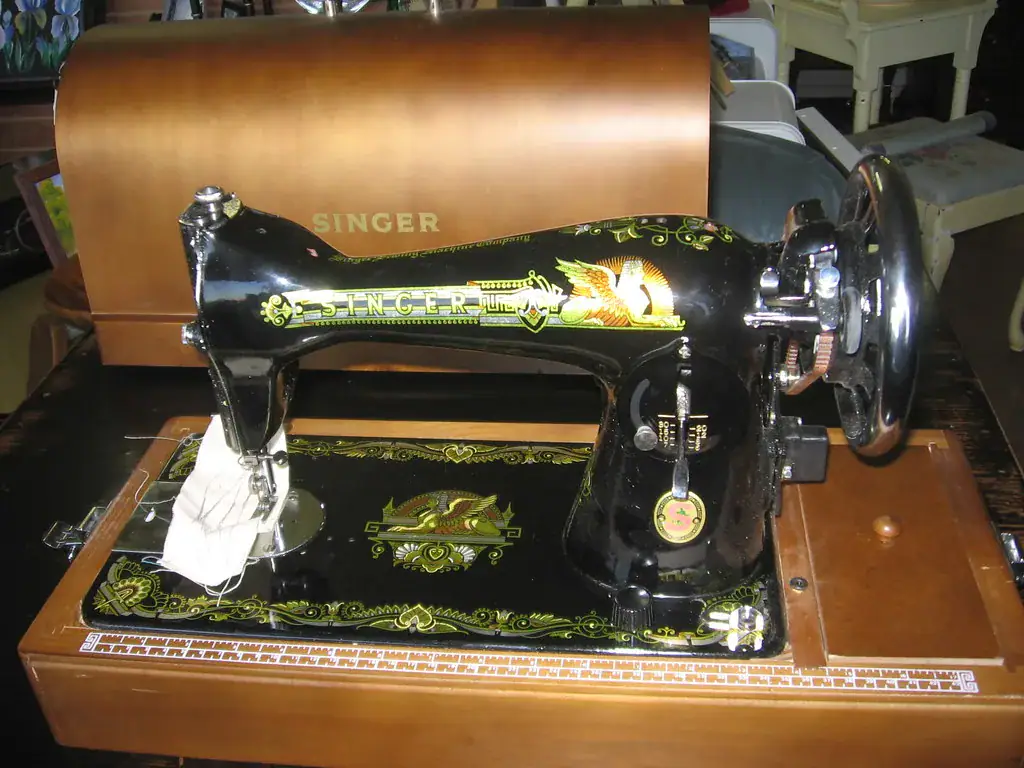
It’s on the bottom shelf next to the bread makers, with $10 written on masking tape across the lid. People on Reddit and TikTok post finds like this: a 1920s Singer for $10, a vintage Swiss machine for $40 that a clerk set aside for a regular customer, even a white Featherweight for a few dollars.
Most of them need something. The same posters list the usual fixes: a new belt, a missing bottom plate, a replaced needle clamp, stiff parts that wanted oil and gear grease. The small parts are cheap:
- Featherweight 221 or 222 motor belt: $13.95 from Featherweight Doctor. They suggest replacing it every year, because the motor is “the most expensive part to replace on your vintage stitcher.”
- Needle clamp screw for a Singer 15-88, 15-89, 15-90, 15-91, 15-125, 15-126 or 201: $3.95 from Millard Sewing.
Find the model number before you order, because each part fits only certain machines. Before you buy, price whatever is missing. On Reddit’s sewing forums, buyers warn that cheap vintage machines are often missing parts or don’t run, which is exactly why a complete, restored one costs more. A $10 machine plus a $14 belt is a bargain. A $10 machine missing a part nobody makes anymore is a doorstop.
#2 The machine that just needs oil and a needle
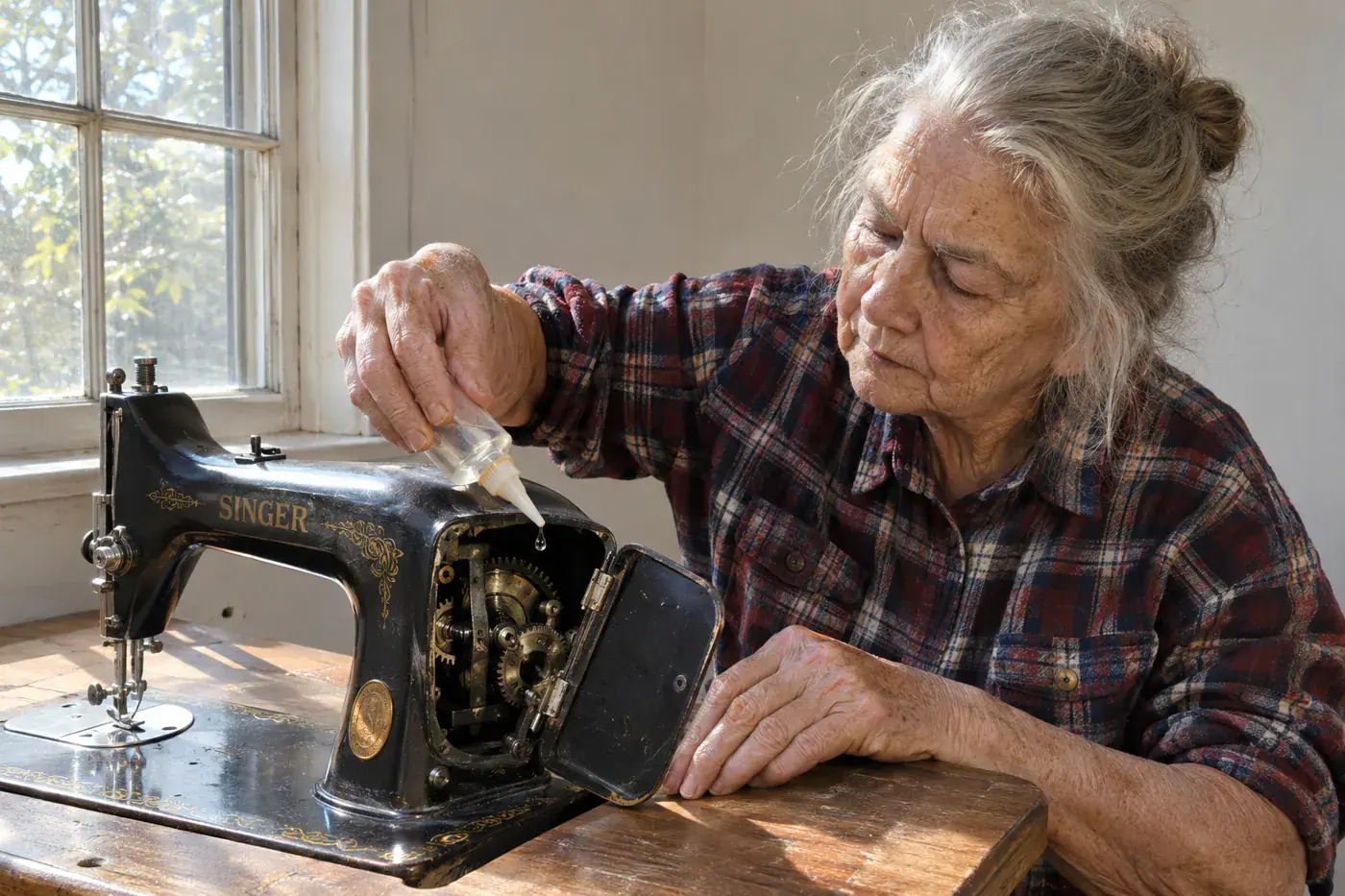
Before anyone hauls a stalled machine to the curb, listen to Lisa Seamswell. She repairs machines in her home workshop in Farmington Hills, Michigan, and calls herself a “sewer and quilter turned sewing machine repair entrepreneur.” On skipped stitches and jams:
“Nine times out of 10, what a sewing machine needs when we start to see issues like skip stitches or things getting jammed is not actually a major repair.” (Lisa Seamswell, repair technician)
“Most of the time,” she says, “what a sewing machine needs is service.” Her checks, in order:
- A fresh needle. “When something goes wrong, the first step is to put in a fresh needle before we assume anything else is wrong.” A dull or bent one can mimic a timing problem.
- The right oil. “And please do not use things like 3-in-1 oil or WD-40. These options are actually doing more harm than good.“
- If you hear the needle hit something, stop. The timing may be off. On one machine she found it off “pretty significantly, but that doesn’t mean it’s a costly repair.”
She’s honest about the limit. Sometimes a professional service costs more than a machine is worth on paper, and in some towns a technician is hard to find. That’s the real question for a common machine.
Lint fakes breakdowns too. Cale Schoenberg, a technician who writes The Sewing Machine Newsletter, has seen machines where the owner complained it wasn’t feeding fabric, and “the lint is actually pushing the needle plate upward.”
Before you call it broken – Use sewing machine oil only. Stitchmend says one drop per oil point is the rule – Throw out any machine oil that has turned yellow – Check under the needle plate for compacted lint, which can mimic a feeding problem – Follow the manual, and plan a full service every one to two years
Edbauer, back in Michigan, has seen what that care buys: “some are 80 to 100 years old and still working like the day they came from the factory.”
#1 Grandmother’s machine, kept for the family
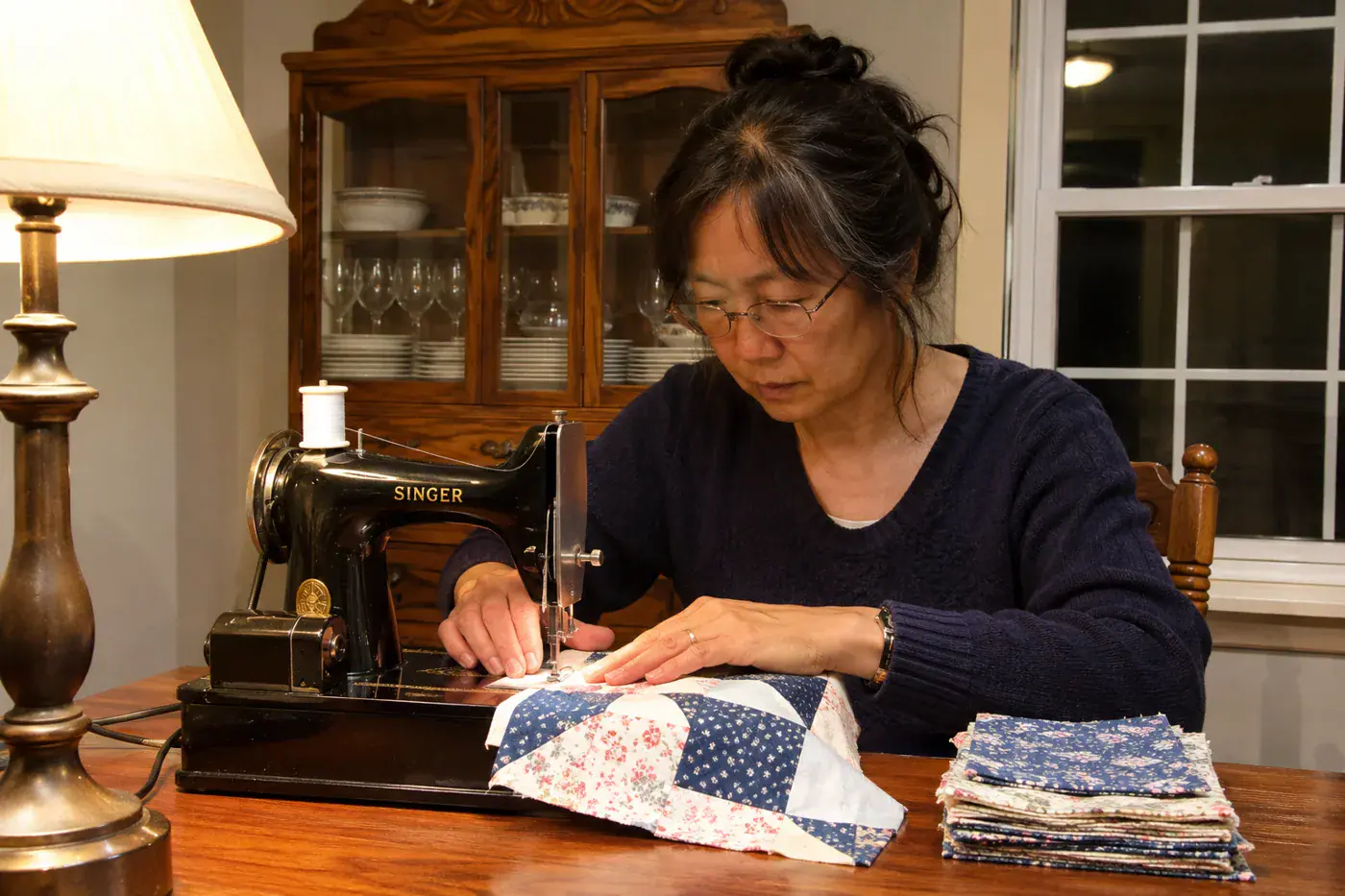
Before you decide, run one number. When the Featherweight came out in the Depression, AntiqBuyer says it carried a retail price of $125. We put that 1934 price through the Bureau of Labor Statistics’ consumer price figures. It comes to about $3,150 in 2026 money. You can check it yourself: enter $125 and 1934.
Now set that next to what Meeker sells most 221s for: $595 to $750. The machine everyone wants, in good shape, brings back roughly a fifth to a quarter of what it cost the family that bought it. A common Singer brings back far less.
So a sale turns a $3,000 purchase into a few hundred dollars. If anyone in your family sews, or wants to learn, the machine is worth more to them running than it is to you as a check.
If yours came from a mother, grandmother or great-grandmother, you’re in good company. On Reddit’s sewing forums, people describe machines handed down well cared for, passed around the family and still piecing quilts. If yours came home from an estate sale instead, the math is the same, and somebody’s family paid that $125.
A quilter whose mother-in-law owns a Featherweight put the long view this way:
“But they are also infinitely repairable and if well maintained will easily last another 50-75 years.” (quilter, r/sewing)
Fifty to 75 years is two more owners. Maybe three.
The bottom line
The price you get depends a lot on who’s standing in front of the machine. A dealer three states away sees a heavy box to ship. A quilter who has been hunting for a 222K sees the end of a long search.
So before you post anything public, take two clear photos, one of the badge and one of the serial number, and send them to whoever you sew with. If that’s nobody right now, send them to the nearest repair shop.
Then wait a day before you name a price.
Bonus: Three ways to give away the machine nobody’s buying
- Midwest Mission in Pawnee, Illinois, takes “electric sewing machines in good working condition as well as treadle sewing machines” and sends them to nonprofits around the world.
- Sew Much Hope in Lehi, Utah, refurbishes donated working machines for refugees and asks for about $20 toward shipping with each one.
- Christine Haynes, a sewing author writing for Craftsy, suggests calling a charity first to ask whether it takes machines that don’t run, so you don’t haul 35 pounds of cast iron across town for nothing.
Questions people also ask
How much is a vintage sewing machine worth?
Most vintage machines don’t sell for much, because they were made in the millions. The collectors’ society says relatively few machines overall command prices in the hundreds of dollars. A later treadle commonly brings under $100 at auction. The big exception is the Featherweight: one dealer sells most 221s at $595 to $750 and up, and free-arm 222s at two to three times that.
How do I find out what year my Singer sewing machine is?
Find the serial number, then look it up in the collectors’ society dating tables. On a treadle or hand-crank machine it’s on the bed or throat plate. On older electrics it’s on the right-hand side as two letters and six numbers, and on a Featherweight it’s under the bed near a corner. The date you get is when Singer allotted that batch of numbers, so the machine itself was likely built a little later.
Does anybody buy old sewing machines?
Yes. Private buyers, dealers and some repair shops all buy them. Christine Haynes suggests eBay or Craigslist for the best price, or a dealer for less money and less effort. Some local shops, like DH Sewing in Miami, buy machines in any condition from nearby sellers. Shops like Modern Domestic in Portland take any brand or age as a trade-in.
Is the Singer Featherweight still made?
Not the original. The Featherweight Shop says the first black Featherweight was produced in October 1933, and the last, a white 221K, came “in the late 1960s, about 1968 to 1969.” Any Featherweight you find secondhand from Singer’s original run is at least about 57 years old.
Is it worth getting an old sewing machine serviced before selling it?
Only if it’s a machine that sells for hundreds. Mr. Sewing in Madison, Wisconsin, charges $80 for a straight-stitch tune-up and $110 for a standard machine, with parts extra. A guide puts a working Singer 15-91 at $50 to $150, so a service can eat most of the sale. On a Featherweight, it’s easier to justify, and Pungo Living Home notes that on serviced machines, “much of the cost is included in the servicing.”
Should I paint or refinish an old sewing machine?
A repaint doesn’t always lower the price. On one Featherweight dealer’s site, professional repaints have sold for more than an original-finish machine listed there. What dealers do mark down is wear, and one guide says worn decals cut value by 40 to 60 percent. The reproduction decals sold for repaints have to be sealed under clear coat, which a careful buyer may read as a sign of a repaint. Check the serial number first, because a 222K or a pre-1870 machine is better left original.