Plaster handprints, macaroni frames, clay ashtrays and the rest of the classic school crafts still in the cedar chest: what each is made of, why it crumbles or fades, and how to keep it.
The flimsiest keepsake is the one in the most danger, and #1 shows you how to slow the damage.
Lift the lid of the cedar chest and the smell comes up first, then the good tablecloths, then the treasure underneath. A lumpy clay dish glazed three colors at once. A frame of elbow macaroni, its gold paint flaking onto your fingers. A God’s eye in orange and brown yarn. Every one of those old school crafts took an afternoon to make. Some have lasted decades. A few are quietly coming apart, and each one for a different reason.
#15 Plaster handprint plaque for Mom
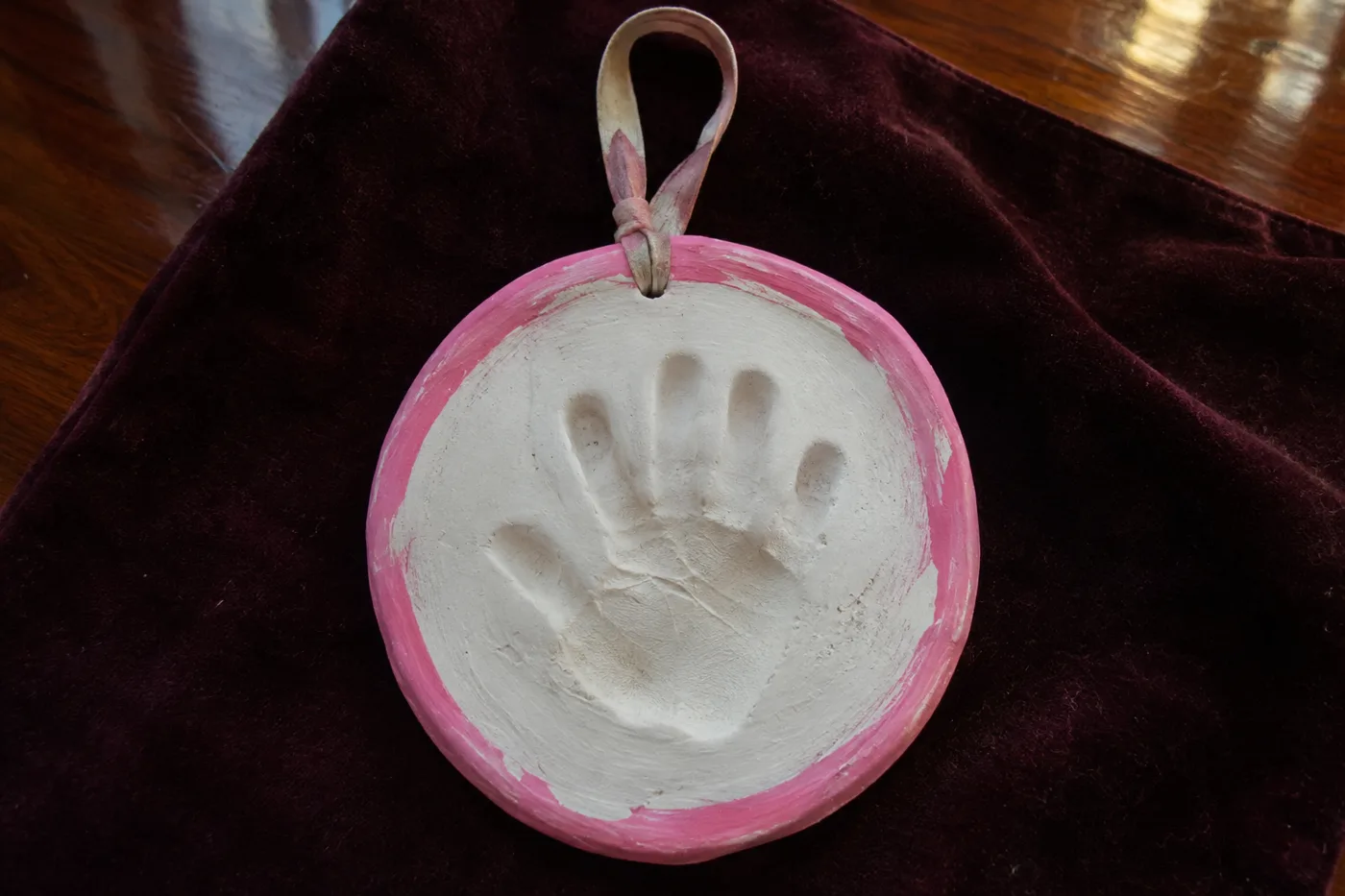
It has a small hand sunk into the middle. The edge is painted pink or sky blue by somebody who couldn’t stay inside the lines. A loop of ribbon comes out the top, pushed into the wet plaster so it could hang on a nail. On the back, if you’re lucky, there’s a name and a year scratched in with a pencil point.
Of all the classic school crafts, this is the one most easily ruined by kindness. Plaster looks like stone and behaves more like a sugar cube.
Plaster care expert Susan Maltby puts it plainly: “Water can dissolve the plaster and will drive any dirt into the plaster, making it even harder to clean.” So skip the damp cloth you’d take to anything else gray with dust. Dust it gently and stop there.
Plaster keepsake rules – Handle it with clean, dry hands. – Keep it in an archival-quality box when it’s put away. – Show it in a display case or behind glass to help keep it from getting soiled. – Skip the eraser, even on a pencil smudge.
If you’re tempted to make a new one, never put a hand into setting plaster: it heats as it sets, and the UK’s National Society for Education in Art and Design warns that skin damage can result if contact is prolonged. In 2007 a 16-year-old in Lincolnshire, England, got both hands stuck in a bucket of it in art class and was left with two fingers, so make the salt dough version in #4 instead.
#14 Clay ashtray made for Dad
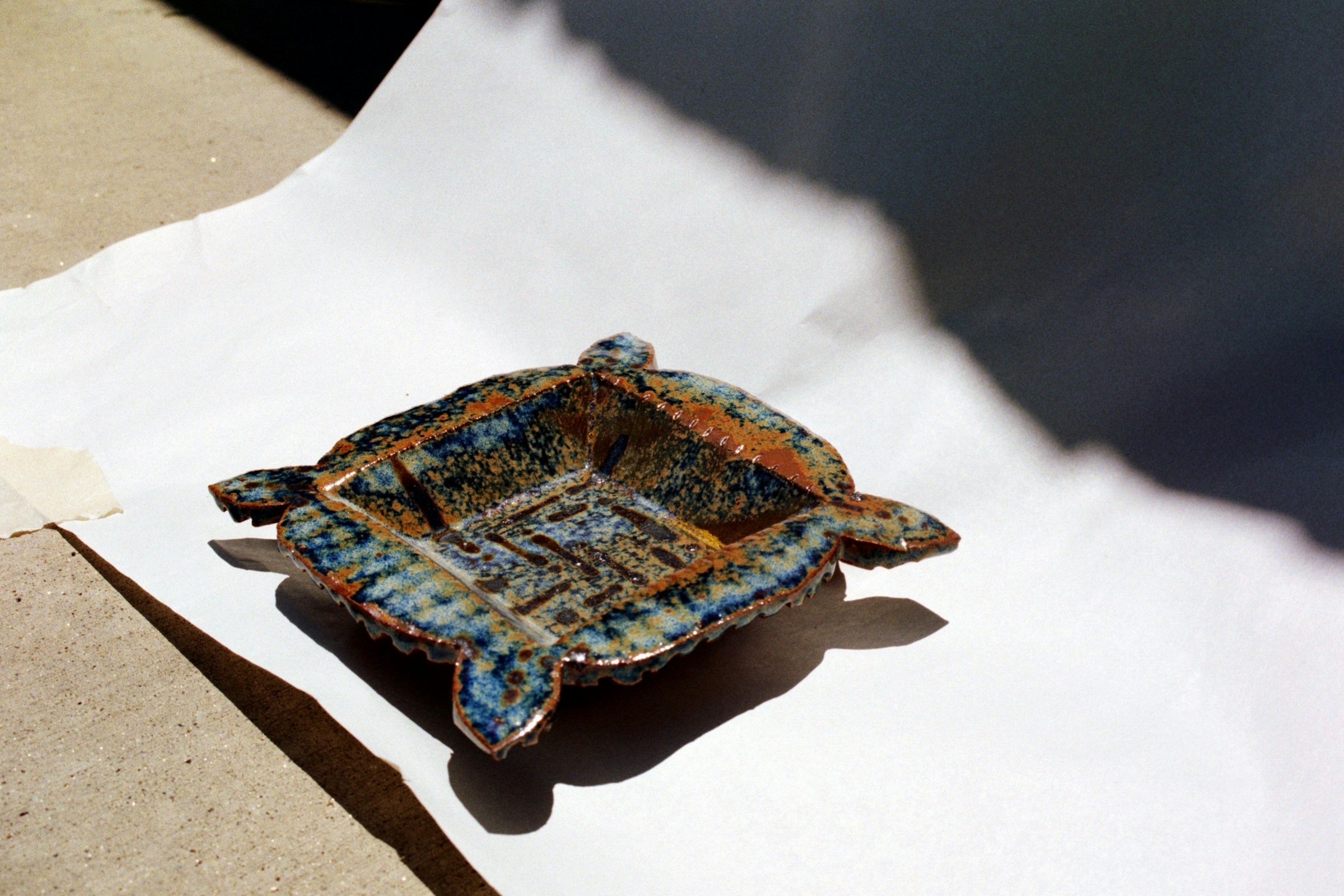
It had a thumbprint pressed into one side to rest the cigarette, or maybe three thumbprints, because more seemed better. It went home wrapped in newspaper, still a little lopsided, and it went straight to work.
That’s the part that makes people laugh now. It was useful. When the Surgeon General’s report on smoking came out in January 1964, ashtrays “seemed to be on every table and desk,” as the Associated Press put it fifty years later. In 1965, 42.4% of US adults smoked. By 2022 it was 11.6%.
Teachers had their own reasons too. Mary Warner, writing for Minnesota’s Morrison County Historical Society, remembers being “encouraged to make ashtrays during the pottery unit in art class.” The teachers wanted something “useful to parents” that “didn’t have to be perfectly glazed for safety.” A cereal bowl had to be safe to eat from. An ashtray only had to hold ashes.
And she’s honest about the results: “Much of children’s lumpy, multi-colored, multi-textured pottery was only good for tapping the ashes off a cigarette.” Her own father smoked “up to three or four packs a day,” and later quit.
Try explaining one to a five-year-old now. Asked on Reddit’s r/kindergarten for historic crafts to do with kindergartners, one commenter thought first of making ashtrays, and of trying to explain what they were and why they were everywhere.
If one is still in the chest, give it a new job. It holds rings by the kitchen sink just as well as it held a cigarette.
#13 Macaroni picture frame sprayed gold
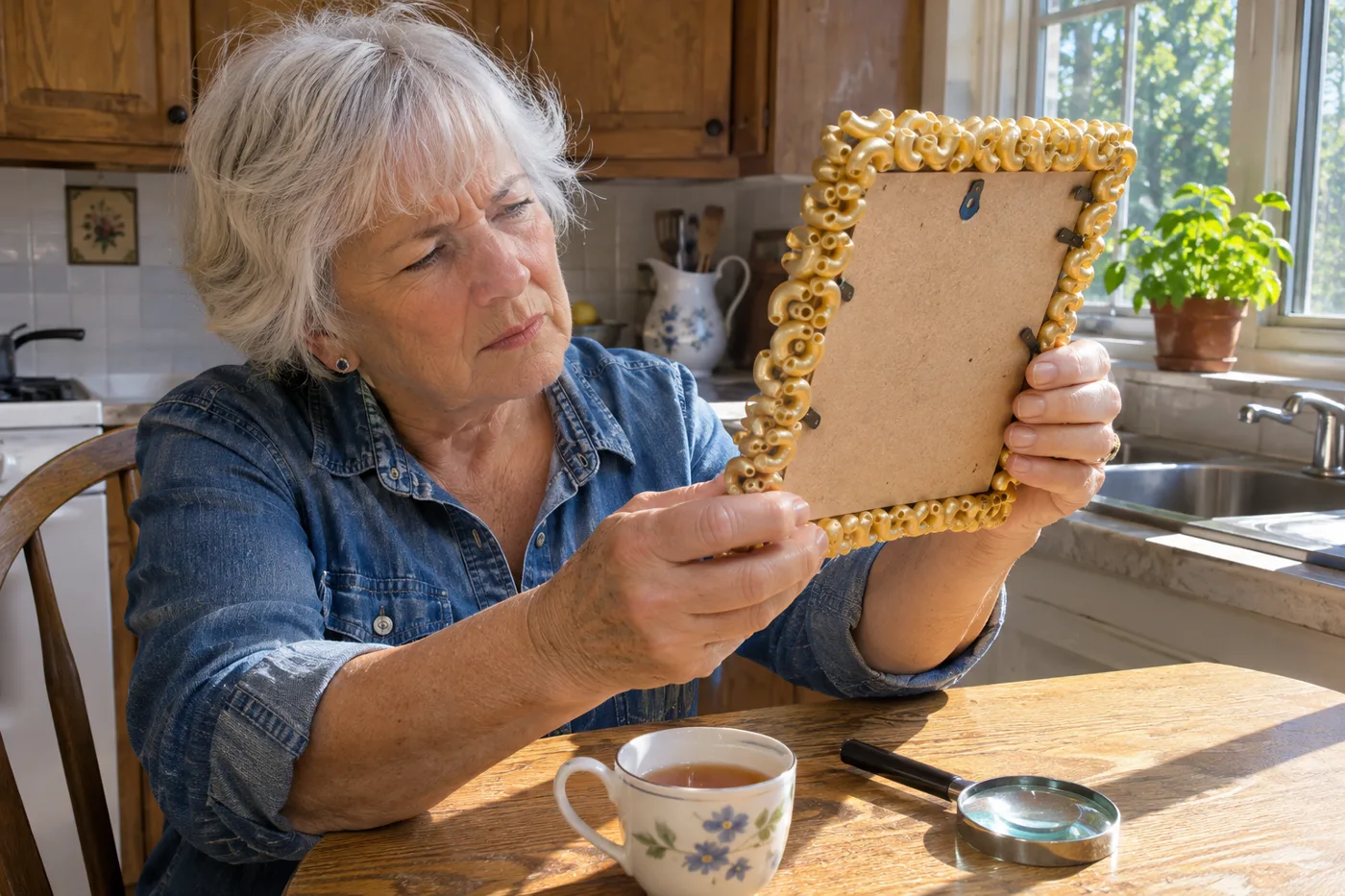
Elbow macaroni, white glue and a cardboard square with the middle cut out. Then the gold spray paint, done outside on newspaper, with the fog drifting onto the shrubs and the smell hanging in your hair all afternoon.
Here’s what nobody thought about: it’s still food. The University of Illinois Extension lists pasta among the stored products pantry pests go after, along with dried flower arrangements and ornamental corn. The usual suspects are cigarette beetles, drugstore beetles, flour beetles and Indian meal moths.
A box is no protection. These insects chew through paper, cardboard and thin plastic packaging, and they finish a whole generation in one to two months.
So lift the frame out and look at it closely, front and back. Check the pasta, the cardboard behind it and the bottom of whatever it’s stored in for anything alive or anything that wasn’t there last time.
The extension says freezing at 27°F or colder for at least 3 to 7 days can kill these insects in food. But delicate and mixed-material objects generally should not be frozen without first consulting an experienced conservator, and a glued, painted macaroni frame is a mixed-material object. Ask a conservator before you freeze it.
Did you know?
Elmer’s School Glue came out in 1968 as “the first white glue that washed out of clothes.” The original Glue-All had been around since 1947, and it was first made with casein, a protein from milk.
#12 Popsicle stick box or trivet
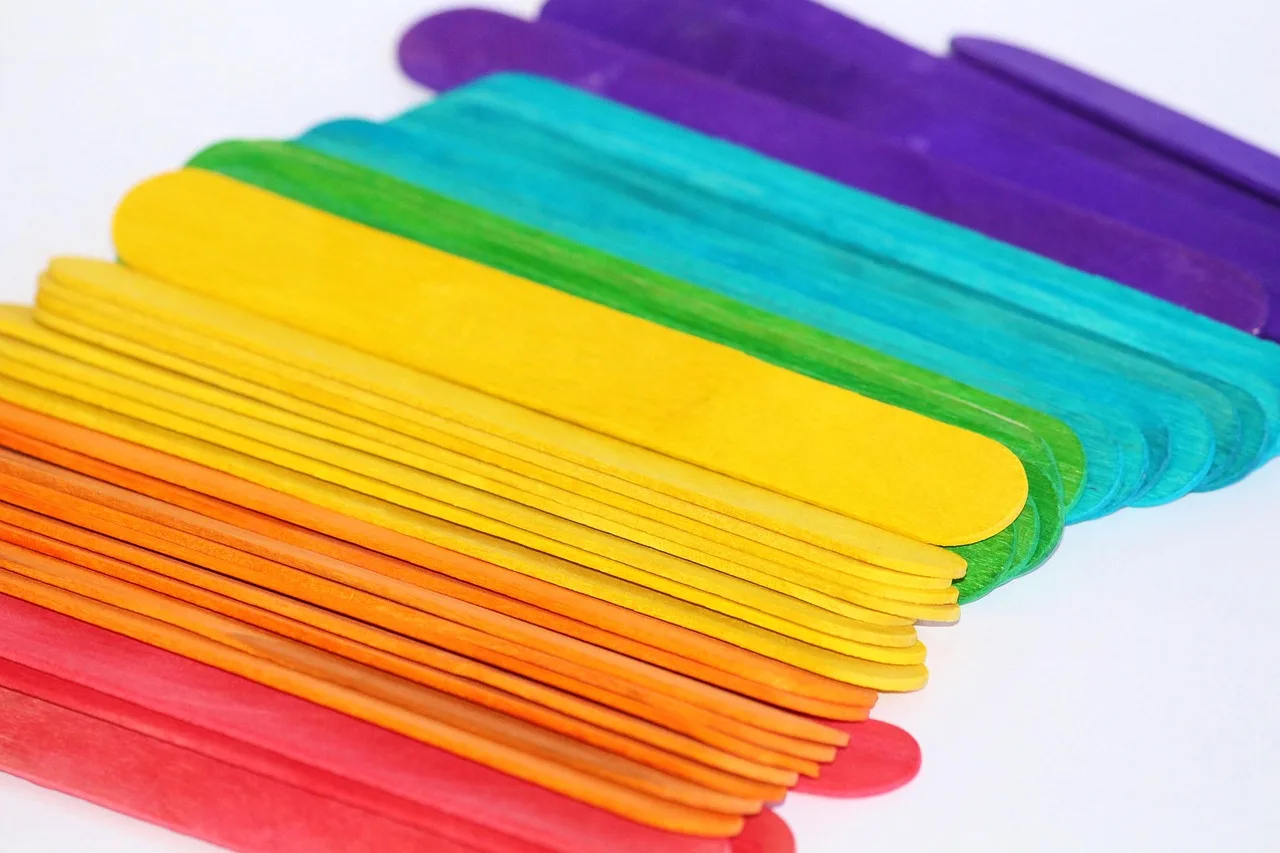
The sticks came in a box, flat and blond and smelling a little like a lumberyard. Somewhere on that box was a picture of what you could build.
There’s a reason the picture was there. In the 1940s, Forster Manufacturing made craft sticks and other wood products at three mills in Maine. Buyers hesitated over a box of plain sticks, because what would you do with them? So the makers printed project instructions right on the packaging.
Forster craft sticks are still around, sold under the Loew-Cornell name.
Popsicle stick lamps first showed up in the 1940s too, and vintage ones can sell for $700 or more (as of 2024).
Your trivet won’t bring that. But if someone in the family built a lamp out of craft sticks, look up what vintage ones have sold for before you sell it.
It’s still an easy craft to do with a grandchild or any small helper: a pack of sticks, white glue, and an afternoon of stacking them crosswise like a tiny cabin wall.
#11 Tie-dyed camp T-shirt
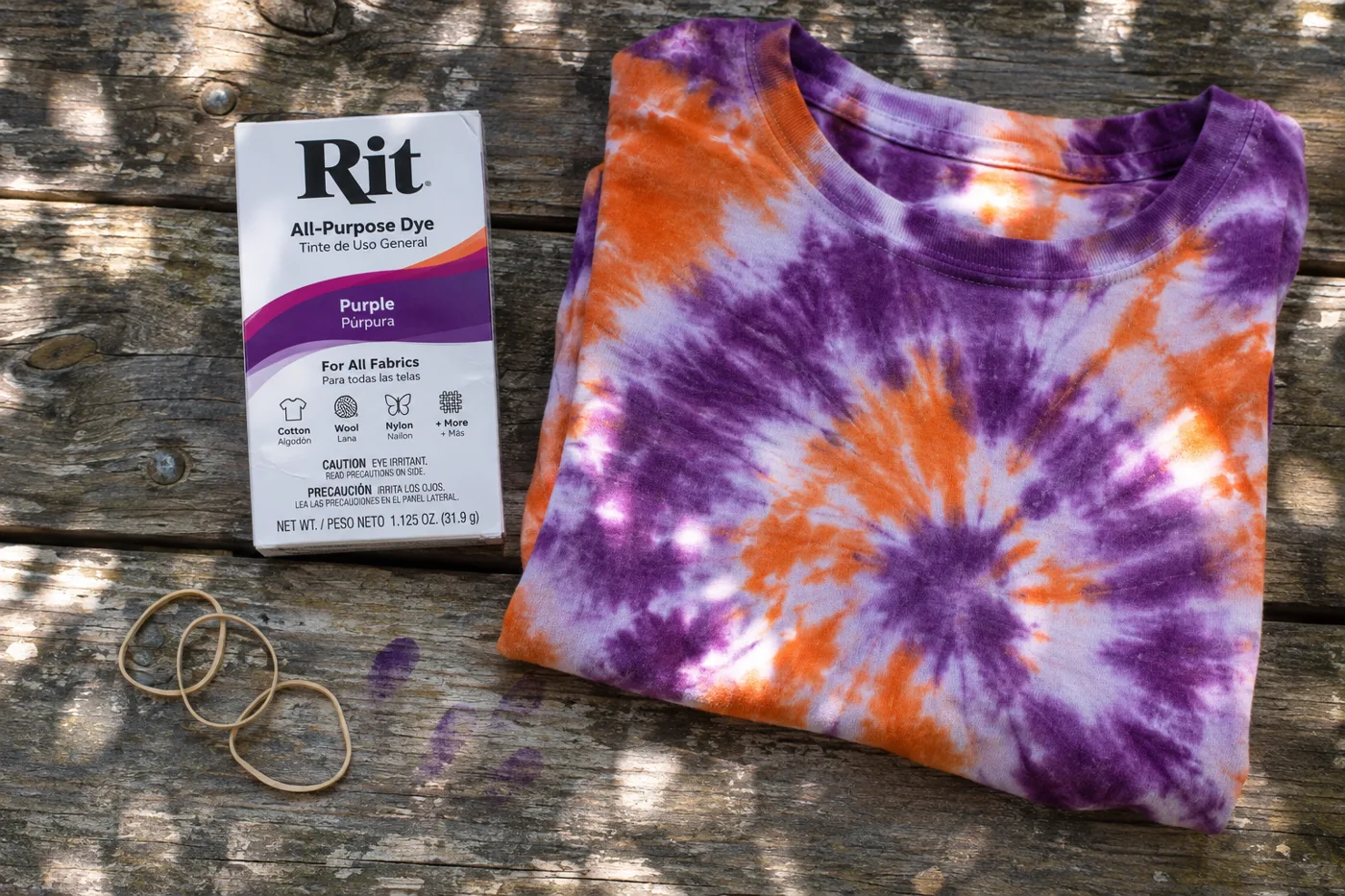
Tie-dye had a sales department behind it.
According to Dharma Trading, which sells dye, Rit’s sales were falling in the 1960s until a manager named Don Price took tie-dye to artists in Greenwich Village. Rit then paid for several hundred tie-dyed shirts to be handed out at Woodstock in 1969, and its sales went up. The Girl Scouts even made a tie-dye “Fun Patch.”
So by the time you were twisting a white T-shirt into a knot of rubber bands at a camp picnic table, with purple hands for a week afterward, the craft had already been through Greenwich Village artists and Woodstock.
If you make one again, look for “fiber-reactive” on the dye label. Procion dyes came out in 1956, and cold-water fiber-reactive dyes later became the choice for tie-dye that will hold up to washing. Dye powder and soda ash, which is caustic, need care: Dharma says to wear an approved dust mask and rubber gloves, and to keep dyes and chemicals away from unsupervised children and pets. Tie-dye is still popular with families, camps and schools.
 You might also like17 Handmade Christmas Ornaments Our Grandmothers Made
#10 String art of nails and thread
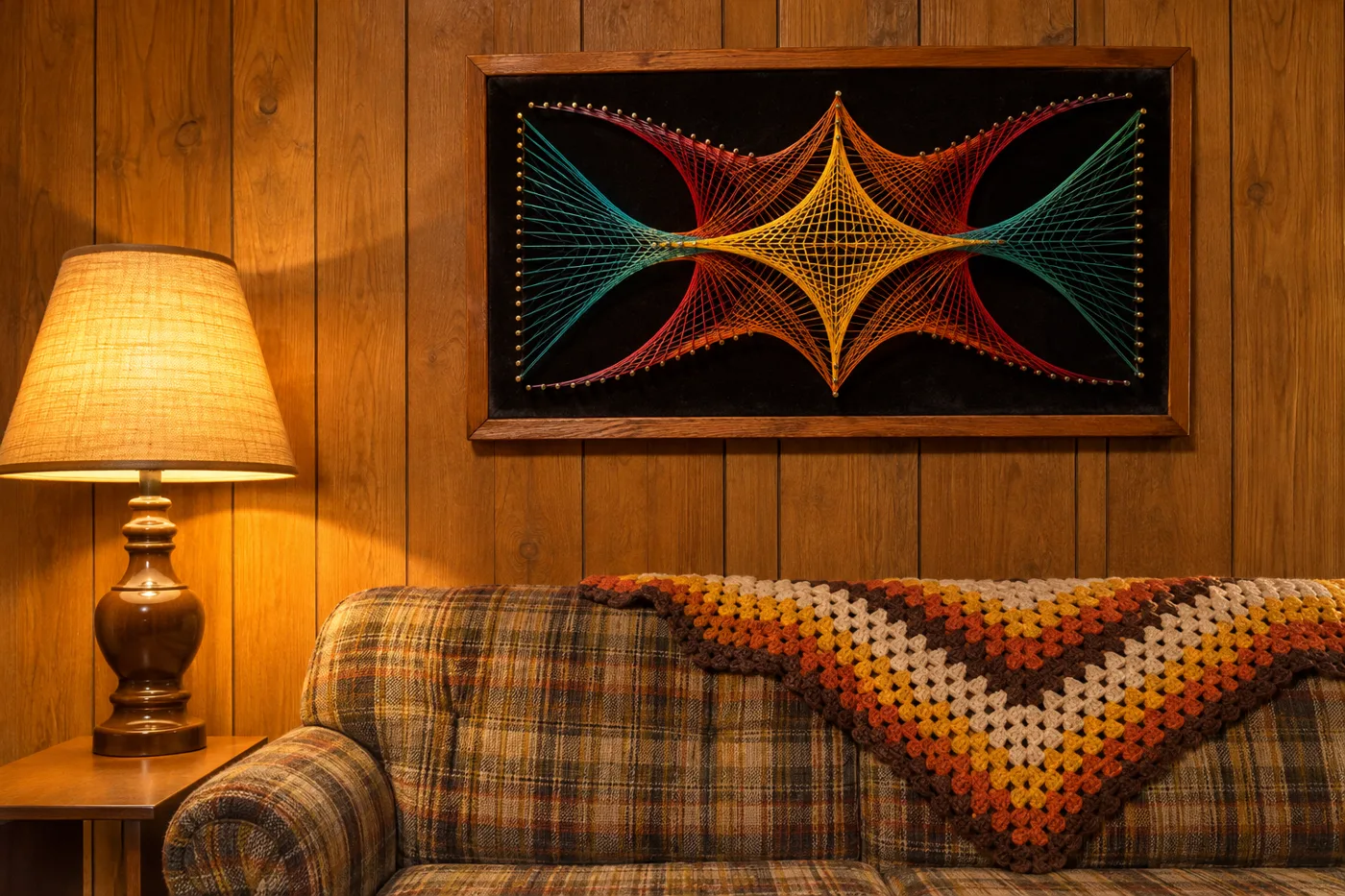
Black velvet on a board, a hundred tiny nails tapped in a ring, and colored thread wound from nail to nail until a curve appeared out of nothing but straight lines.
String art grew out of Mary Everest Boole’s “curve stitch” activities for teaching children math.
By the late 1960s it had become a popular decorative craft through kits and books. The kit designer John Eichinger gave his designs a grander name: “String Mandalas.” He designed many of them for Open Door Enterprises, which he calls “a leading distributor of hobby craft kits.”
So if a grandchild is struggling with geometry, the thing on the wall is a math lesson.
#9 Tooled leather coin purse or bookmark
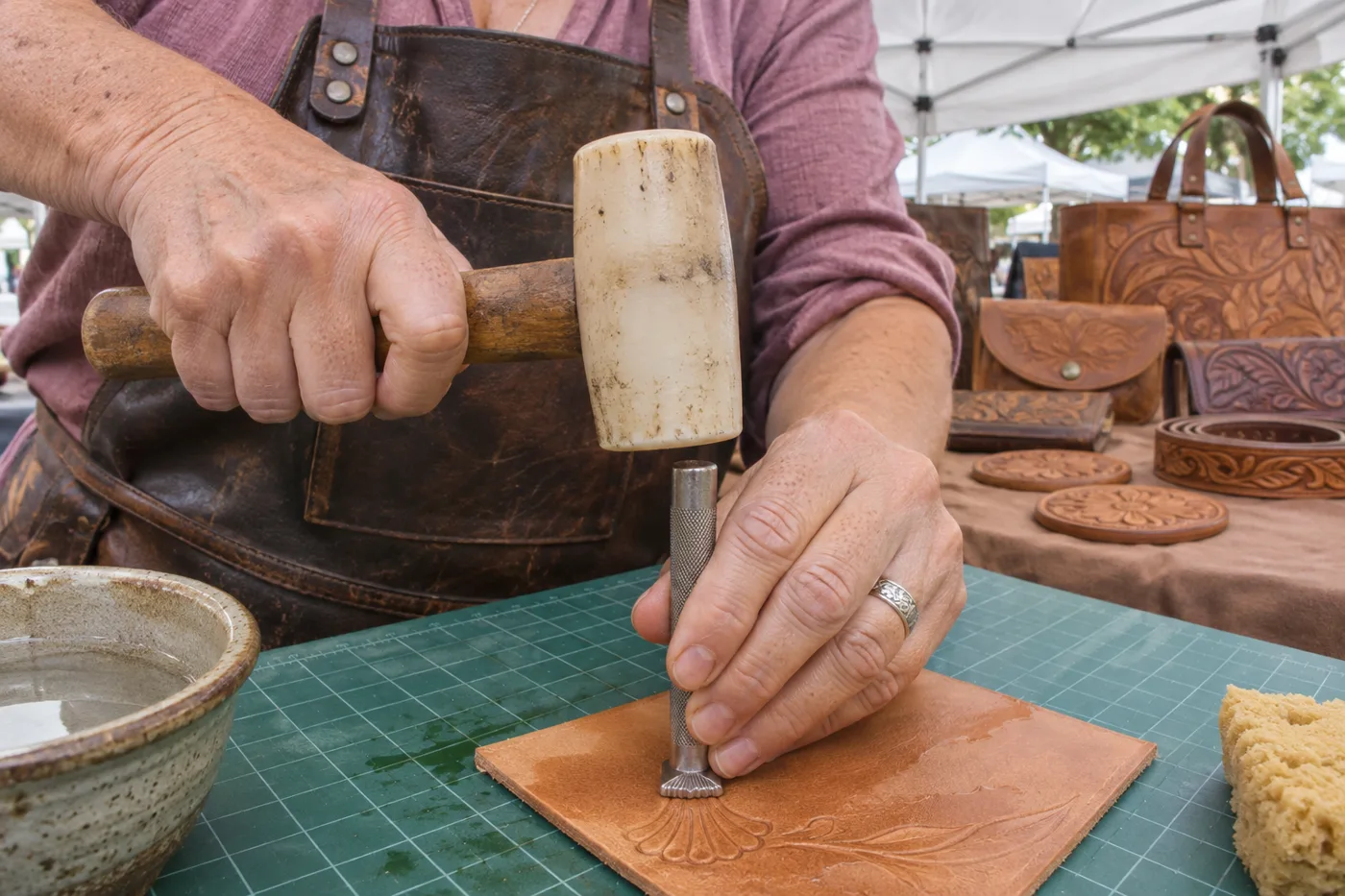
Tooling leather starts with water. Tandy Leather’s instructions say, “Start by lightly wetting the surface of the leather using a damp sponge or spray bottle.” It’s ready when it “feels cool and firm but allows for a slight impression.”
That’s why the camp version was so satisfying. A few taps and your initials were in it for good.
The mistake comes decades later, when the coin purse is stiff and dry and you reach for leather oil or saddle soap to bring it back. The Canadian Conservation Institute answers that question with a flat no. On stiff vegetable-tanned leather, the oils “oxidize and may produce deteriorative effects,” including further stiffening and darkening. Saddle soap “should not be used.”
What helps is boring: keep it in the dark, in an opaque box, and out of damp. The institute says humidity above 65% is favorable for mold to grow on leather, so a damp basement is a poor home for it.
Did you know?
Charles Tandy opened his first leathercraft store in 1950, and the company went on to sell leather moccasins and coin purses in huge numbers to Scouts. The chain later grew to about 150 stores.
#8 Spool knitting cord from a nail-topped spool
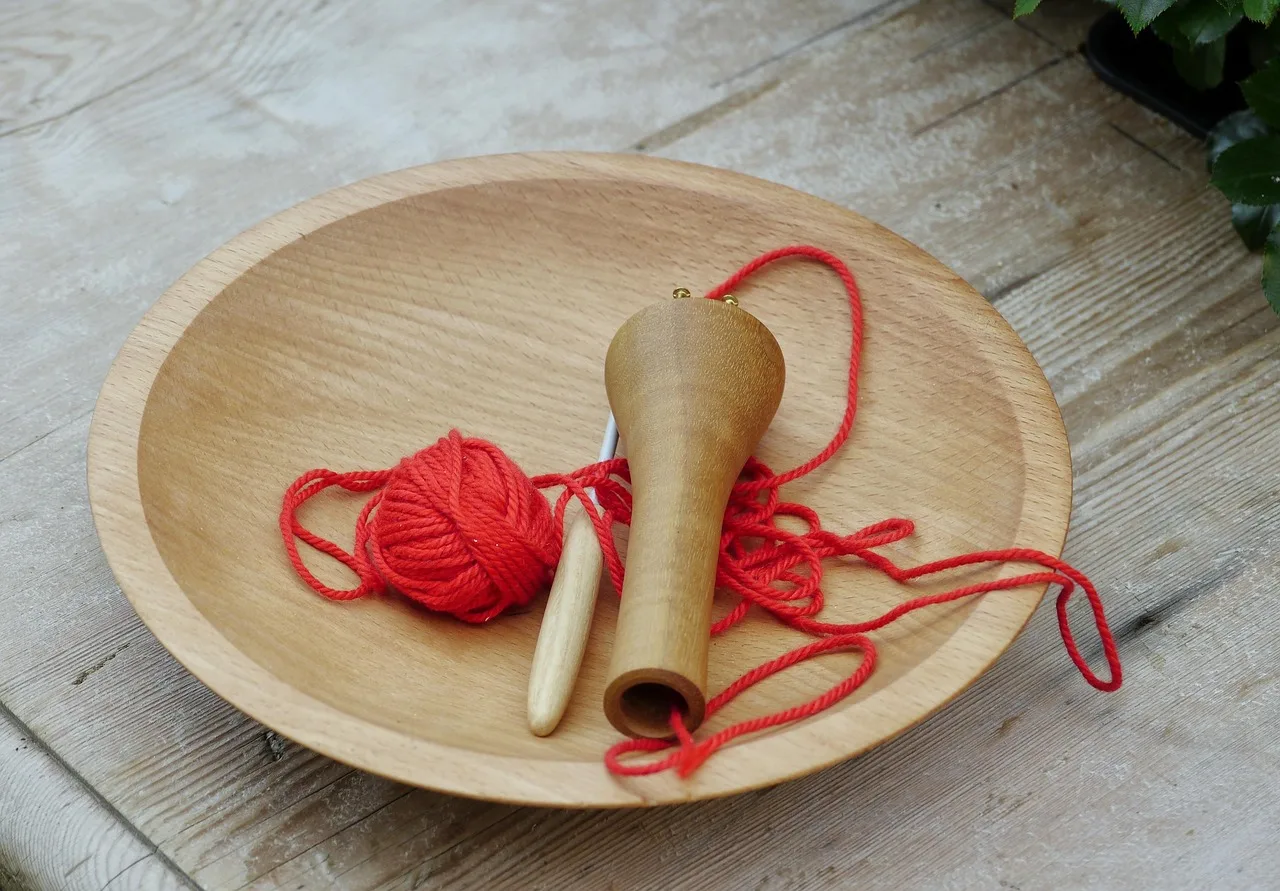
An empty wooden spool, four nails hammered into one end, and a tail of yarn growing longer out the bottom while you lifted loops over the nails. PieceWork magazine describes the knitting spool just that way, with nails, pegs or staples on top. Its names include:
- Knitting Nancy
- Bizzy Lizzy
- Corker
- Knitting Knobby
The real question is the cord, a long rope of it rolled up in the chest because nobody could bear to throw it out.
PieceWork lists what it’s good for, and a knitter will see the possibilities at once:
- Drawstrings and ties
- Coiled flat and stitched into a mat or a coaster
- Coiled and stitched into a small purse
- Tied around a gift box
Coil the cord and sew it into a coaster, and the cord a child made decades ago is on the coffee table under your iced tea.
#7 Melted crayon suncatcher in the kitchen window
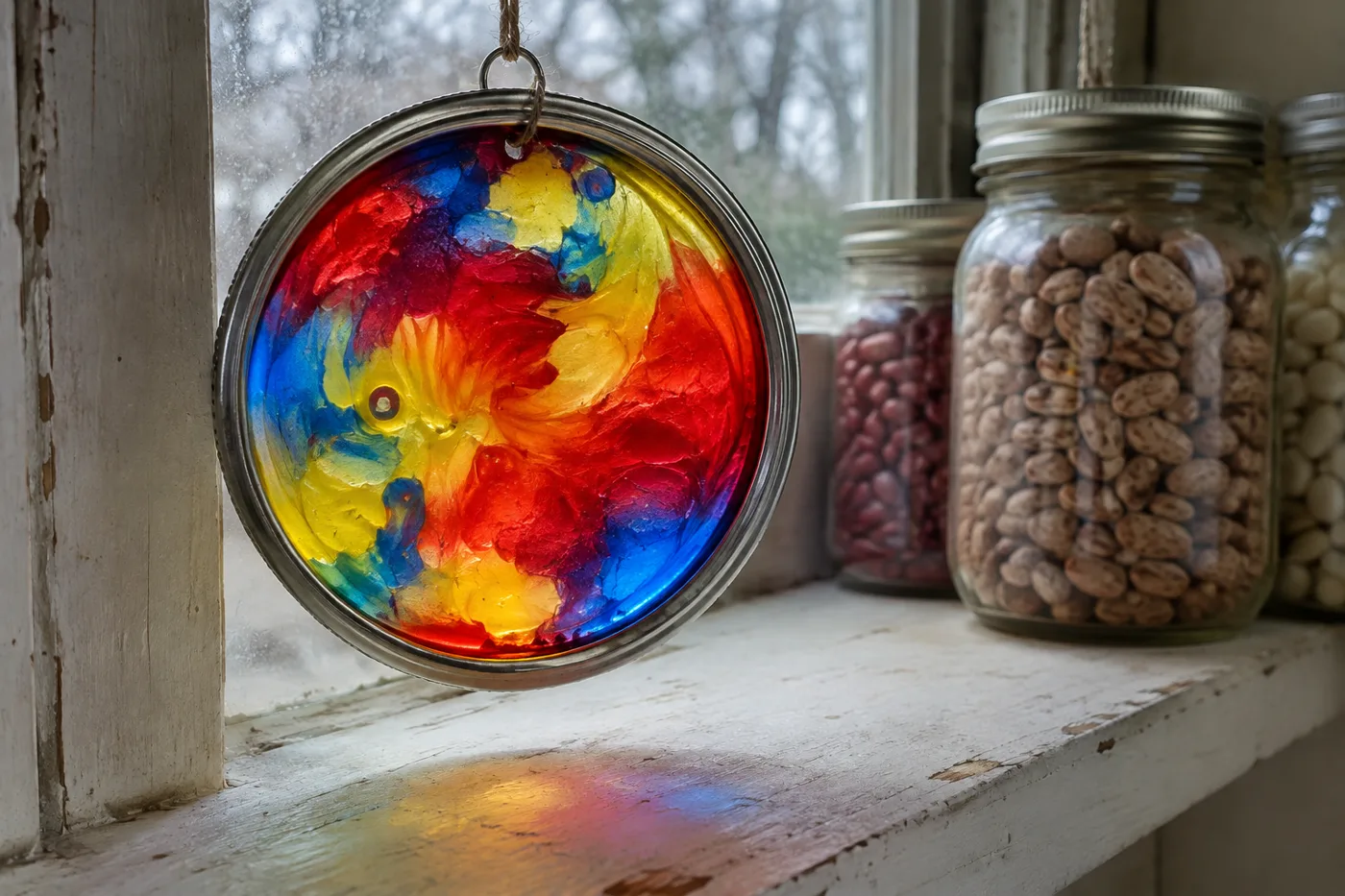
The teacher had the iron. You had a pile of crayon shavings, a pencil sharpener’s worth of red and yellow and that one blue, scattered between two sheets of wax paper. Then a towel on top, the hiss, and the smell of hot crayon filling the classroom.
It went home and got taped to the kitchen window, where the light came through it every morning. And then one August it sagged, or the colors ran together into brown.
Why a crayon suncatcher slumps – Wax crayons begin to soften around 105°F. – They melt at about 120 to 147°F. – That’s why one can slump in a hot window. – Hang the old one where direct sun doesn’t hit it.
Crayola has since dropped the iron. In its own version, children sprinkle crayon shavings between two sheets of wax paper and tape the edges. Then, “With the help of an adult, use a hairdryer to melt the shavings. Let cool 15 minutes.” The finished circle goes into a mason jar lid.
#6 Sunday school and Bible school crafts
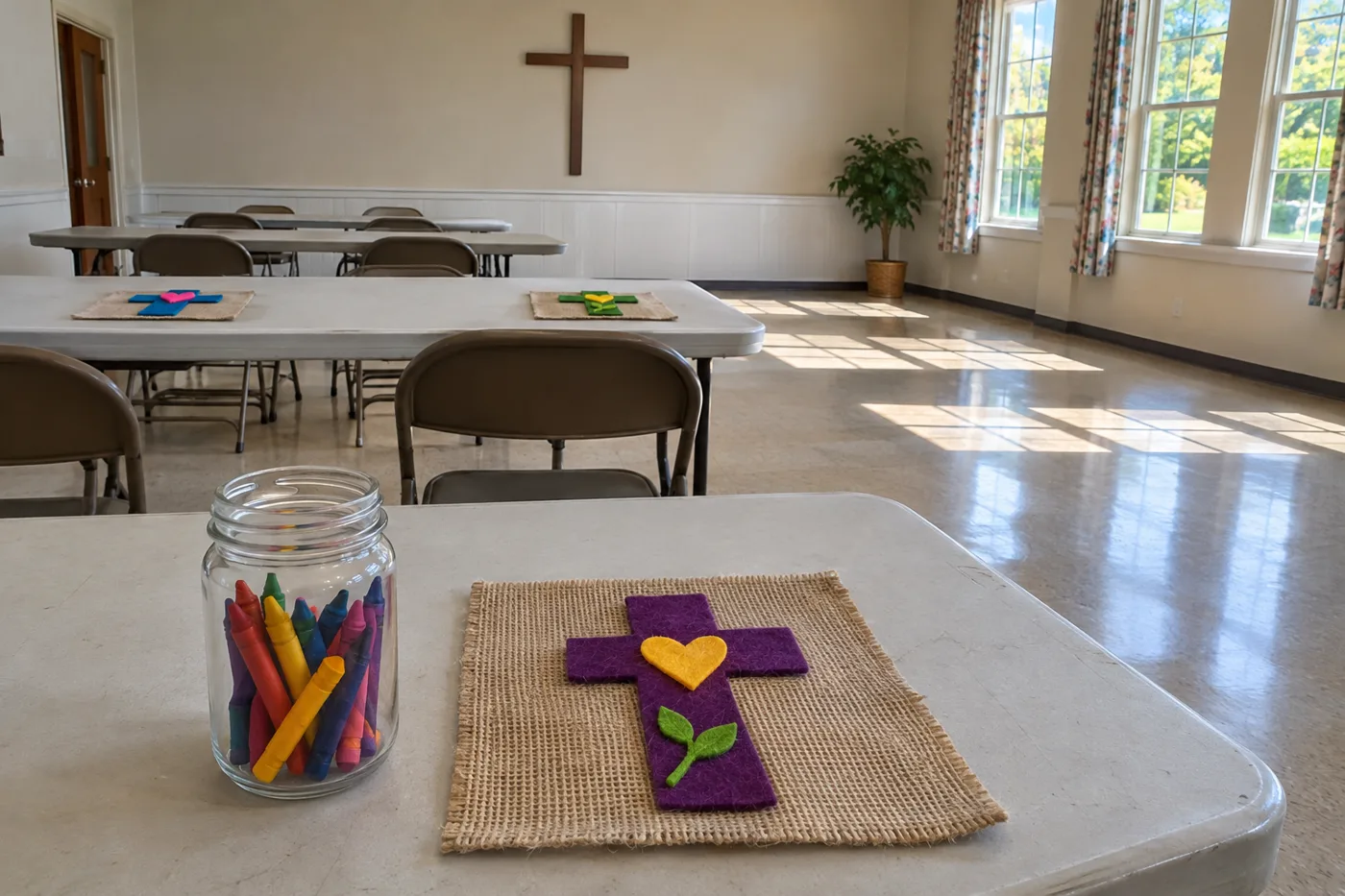
One early Bible school with crafts was held in a beer parlor.
In 1898, Eliza Hawes of Epiphany Baptist Church in New York City rented one on the East Side and ran an “Everyday Bible School” there: storytelling, music, crafts and Bible study. Four years before that, a Mrs. D. T. Miles had taught 37 children in a park in Hopedale, Illinois.
The crafts got organized after that. Standard Publishing put out a Vacation Bible School curriculum with “craft patterns” in 1923. In 1961, “packaged crafts and visuals” became available to buy.
The Baptist Sunday School Board, now Lifeway, started a Vacation Bible School department in 1924. In 2024, more than 2.5 million kids used Lifeway’s curriculum each summer, in more than 25,000 churches.
The piece in your chest has a lot of cousins.
 You might also like17 Dollar Store Christmas Crafts That Look Expensive
#5 Shrinky Dinks charm or name tag
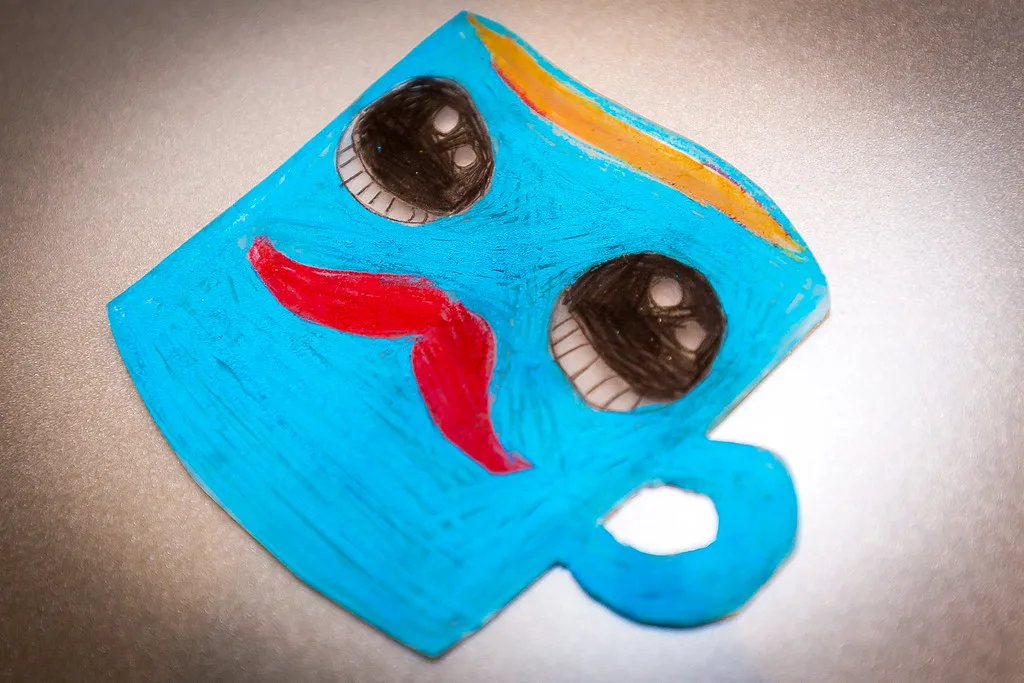
You crouched in front of the oven door with your nose almost on the glass. The plastic curled up like a potato chip, and for a terrible second it looked ruined. Then it lay down flat, small and thick and bright.
Shrinky Dinks began as a Scouts project. Two mothers, Betty Morris and Kathryn Bloomberg, made them with their sons, and they were “first sold in a Brookfield, Wis., shopping mall in 1973.” They hit their peak in the mid-1980s.
The trick is in how the plastic is made. Carnegie Mellon University explains that the sheets are polystyrene stretched during manufacturing, and the oven’s heat lets them pull back.
| What Carnegie Mellon says | The number |
|---|---|
| Oven temperature | 325°F |
| Baking time | 1 to 3 minutes |
| Final size | About 1/3 of the original |
| Final thickness | About 9 times thicker |
| Microwave | Doesn’t work |
That shrinking makes Shrinky Dinks a good way to put a name and a year on a keepsake. Write the name and year large. It comes out as a sturdy little tag that can hang from the ornament in #4.
#4 Salt dough ornament, remade a safer way
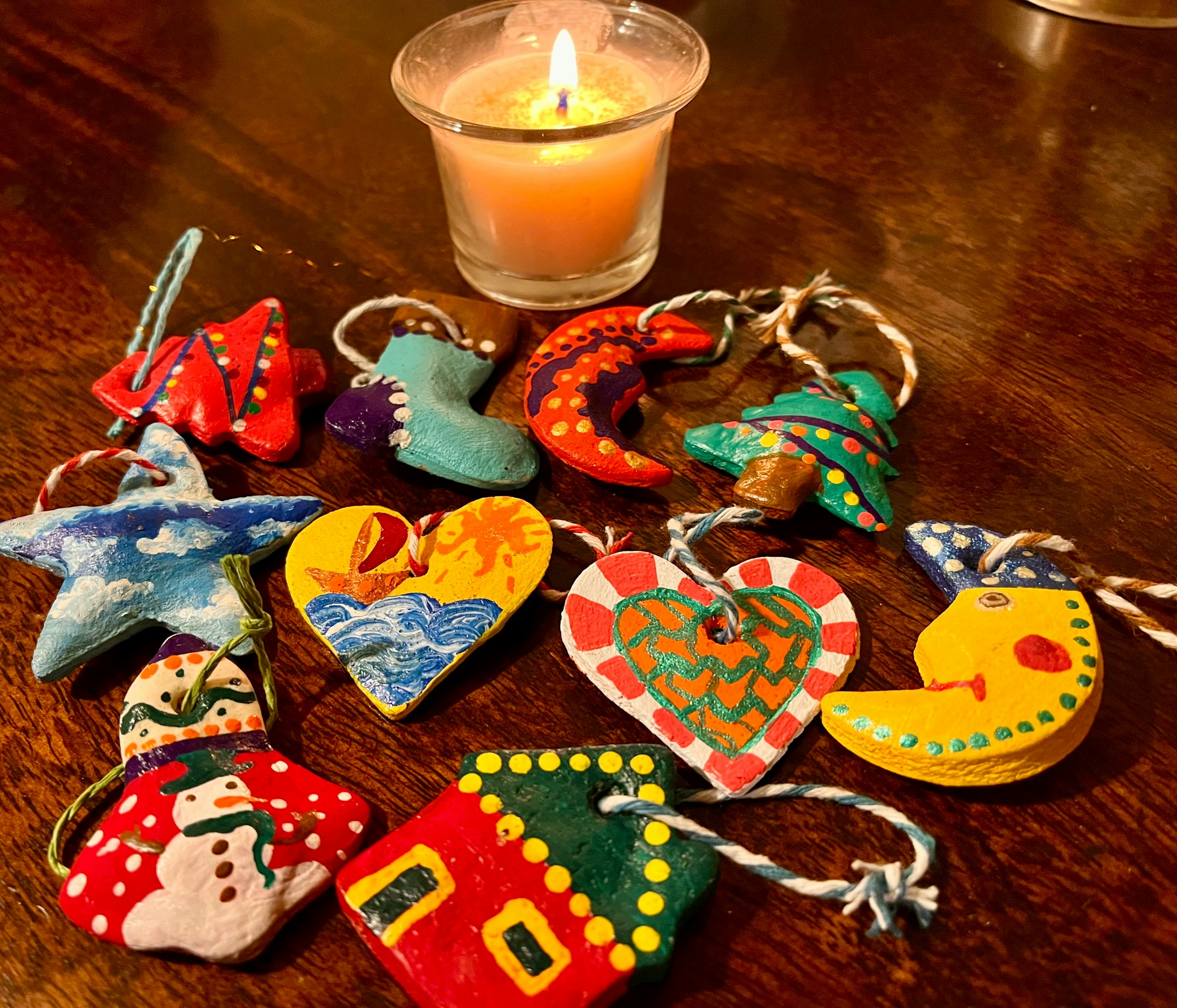
This is the handprint plaque from #15, made a safer way, one a grandchild can help with. The hand goes into soft, cold dough for a second, never into plaster.
The recipe comes from the Mosaic Templars Cultural Center in Arkansas:
- Mix 2 cups all-purpose flour, 1 cup table salt and about 1 cup cold water.
- Bake at 250°F “until they are hard, about 2 hours.”
Go by “hard,” not by the clock.
For the name and year, hang a shrink-plastic tag from #5 on it.
#3 Camp lanyard, the boondoggle
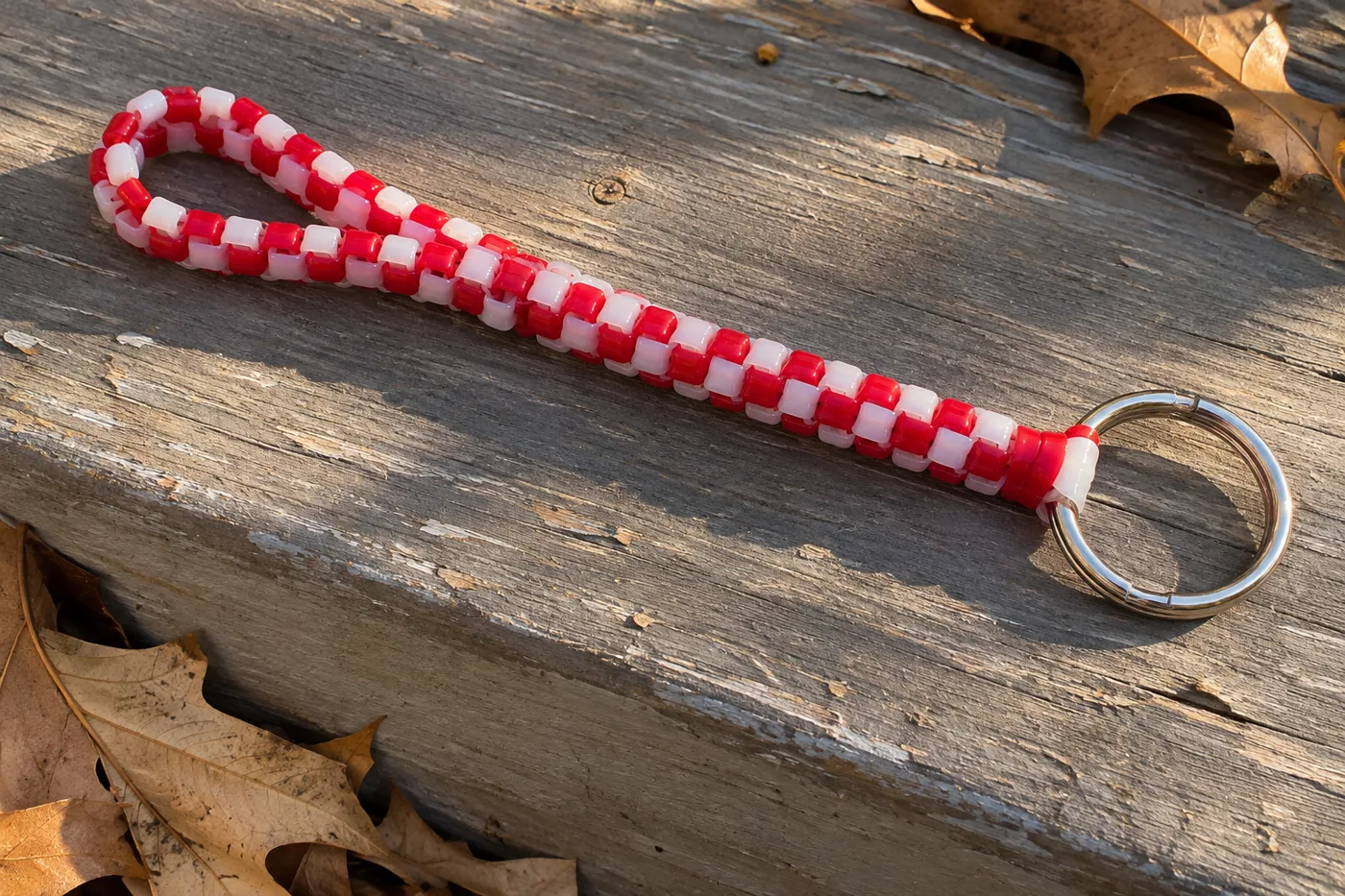
Camp kids called the lanyard a boondoggle, and the word is older and odder than most people know.
The earliest known use in print is in the Rochester, N.Y., Democrat and Chronicle on July 23, 1927. The next year the same paper reported that Rochester scouts had given the cowboy star Buck Jones “a leather Boondoggle or whistle cord.”
A Rochester scoutmaster, Robert H. Link, claimed he coined the word. The word historians at Wordorigins call that plausible but unproven. In 1935 Link said, “The lanyards still are known as boondoggles.”
That same year the word came to mean wasteful New Deal make-work.
#2 Yarn God’s eye on two sticks
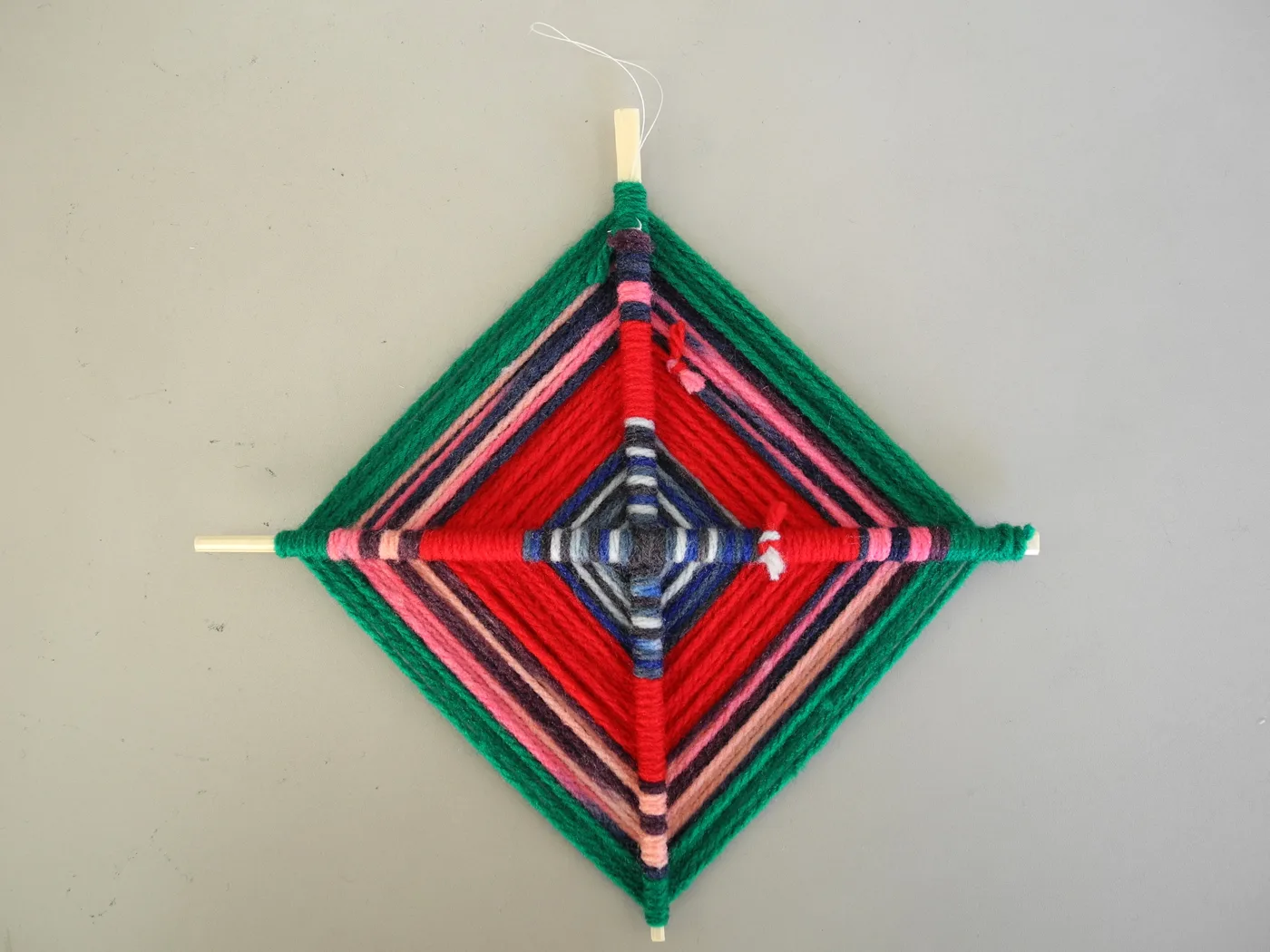
Two sticks lashed in a cross, and yarn wound around each arm in turn until a diamond of color grew out from the center. It used up the odds and ends in any yarn basket, and craft author Wendy Piersall made them as a girl.
It comes from western Mexico. The Huichol people, also called the Wixaritari, made god’s eyes for altars and ceremonial shields. Spanish colonists who arrived in the 1500s named them “ojos de dios.” In the late 1960s the American counterculture picked them up as a rallying symbol, without explicit reference to their original meaning, and Sunday school teachers still sometimes use them as a visual aid.
Piersall remembers making them in the early 1970s:
“One of the very first crafts I ever remember making as a kid.” Wendy Piersall, craft author, on making them “in Vacation Bible School and at Girl Scout Camp“
Her supply list is the whole appeal: scrap yarn, two sticks, and floral wire if you want it. For a knitter or crocheter, that’s a project you can start with what’s already in the basket, and a grandchild can pick the colors.
Did you know?
In the Huichol tradition, a father weaves the center eye when a child is born, then adds one color for each year of the child’s life until the child turns five.
#1 Construction-paper Mother’s Day card
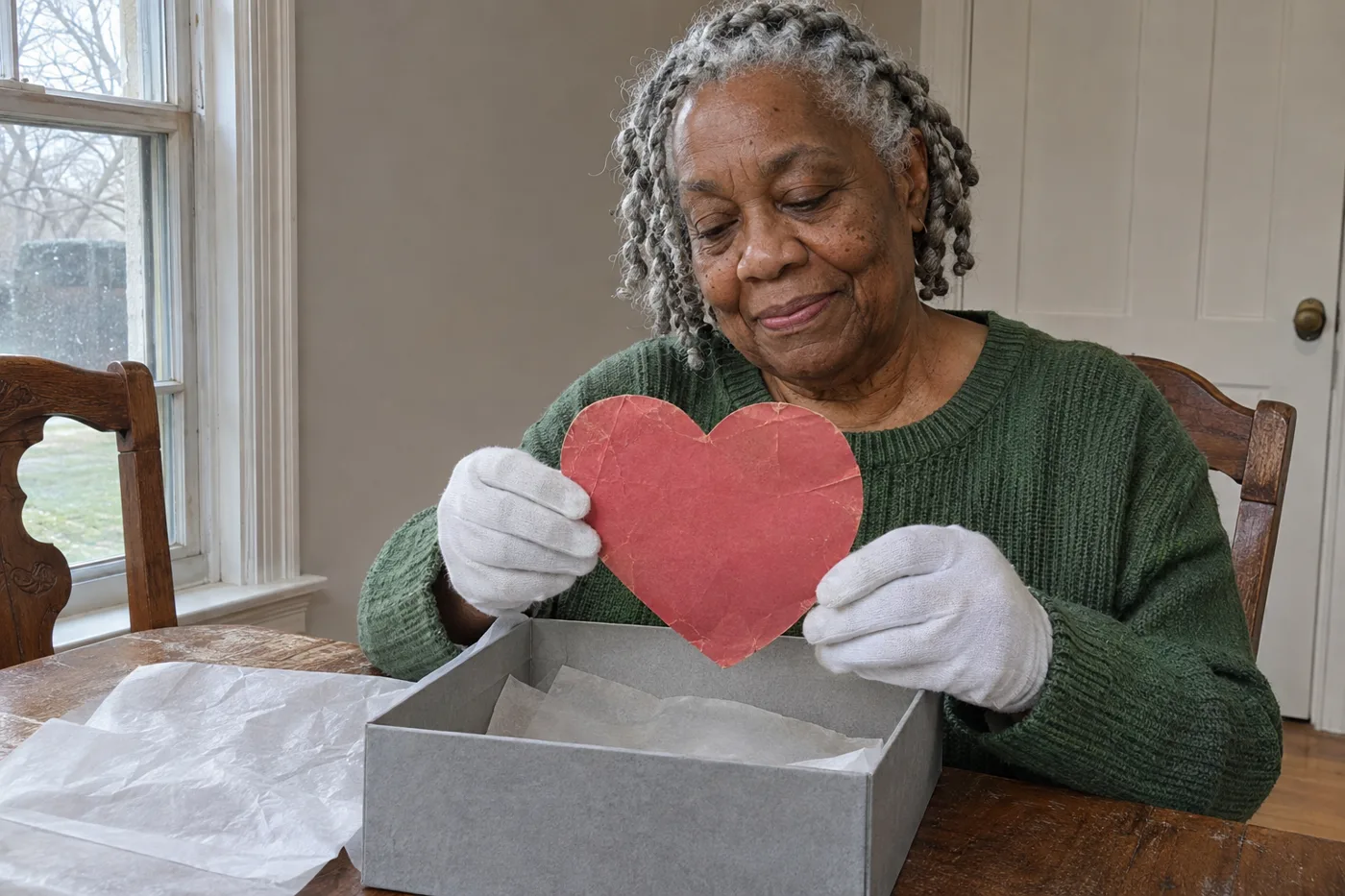
A heart cut lopsided from red construction paper, a poem copied in careful pencil from the blackboard, and a little glitter that’s still turning up somewhere. It’s the most fragile thing in the chest.
Two things are working against it. Construction paper gets its color from dyes added at the mill, and Gregory Fike, a paper science graduate student, says those dyes “are the primary culprits in the fading of the paper during exposure to sunlight.” The paper also holds leftover lignin, a natural part of wood pulp. The University of Illinois preservation program calls lignin “an acidic substance that causes paper to discolor, embrittle.” That’s the browning and the crumbly edges.
For newsprint and groundwood papers, a proper storage environment will slow deterioration but will not stop it completely.
Store it in acid- and lignin-free folders and boxes, the Library of Congress says, somewhere cool, clean, stable and fairly dry, about 35% humidity. Keep it out of attics and basements, too.
Framing is where good intentions do the most harm. Dr. Lori Verderame, an antiques appraiser, says on her own site: “Replace damaging wood, cardboard (acidic and damaging) or paper backboards.” That goes for a card that has been in a frame for decades, too. In one of her videos she says a brown mat is acidic and can damage the artwork it holds. In a 2023 column she adds that cardboard draws bugs as well.
The Library of Congress goes one step further: it doesn’t recommend hanging paper originals long term at all, because light damage is permanent. Its answer is to frame a good copy behind UV-filtering acrylic with acid-free, lignin-free backing, and keep the original in its box.
Paper keepsake storage test – Is the mat brown or the backing cardboard? Replace it. – Is it in an attic or basement? Move it. – Is there tape, glue, a rubber band or a paper clip on it? Take it off. – Has the original been hanging for years? Frame a copy instead.
Keep reading
 17 Things Christmas Bazaar Sellers Know That Craft-Fair Guides Don’tSee all 17 →
More you’ll enjoy
 17 Handmade Gifts Grandkids Will Actually Keep
 17 Christmas Crafts for Adults That Make Lovely Gifts
 15 Things Hiding in Grandma’s Sewing Box That Could Be Worth Real Money
The bottom line
The flimsy things in the chest, paper and pasta and plaster, were made to be looked at once and loved forever, and they’re the ones that need you.
Most of them can’t tell anyone whose hand, which grade or what year. If you’re the one who remembers, you’re the only record that exists.
So here’s a question to sit with when the lid is open: which one did you make, and which one was made for you?
Bonus: Four ways to pass the crafts on
- Offer leftover yarn, floss and buttons to a school or nonprofit kids’ craft program. A volunteer who runs children’s crafts says people don’t know what to do with their needlework leftovers, and an after-school craft leader says they buy the supplies themselves; other leaders report paying or asking for donations too.
- Photograph each piece front and back in daylight. The photo is the copy you can print, frame or send, so the original can stay in its box.
- If the maker is still around, ask what they remember about making it, and write the answer down word for word. The story is usually better than you’d guess.
- Hand a grandchild or any young helper the camp version of a craft before you hand them the keepsake. A child who has wound a God’s eye knows what the old one cost somebody.
Questions people also ask
How do you preserve a plaster handprint?
Keep it dry, dust it gently, and never wash it. Plaster care expert Susan Maltby warns that water can dissolve the plaster and drive dirt deeper into it. Handle it with clean, dry hands, and store it in an archival-quality box or show it behind glass.
How do I store my children’s old artwork so it doesn’t turn yellow?
Store it in acid- and lignin-free folders and boxes in a cool, clean, fairly dry spot, about 35% humidity, away from attics and basements. The Library of Congress also says to take off tape, glue and clips. If it’s framed, appraiser Dr. Lori Verderame says to replace acidic cardboard backing.
Why did kids make ashtrays in school?
Because smoking was everywhere: 42.4% of US adults smoked in 1965. A Minnesota historical society writer recalls that teachers wanted a gift “useful to parents” that “didn’t have to be perfectly glazed for safety.” By 2022 the smoking rate was 11.6%, and the gift had lost its job.
What old school crafts can I make with my grandkids?
Salt dough ornaments, shrink-plastic name tags and crayon suncatchers are all easy to remake. Salt dough bakes at 250°F for about 2 hours, shrink plastic bakes at 325°F for 1 to 3 minutes, and Crayola’s suncatcher uses a hair dryer with an adult helping in place of an iron. Make a handprint in salt dough, never in setting plaster.
What is a God’s eye craft?
It’s yarn woven around two crossed sticks, a craft that comes from the Huichol people of western Mexico. Spanish colonists arriving in the 1500s named the pieces “ojos de dios.” In the US it became a late-1960s counterculture symbol and a camp and Sunday school craft. Craft author Wendy Piersall remembers making them at Vacation Bible School and Girl Scout camp in the early 1970s.
Is it safe to make a plaster handprint with a child?
Not by putting a hand into setting plaster. The UK’s National Society for Education in Art and Design says hands should never be submerged in mixed plaster, because it heats as it sets and can damage skin. Press a hand into salt dough instead and bake it hard.