Sixteen quiet ways cardboard, plastic, light, damp and old habits wear on your yardage, each with a fix you can start this week.
The bug you’d bet on is the one least likely to eat your quilting cotton. #1 tells you which ones to look for, and where they hide.
The tote on the top closet shelf has a strip of masking tape on the end that says BLUES, in marker gone brown. You haven’t lifted that lid in years. When you finally do, the first thing that reaches you is a smell, faint and a little like a cellar.
Your good fabric needs something simpler than you’d guess when you look up how to store a fabric stash: a pillowcase, a few saved packets, and an honest look.
#16 The sealed tote nobody has opened in years
You snap the lid down tight because tight feels safe. But plastic holds in whatever went in with the fabric, and that includes damp.
The archival supplier Gaylord says it flatly: “Wrapping or containing textiles in any plastic film or container can cause moisture condensation.” Condensation can promote mold.
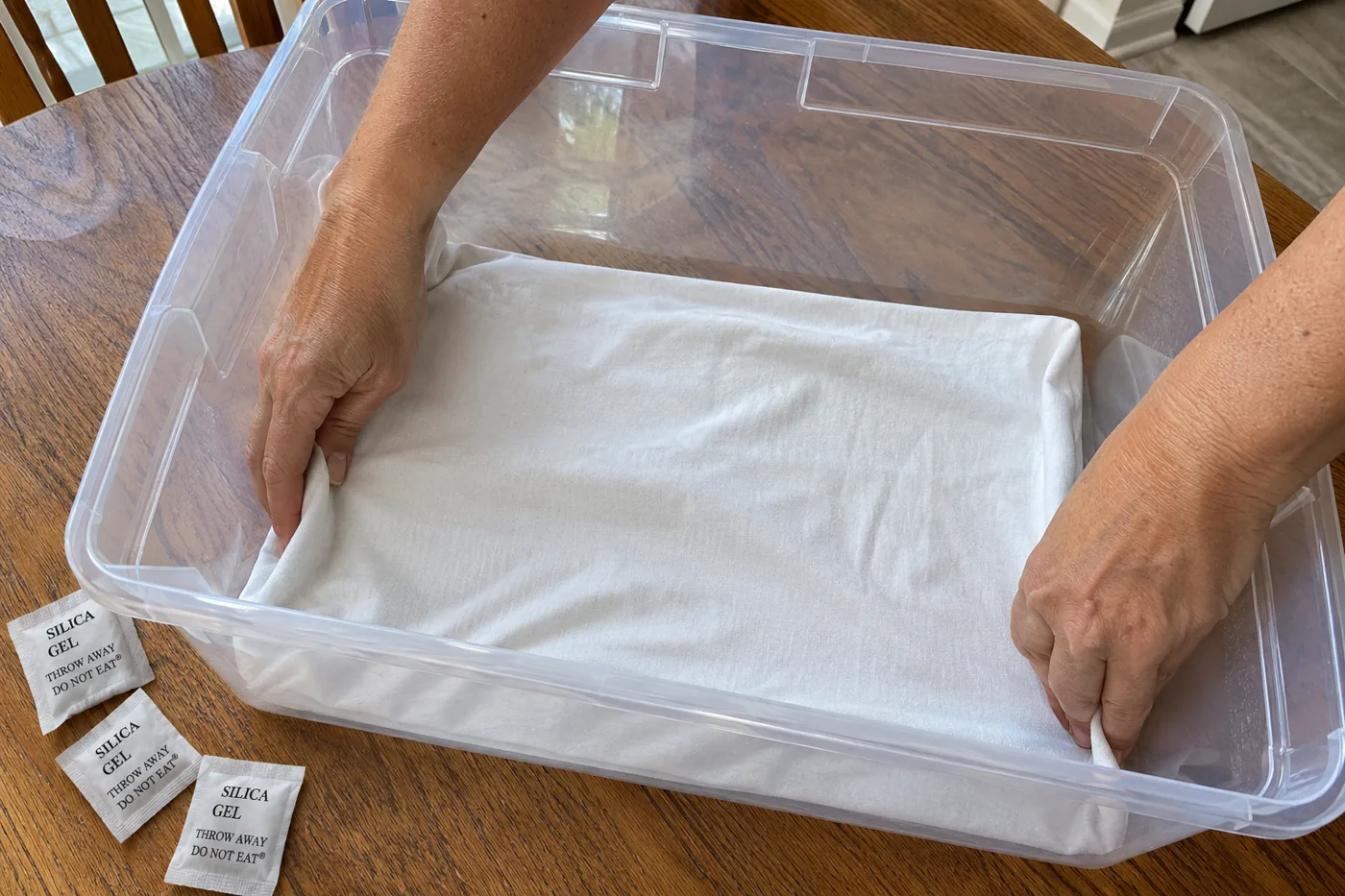
You don’t have to throw the plastic totes out. The International Quilt Museum in Lincoln, Nebraska, accepts new (not recycled) HDPE or polypropylene containers, as long as they’re lined against moisture “where moisture may condense, possibly leading to mold and mildew growth.” Gaylord advises lining any box with acid-free tissue. Our suggestion is to use what’s already in your linen closet: a washed, bone-dry cotton pillowcase or an old sheet.
Then raid the junk drawer for those little desiccant packets marked silica gel, the ones that come in shoe boxes. Silica gel can absorb moisture from closed spaces, as University of Missouri Extension notes. Saved packets stop working once they’re full of moisture. Dry & Dry, a desiccant maker, says paper and cloth packets can be dried out in a regular oven (not a convection one) at 200 to 250°F. Spread them thin, start with half an hour, and let them cool completely. Treat the packets as a helper and keep the lining as your main protection.
Here’s what will undo all of it: fabric that goes in damp. Missouri’s rule is “Never let clothing or other fabric articles lie around damp or wet.” Sealed in plastic, that damp has nowhere to go.
This week, for the one tote you trust least:
- Lift the top layer and feel underneath for a cool, clammy patch.
- Line the tote so no fabric touches the plastic.
- Drop in a handful of saved packets along the sides.
- Put the tote back up on a shelf, off any floor that ever feels damp.
If it smells musty when you open it, skip ahead to #7 first.
#15 The brown line where cardboard touches cotton
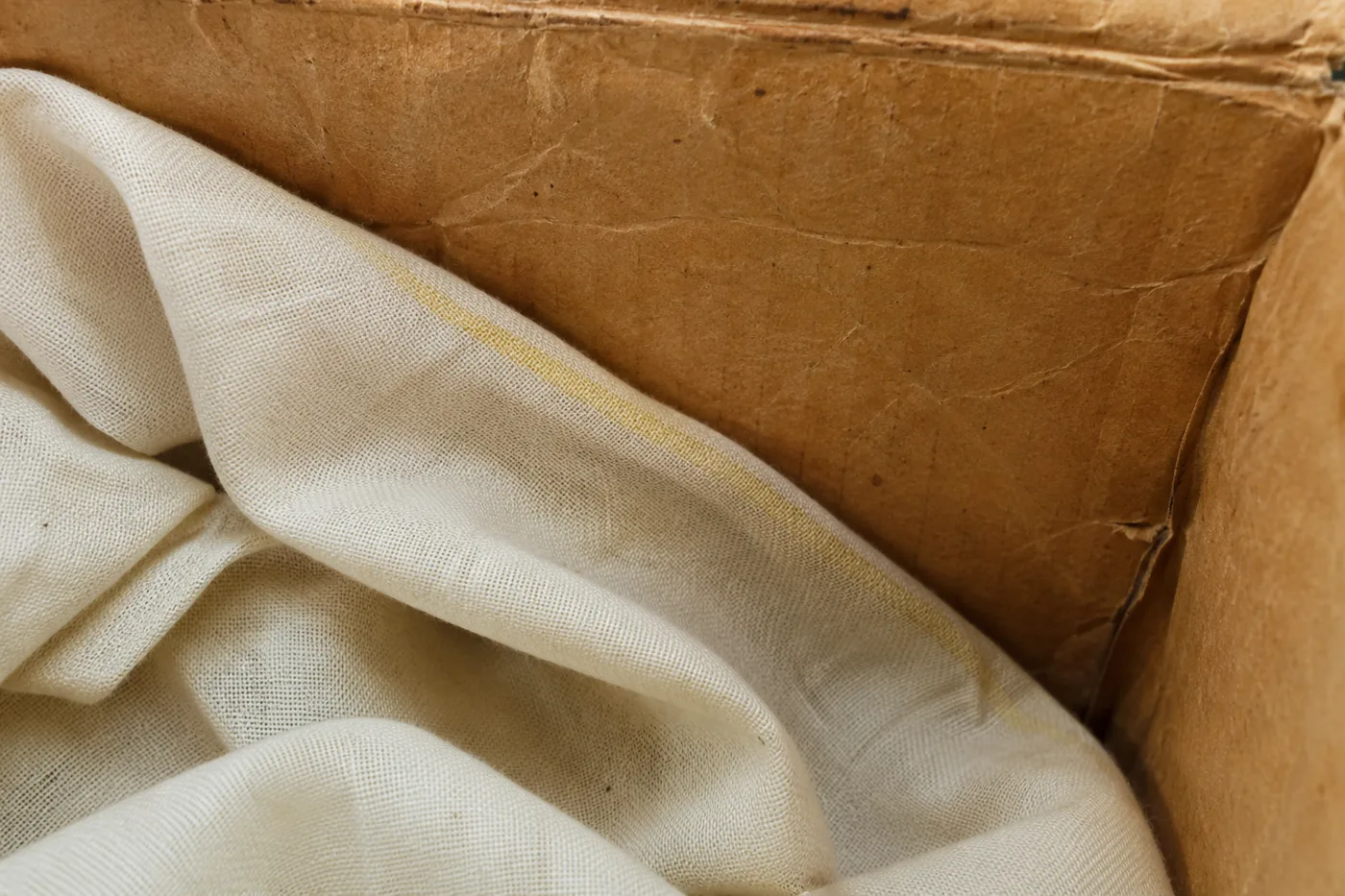
Pull out the piece that’s been resting against the side of a cardboard box and look at the edge that touched it. A tan stripe, crisp where the box wall was, means the box has been working on your fabric.
Gaylord lists cardboard among the household materials that damage textiles. NC Historic Sites calls lignin “the acid-producing agent in wood pulp,” and then adds, “The acid in the wood will cause textiles to yellow.” CCAHA, a nonprofit conservation center, recommends lignin-free, acid-free papers for storage, and says lignin can cause yellowing and brittleness in paper over time.
The fix is a barrier:
- In a box, lay a washed pillowcase or a length of washed sheet against every wall the fabric touches.
- On a cardboard board, wrap the board in a strip of washed muslin before you wind the fabric back on. That’s our suggestion, and it uses up muslin you probably bought by the bolt.
A barrier needs looking after. The University of Nebraska-Lincoln Extension, which suggests washed unbleached muslin as a lining, says to take it out and wash it now and then, yearly if you can, and put it back. You won’t line every box this week, so start with the ones holding fabric you’d hate to lose. A stripe that’s already there also tells you something useful: the boxes stacked beside it have been doing the same thing.
Did you know?
Kathleen Daly of the Oregon Historical Society tested boxes in her own collection that were sold as acid-free. When she touched her pH pen to them, they clearly read as acidic.
#14 Faded stripes on the folds facing out
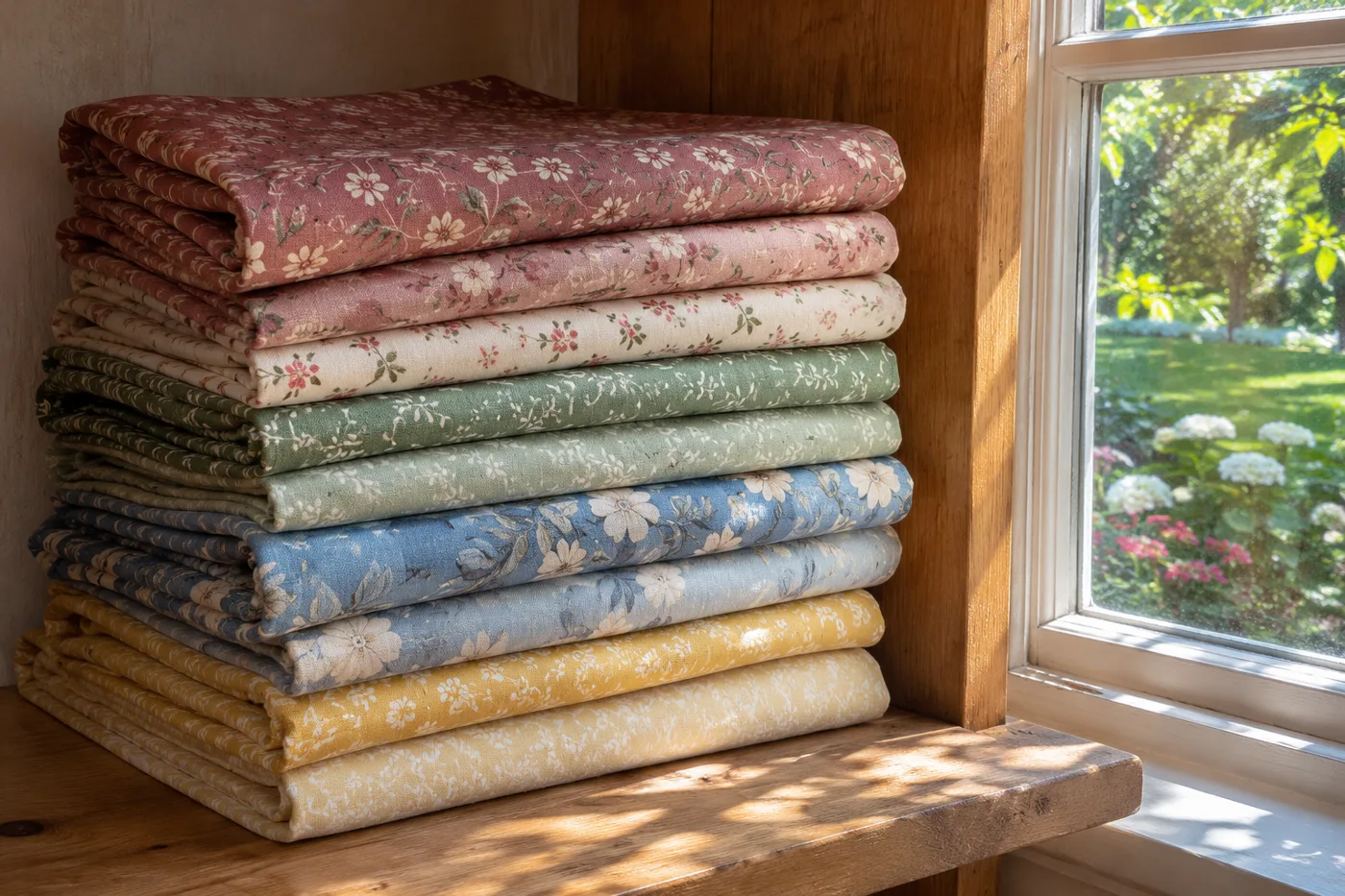
“You can get those tell-tale faded lines along the folds that are exposed.” A sewist on r/sewing
You’ve seen it. A stack of folded cottons on an open shelf looks fine from the front until you unfold one and find a pale band, exactly as wide as the edge that faced the room.
Sunlight fades fabric a little at a time, and the time adds up. The Northeast Document Conservation Center, a conservation nonprofit, says light damage is “cumulative and irreversible.” The Canadian Conservation Institute adds that visible light fades most dyes, while ultraviolet light yellows and weakens the fibers themselves.
Stephanie Soebbing, owner of the Quilt Addicts Anonymous quilt shop in Rock Island, Illinois, says standing folded fabric on edge means “Less stress on the folds.” She says drawers or boxes protect fabric from light: “This is especially good if you’ve got a lot of sun coming in.”
On an open shelf, though, standing fabric on edge still leaves one folded edge staring at the window. So the habit that matters is turning it. NC Historic Sites advises refolding now and then so that different sections take their turn being exposed.
What to do this week:
- Flip every stack on an open shelf so the other edge faces out.
- Hang a sheet or an old curtain across the front of the shelves.
- In your sunniest room, move your best pieces into a drawer or a lined box.
A band that has already faded won’t come back. Fold it to the inside, where it can’t get worse.
#13 Gray dust on top of open stacks
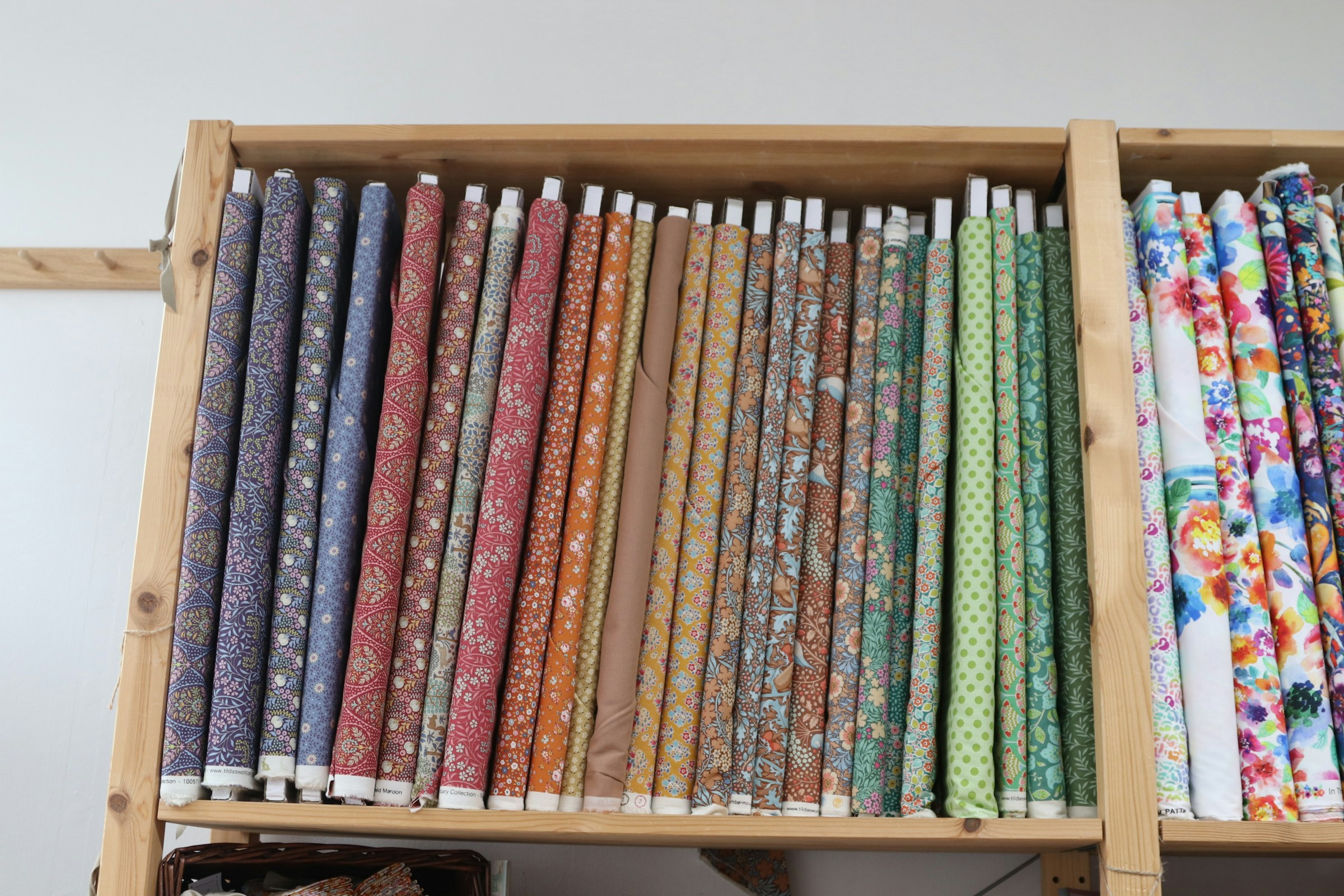
The gray film on top of an open stack is more than dirt. It holds sharp, gritty bits of silica that can cut through fibers, the Canadian Conservation Institute warns.
The George Washington University Museum explains how. Textiles expand and contract as humidity changes, and dust particles cut into fibers as they do.
Some quilters treat dust as a main threat. “I live rurally in Texas, so dust & sun are enemies,” a quilter wrote on r/quilting.
The conservators’ answer is cotton. For rolled textiles, the Canadian Conservation Institute says to “cover it with prewashed cotton sheeting.” At home:
- Drape a washed cotton sheet over your open shelves, top and front.
- On laundry day, carry it outside, shake it, and wash it with your towels.
If you only fix one thing about open shelves, make it this sheet.
#12 Buying a print you already own
You stood at the cutting counter with a bolt you loved, paid for two yards, drove home, and found the same print in the third bin from the left. Or you spent an hour looking for a piece you knew you had and gave up. On Reddit, sewists say fabric gets lost in stacked shopping bags and loose piles, or pushed into a cupboard and forgotten.
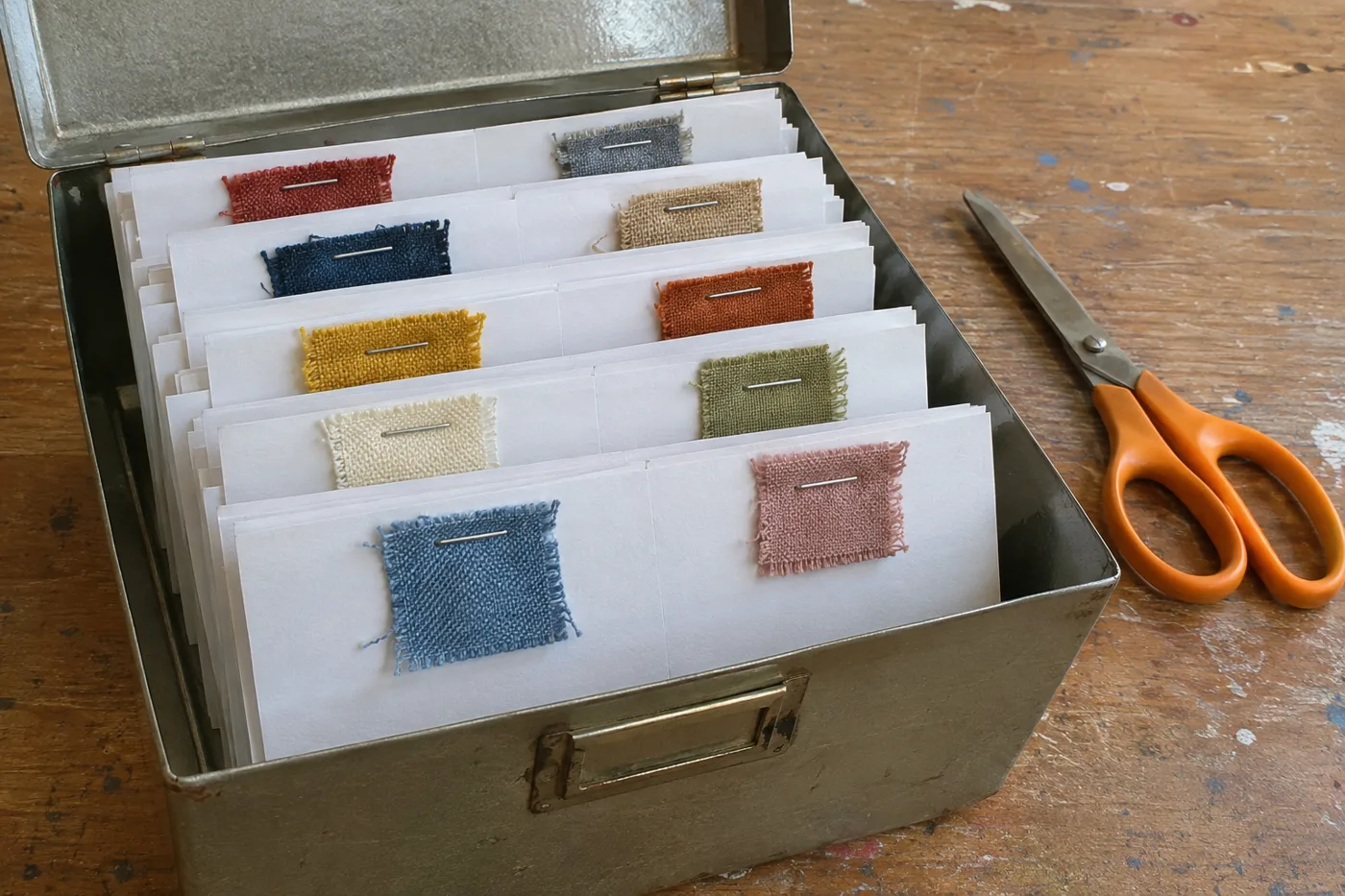
The fix is a record, and it can be cheap. Julie described a swatch-card system on the Fabric Mart blog in 2012: “I cut a small swatch and stapled it to an index card.” Each card lists the yardage, the fiber and the width, and the cards sit in a file box with color-coded tabs. A reader there keeps her swatch cards in a binder with see-through pages, sorted by color, so she can carry it into the shop.
Sewists on Reddit keep records too. One tucks a card into each bundle with the maker, the line, the design number and the shop it came from. Another quilter on r/quilting says they keep a spreadsheet of what’s in each bin.
“In other words, instead of being organized, I just wrote down a map to the chaos.” A quilter on r/quilting
A map is enough. You don’t need to refold anything to make one.
What stops this from working is a system too fussy to keep up. On TikTok, sewists describe systems that collapsed because everything had to go back perfectly or be ironed first. So start small this week. Card only your pieces over a yard. For fat quarters, one card per bundle will do.
There’s a storage reason too. Fabric you can find is fabric you use, and fabric in use doesn’t sit forgotten in a bin.
 You might also like15 Checks That Tell You What an Old Quilt Is Really Worth
#11 Washed and unwashed cottons in one stack
Quilting cotton can shrink about 3 percent in the wash. That sounds like nothing until you do the sum from a National Quilters Circle video on preshrinking: a quilt meant to finish at 100 inches can end up near 97.
The rule is to treat every piece the same. The video’s presenter puts it simply: “if you preshrink one component preshrink them all.”
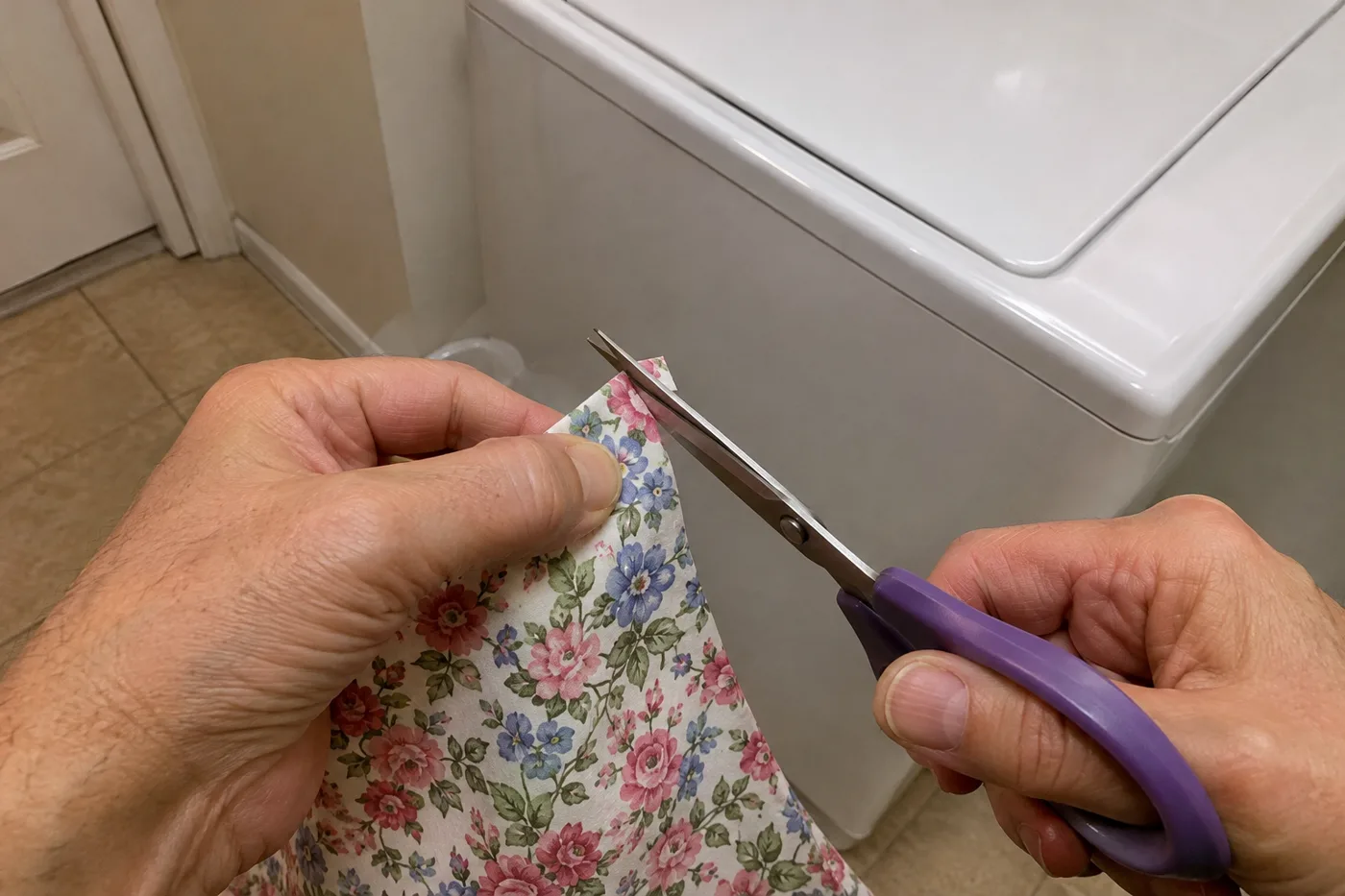
That rule only works if you can tell, years later, which pieces you washed. A pile of folded cottons doesn’t tell you. One quilter on Quiltingboard clips a corner off each piece before washing, so an uncut corner means unwashed. If you’d rather not cut, tape a note on it. Don’t use a pinned note, which only sends you to #6.
Then give washed pieces their own stack, so the two never mix again.
Two cautions from the same video:
- Don’t pre-wash precuts. Jelly rolls, charm packs and layer cakes ravel in the wash and lose the exact width you paid for.
- Test darks for bleeding first. Rub a white scrap on the dark fabric, or soak a small test square in hot water, and see if color comes off.
#10 Fabric you know you’ll never cut
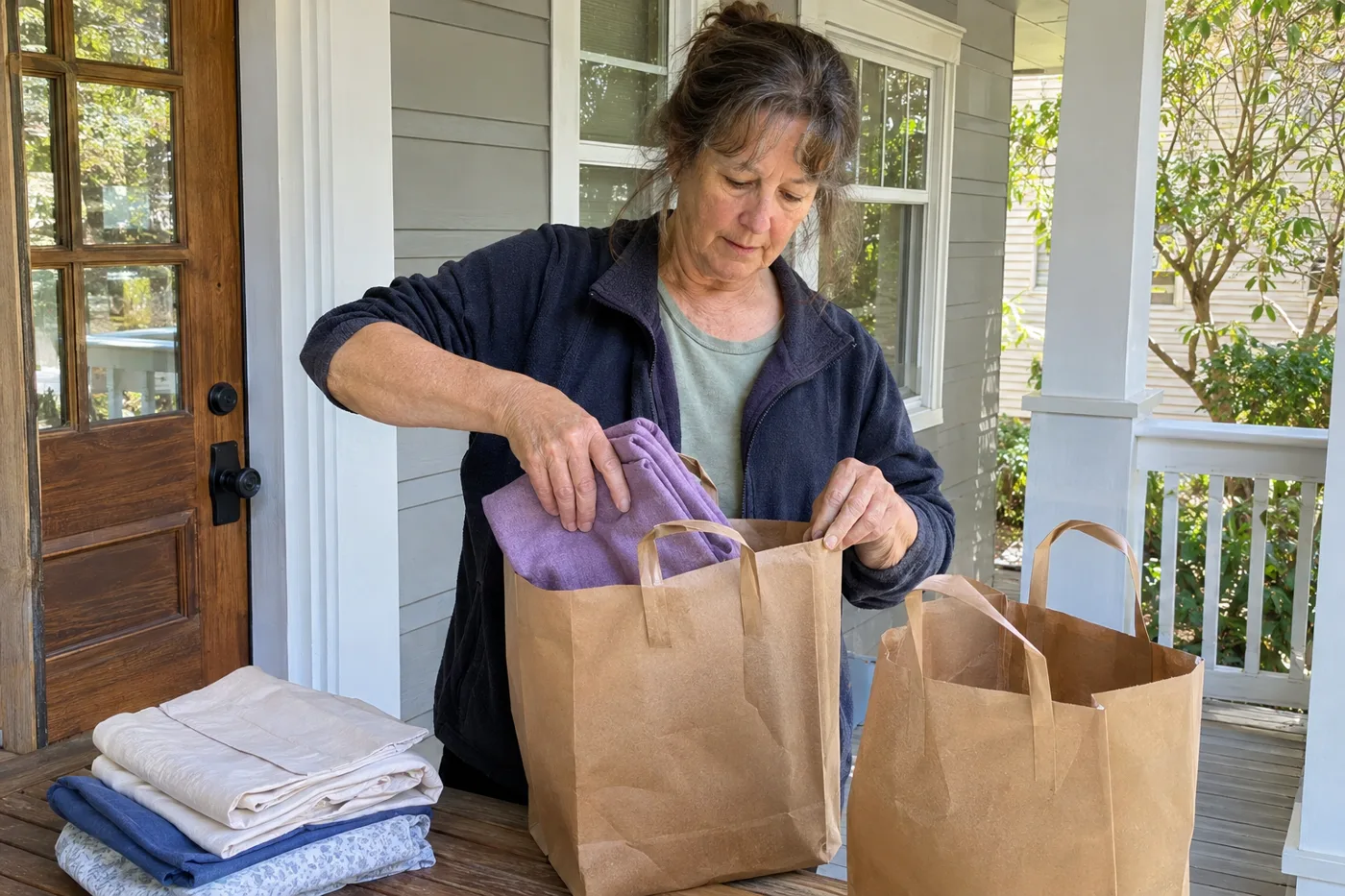
Every shelf in a closet with steady temperature is prime real estate. The fabric you dislike, or the boxes that came to you from someone else’s sewing room, is taking up space your best pieces could be using.
Stephanie Soebbing says in her video that you shouldn’t feel you have to keep fabric you no longer like, and suggests guild charity quilts as a good home for it. Give yourself that permission this week, then fill one grocery bag.
Where it can go:
- Project Linus. Volunteers make new, handmade, washable blankets for seriously ill or traumatized children up to age 18. The national page doesn’t cover fabric donations, so call your local chapter and ask what it can use.
- Creative reuse shops. Connecting Threads lists creative reuse shops around the US, from The Scrap Exchange in Durham, North Carolina, to FabMo in Sunnyvale, California, and SewGreen in Ithaca, New York.
- The places sewists name. In one long Reddit thread about unwanted fabric, people mention community college sewing classes, schools, libraries, nursing homes, animal shelters and local “buy nothing” groups.
Every shop sets its own rules, so check before you load the car. Here’s how one shop, SCRAP Creative Reuse in Portland, Oregon, sorts fabric, as an example only:
| SCRAP Portland takes | SCRAP Portland turns away |
|---|---|
| Pieces at least 1 yard, with selvage | Hemmed pieces, and most pieces under a yard |
| Fat quarters | Fabric with holes, odors or stains |
| Up to 3 grocery bags at drop-in | Anything with pins in it |
One more rule from that shop matters most. SCRAP will reject the whole donation if it finds mildew, mold or pests anywhere in it. So pull any musty piece out of the giveaway bag before it spoils the rest.
#9 The shop light left on over open shelves
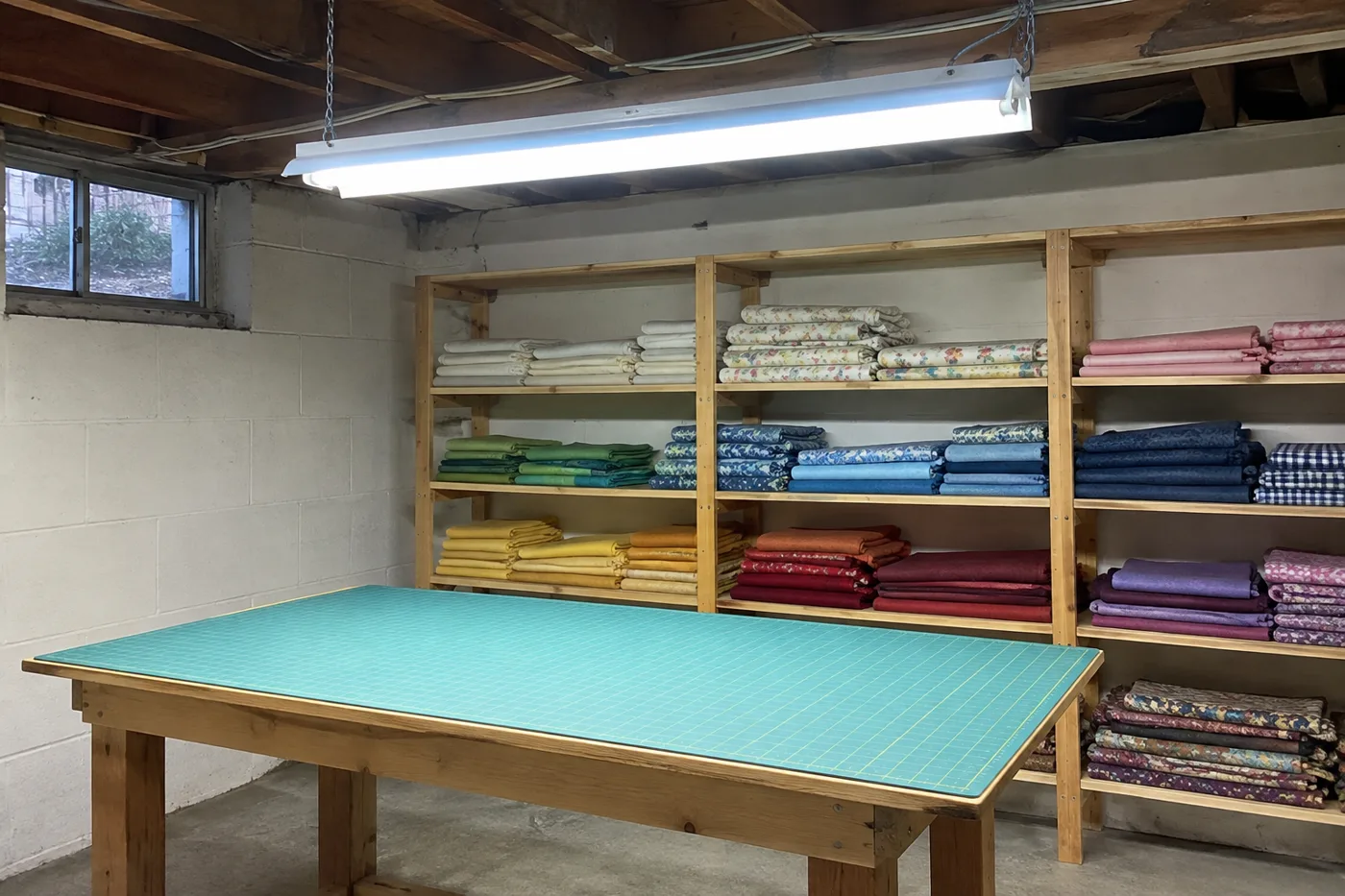
That four-foot fluorescent shop light over the cutting table is shining on more than your mat. The Northeast Document Conservation Center says common fluorescent lamps “emit significant UV radiation,” while LEDs “do not emit UV or IR radiation.” Its advice for storage rooms is to keep the lights off unless someone is in there getting something.
So flip the switch when you leave the room, the same way you’d turn off the iron. Gaylord recommends blackout covers or closed cabinets in storage.
Swapping fluorescent tubes for LEDs cuts the ultraviolet. It doesn’t stop the fading, because ordinary visible light fades most dyes too. Switching the lights off cuts exposure to both UV and visible light.
#8 The number on the bottom of the bin
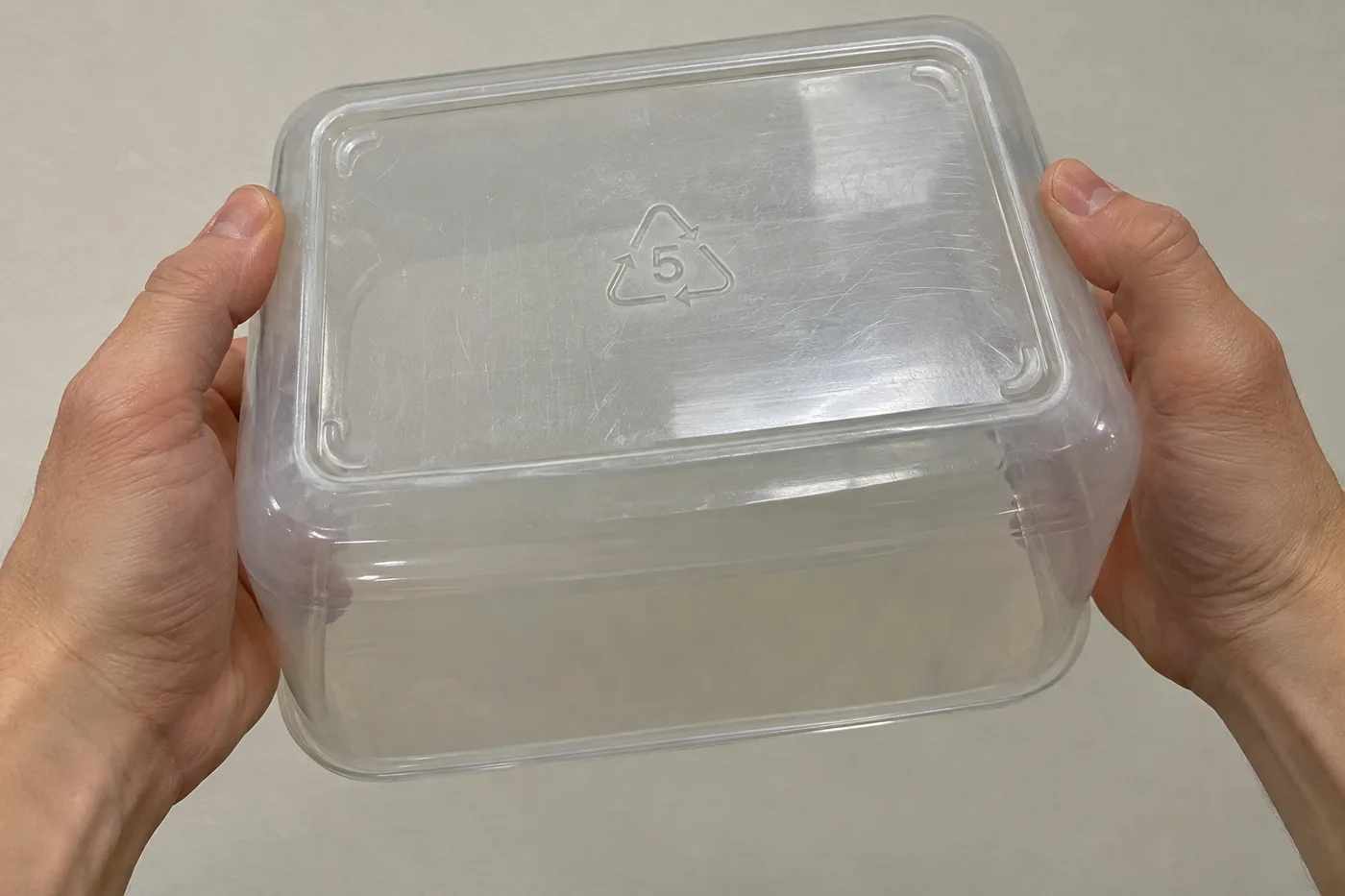
Turn the bin over. Near the middle you’ll usually find a small number inside a triangle of arrows, the recycling code. That number tells you what kind of plastic your fabric has been living in.
It matters because some plastics carry plasticizers. The Canadian Conservation Institute names plasticizers that migrate out of certain plastics, such as PVC, as a hazard to textiles. NC Historic Sites goes further and warns against plastic tote boxes altogether, because their plasticizers “can harm fibers.”
The International Quilt Museum takes a middle road. It accepts bins made of new HDPE (high-density polyethylene) or polypropylene, lined. CCAHA calls polyethylene “chemically inert and very stable.”
Check the bottom of your bin – A 5 means polypropylene (PP). The quilt museum accepts it new and lined. – A 2 means HDPE. Same terms. – PVC gives off hydrochloric acid as it breaks down, according to CCAHA. – No code at all? Line it this week, or move your best fabric to a bin that has one.
The museum means new plastic, not recycled, and the bottom of the bin won’t tell you which you bought. The Association of Plastic Recyclers says the arrows only identify the kind of plastic. Recycled plastic shows up in words on the label or box, such as “post-consumer content” or “made with recycled content.” If the label’s long gone, that’s one more reason the pillowcase lining from #16 is worth doing on every bin, whatever the number says.
Did you know?
The plasticizers in plastic tote boxes can do more than weaken fibers. NC Historic Sites says they can also change dye colors, so a print may not come out of the bin the shade it went in.
#7 The one piece in the stack that smells
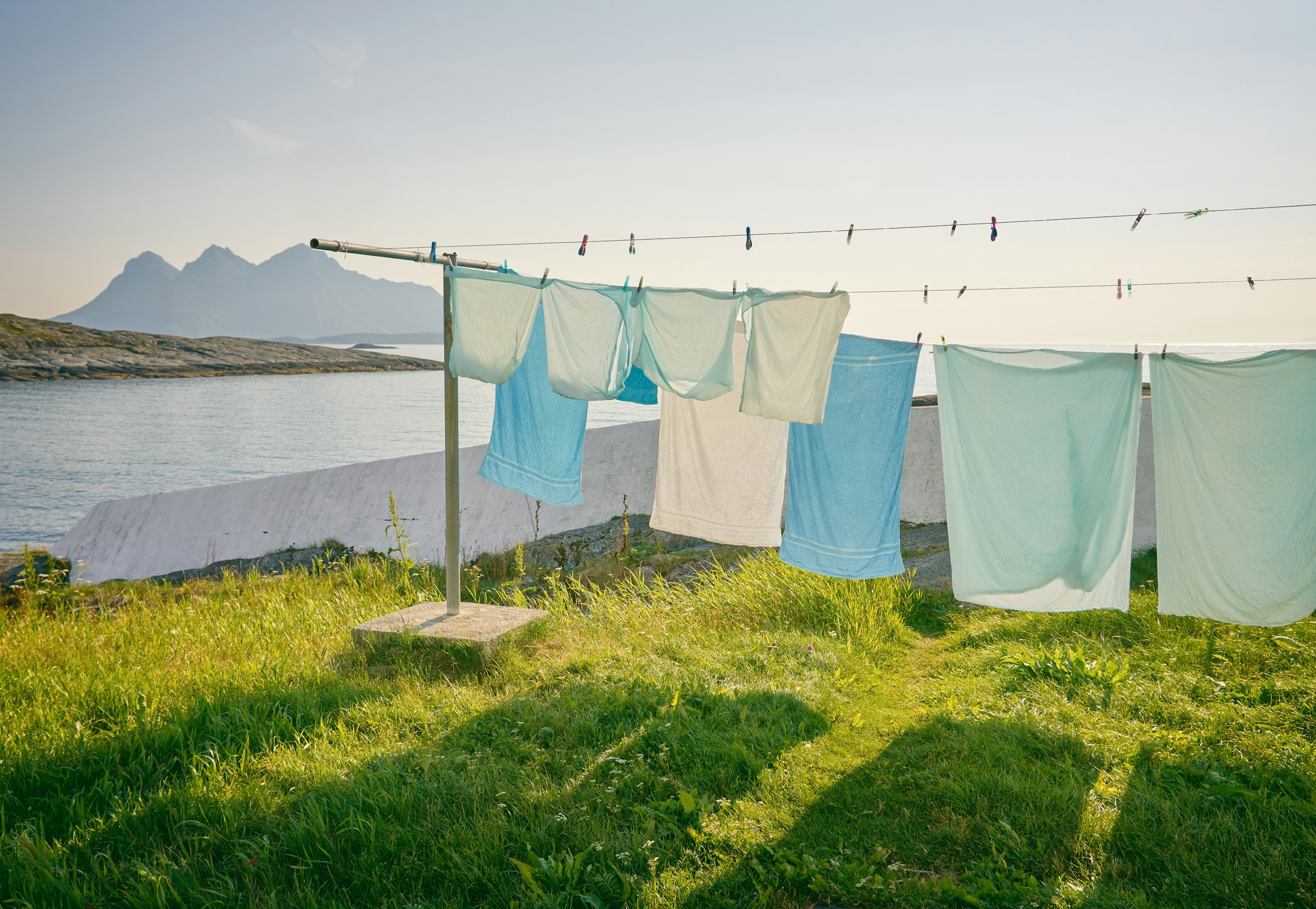
You’re going through a stack and one piece stops you. It smells like a cellar. The others seem fine.
Take that smell seriously. University of Missouri Extension says musty odors indicate mold growth. Mildew develops most often on cotton, linen, rayon, silk, wool, leather, wood and paper. Many synthetic fibers resist mildew.
What to do, in order:
- Lift it out and keep it away from the rest until it’s washed.
- Take it outdoors and brush off any surface growth there.
- “Sun and air fabrics thoroughly,” as Missouri puts it.
- “Wash mildew-stained articles at once.” Don’t put it back in the stack to deal with later.
- If a stain remains, try lemon juice and salt, or a peroxygen bleach, as University of Missouri Extension advises. University of Georgia Extension says to pretest any cleaning agent on a hidden corner for colorfastness first. Never use chlorine bleach on silk, wool or spandex.
Sun fades dyes, so this sounds like it contradicts #14. One airing to rescue a moldy piece is a trade worth making. Leaving it on a sunny shelf for years isn’t.
Then go back for the pieces that were folded against it. Smell each one.
If the musty piece turns out to be a charm pack, wash it anyway. Losing the exact edges is better than putting mold back into the bin.
 You might also like17 Things to Check Before You Sell (or Give Away) an Old Sewing Machine
#6 A forgotten pin in a fold
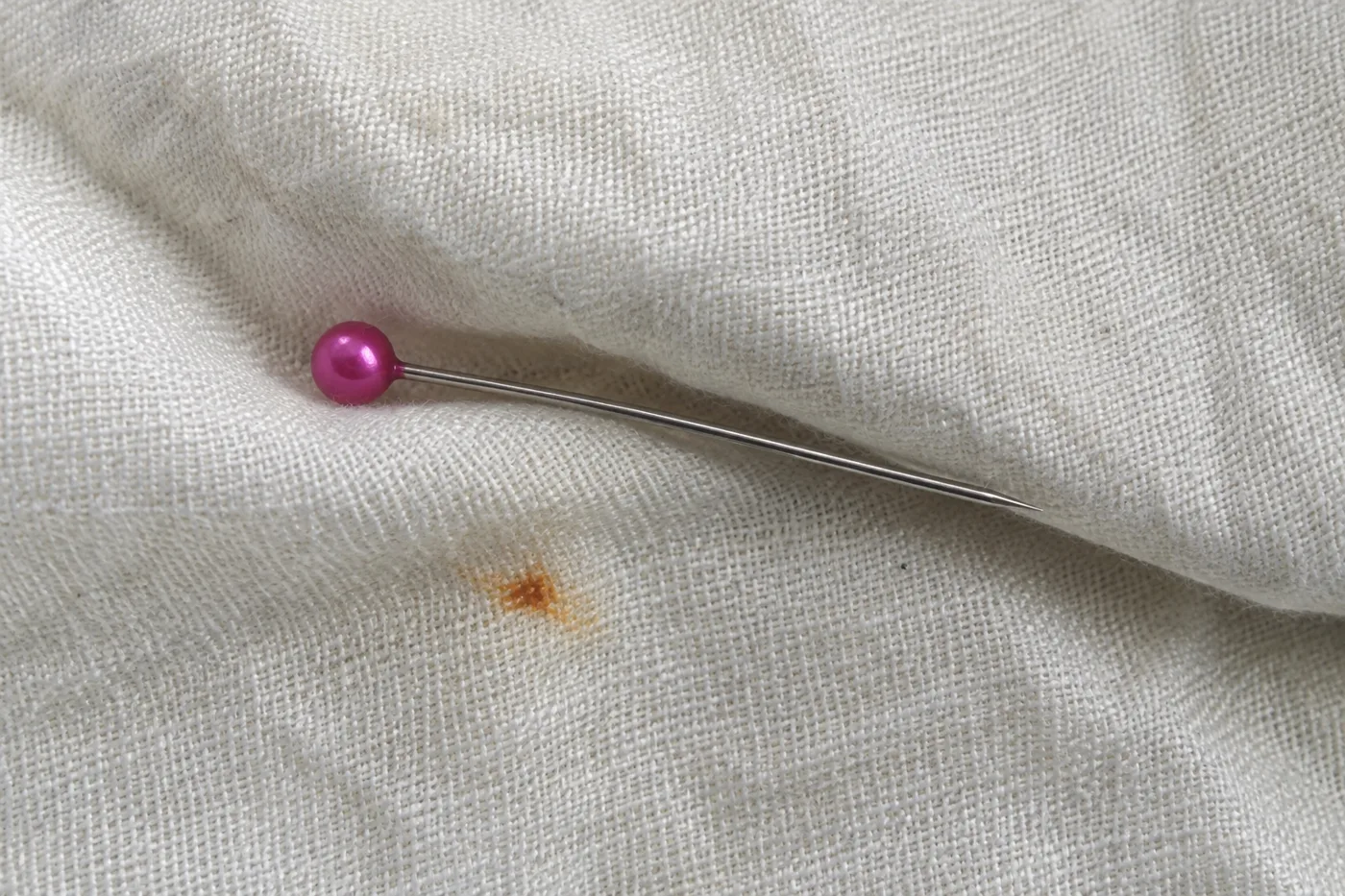
You smooth open a fold you haven’t touched in years and there it is: a straight pin, its head still bright, sitting beside an orange-brown dot the exact length of its shank.
The Canadian Conservation Institute’s advice is blunt: “Remove pins and staples. These put stress on the fabric and are almost certain to rust.” Quilters hear the same thing from each other. A sewist commented on TikTok: “I would change from the metal Bobbie pins to plastic. You might get rust stains.“
So this week, pull the metal out of anything stored for the long haul:
- Pins holding yardage on boards or mini bolts
- A pinned paper note
The institute also says to cover any corroded fastener with acid-free tissue or clean white cotton.
For a rust spot that’s already there, UGA Extension’s first method is this: “Sprinkle salt on the stain, squeeze lemon juice on it and spread in the sun to dry. Rinse thoroughly.” For cottons that can take boiling, they also give a cream of tartar method: 4 teaspoons to 1 pint of water, boiled.
Don’t reach for chlorine bleach. UGA says it sets rust stains. UGA also says to pretest for colorfastness first, so try it on a corner you’d trim off anyway, never on the middle of a piece you love.
#5 The tote in the attic or basement
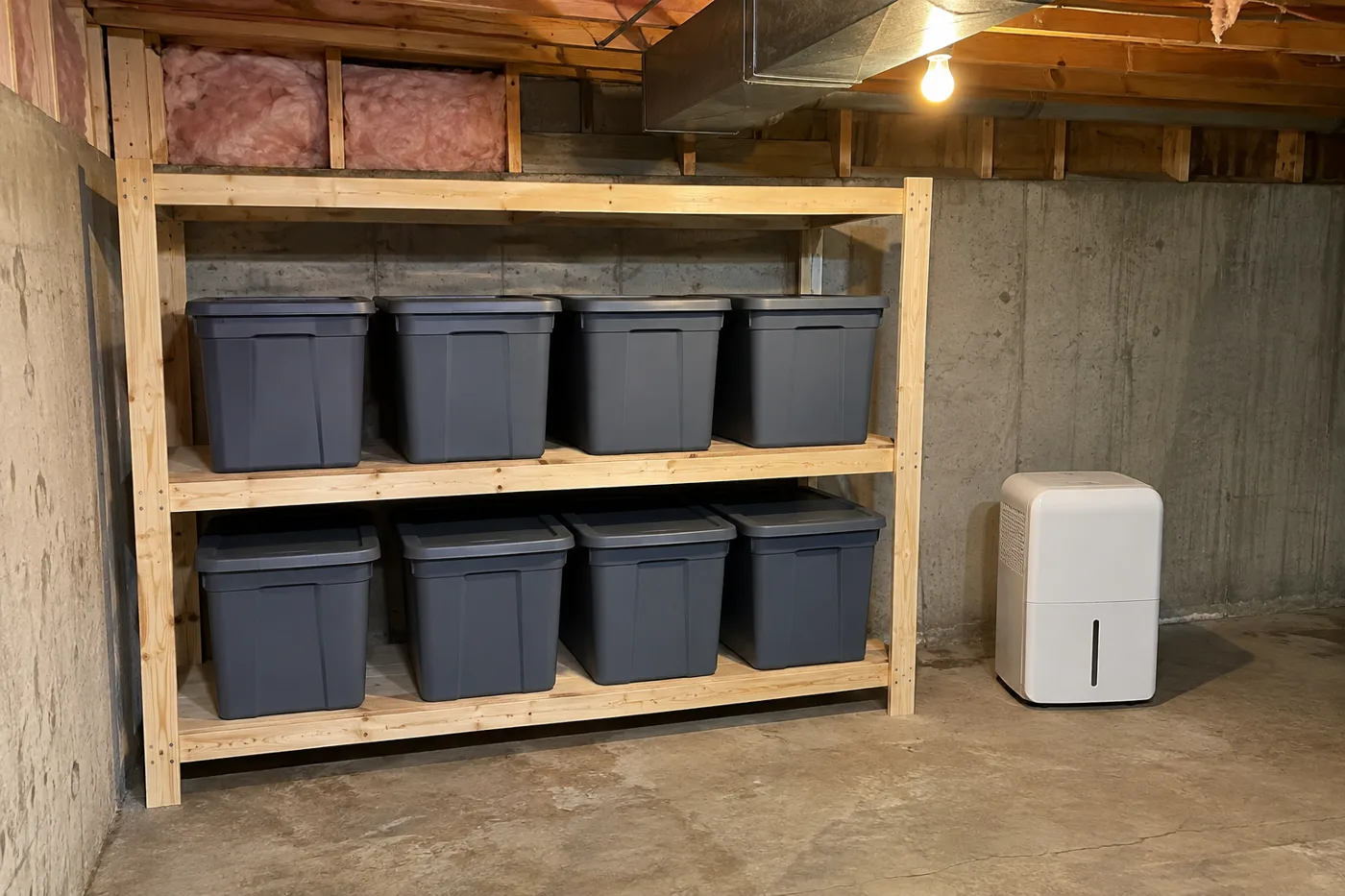
The International Quilt Museum and NC Historic Sites both say to keep fabric out of attics and basements. The museum’s wording is “Avoid attics and basements where fluctuations in temperature and humidity levels may be extreme.” NC Historic Sites says to store textiles in the main part of the house instead.
For storage, the quilt museum aims for 62 to 72°F and 45 to 55 percent relative humidity, the kind of steady air an attic or basement rarely gives you.
Water also gets in from outside. The Census Bureau’s housing survey found that in 2021, 11.4 million of 128.5 million occupied US homes reported water leaking in from outside. That’s roughly 1 home in 11 that year. Missouri Extension notes that musty basement odors mean mold, and recommends a dehumidifier down there.
The fix this week is one tote. Choose the tote holding your best fabric and move it to a closet on the main floor. It’s a start, and you can move the rest later.
If the basement is the only room you have for storing fabric, make it as safe as you can:
- Run a dehumidifier.
- Keep every bin up on shelving.
- Cover the shelves with a cotton sheet and lay plastic sheeting over the cotton. The Canadian Conservation Institute uses that combination because “the plastic sheeting will also protect from water leaks.”
#4 Yardage folded on the same lines for years
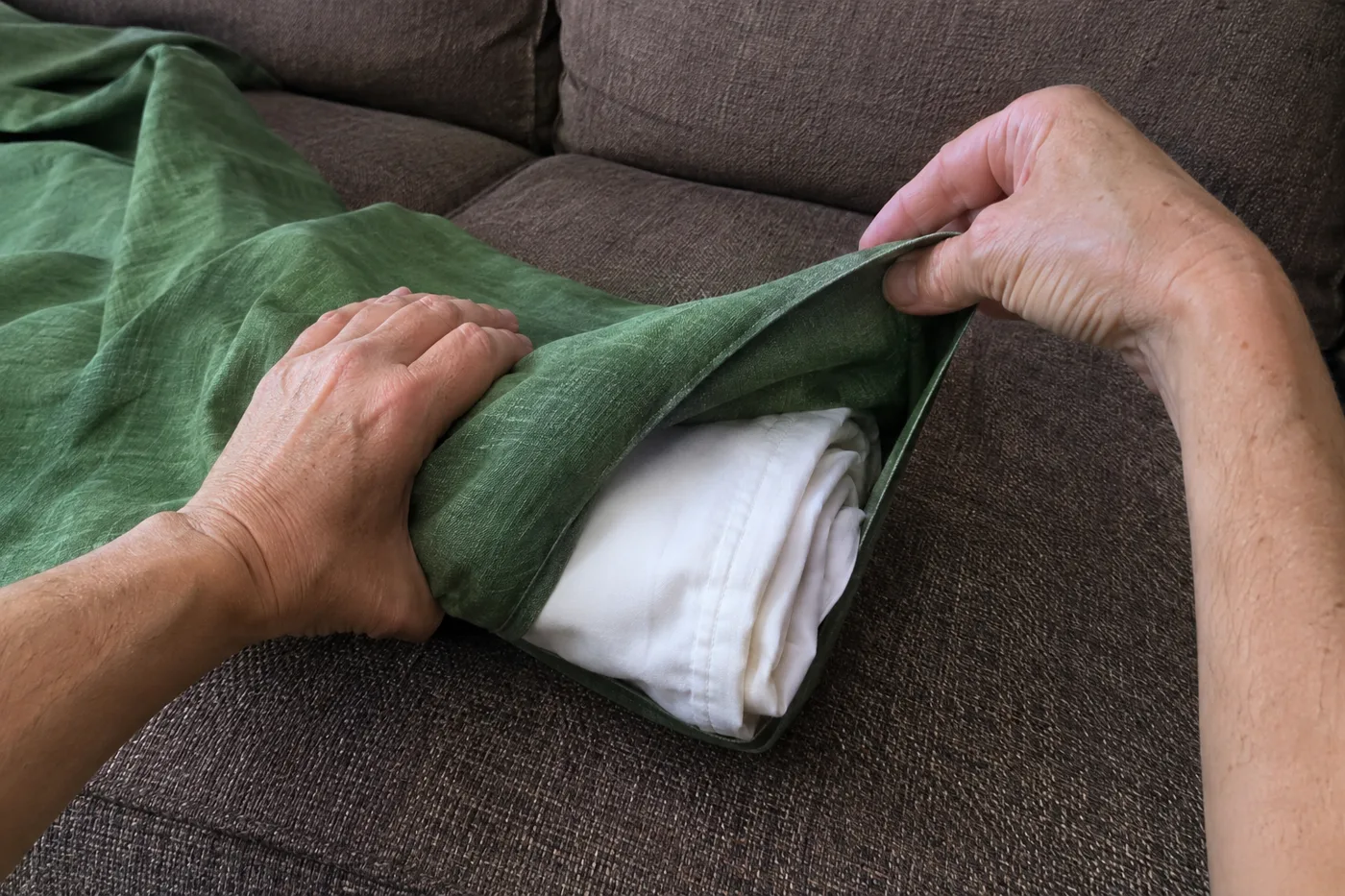
Every fold is a hinge, and a hinge that never moves wears through in one place.
The antiques appraiser Dr. Lori Verderame tells quilt owners exactly what to do: “I’d like you to refold your quilt in a different way.” The International Quilt Museum refolds the quilts in its own collection every two years along new lines each time. For home storage it says to “Refold periodically to minimize the chance of permanent creases and fold lines.”
The reason is in the fibers. Studio Art Quilt Associates, a professional group for quilt artists, says folds put stress on fabric “which can lead to breakage in the fibers along the creases.” The Canadian Conservation Institute warns that sharp creases “have the potential to fracture.”
That changes how you handle an old crease that won’t press out, like the center fold from a bolt you bought years ago. A line that has already weakened may not fully recover. Plan to put that line at a seam or cut around it, and protect the rest of the piece from getting the same mark.
To refold yardage:
- Fold along new lines, moving the old crease off to one side.
- Pad the folds. Gaylord pads them with rolled acid-free tissue or polyester batting covered in muslin, which you can make from batting scraps and muslin already in your sewing room. A rolled-up washed pillowcase does the same job; that’s our suggestion.
- Tuck the raw edges inside the fold so they aren’t poking out.
- Keep stacks low. The Canadian Conservation Institute says, “If possible, limit the stacking of textiles.”
Your twice-a-year stash check (our routine) – Refold each piece along new lines. – Sniff each bin as you open it. – Inspect seams, folds and creases closely. – Turn each stack so a different edge faces out.
#3 Cedar chests and blocks against your cotton
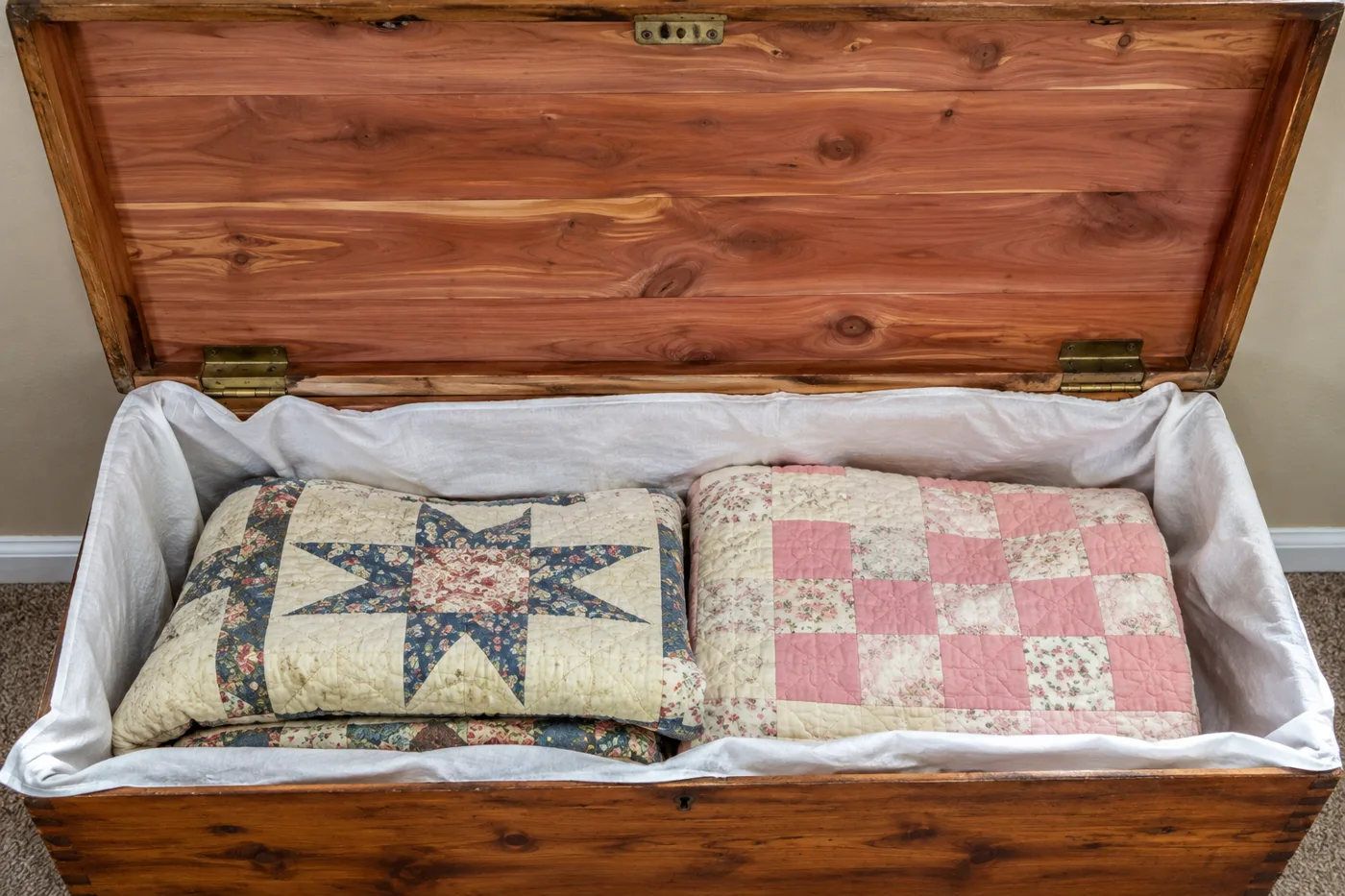
“Cedar will repel bugs, the quilt will suck up just like a sponge the smell of the cedar.” Dr. Lori, antiques appraiser, in her video on quilt storage
Dr. Lori doesn’t want quilts kept in cedar, and the smell is the smaller problem. The bigger one is the wood itself. The International Quilt Museum says “woods of any type release volatile, acidic oils that yellow and weaken textiles.” NC Historic Sites says to avoid direct contact with cedar chests. Gaylord calls cedar chests “generally ineffective” and unsuitable for textiles because wood is acidic.
The protection people expect from cedar is thinner than the scent suggests. UC IPM, the University of California’s pest program, says eastern red cedar oil “can kill small larvae, but it doesn’t affect large larvae,” and that cedar loses this effect after several years. Utah State Extension adds that it’s difficult to keep the scent strong enough over time.
The museum, extension and archival sources we read say little in cedar’s favor. The best any of them says for it is that it kills small larvae while the oil is fresh. UC IPM’s conclusion is the one to remember: “Having a tightly constructed chest is more important in the long run than the type of wood used to make it.”
How to decide:
- Keep the chest if you love it. Line the chest with cotton or tissue so no fabric touches the wood, as the museum advises.
- Pull the cedar blocks out of your cotton stacks. They put acidic wood right against the fabric and do little else for it.
Did you know?
Virginia Tech’s insect identification lab warns: “Do not apply cedar oil directly to items or it may stain them.” That matters if you’ve ever refreshed a block with oil and tucked it straight back between your fabric.
#2 Mothballs tucked in with the fabric
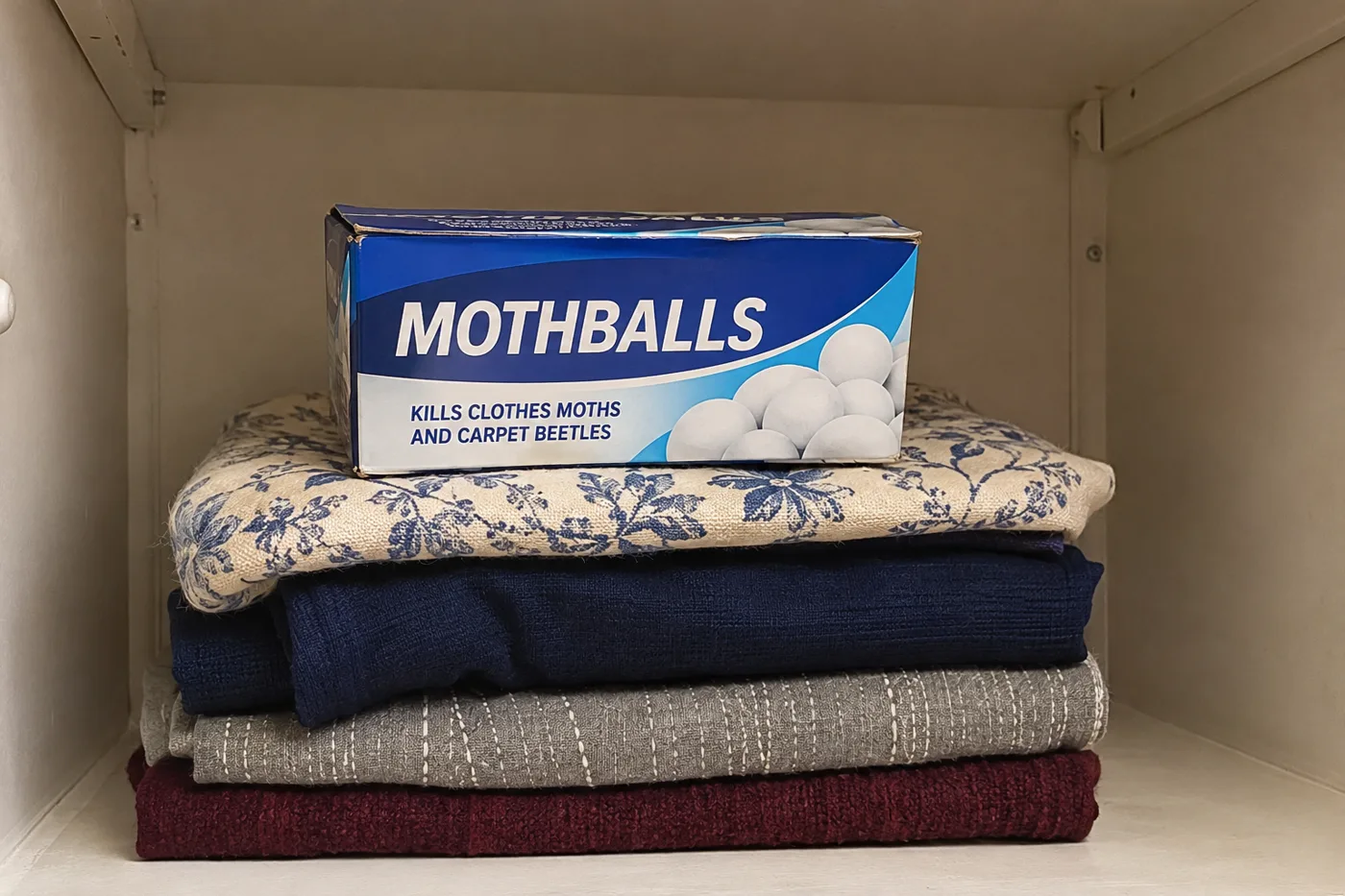
When you smell mothballs, you are inhaling the insecticide. The National Pesticide Information Center says mothballs are “nearly 100% active ingredient,” and that they “slowly turn from solids to toxic vapor.”
UC IPM says the vapors build up to the required concentration only in an airtight container. Outside one, larvae “continue to feed.”
The same source has a surprise for anyone who uses plastic bins and bags. Mothball products can make plastic “soften and melt into the fabric.” So a handful of mothballs dropped into a tote can damage the very fabric they were meant to protect.
Gaylord says mothballs “are hazardous to your health,” and the pesticide center reports that clothing stored in mothballs without being washed afterwards has caused anemia in infants. So wash anything headed for a baby quilt before you sew it.
This week, take the mothballs out, and take unused ones to your local household hazardous waste program, as Poison Control advises. Hang or spread the fabric outdoors to air, as Virginia Tech advises for getting rid of the smell. Then move straight on to #1, which protects the stash without any of this.
#1 Bugs in the bins nobody opens
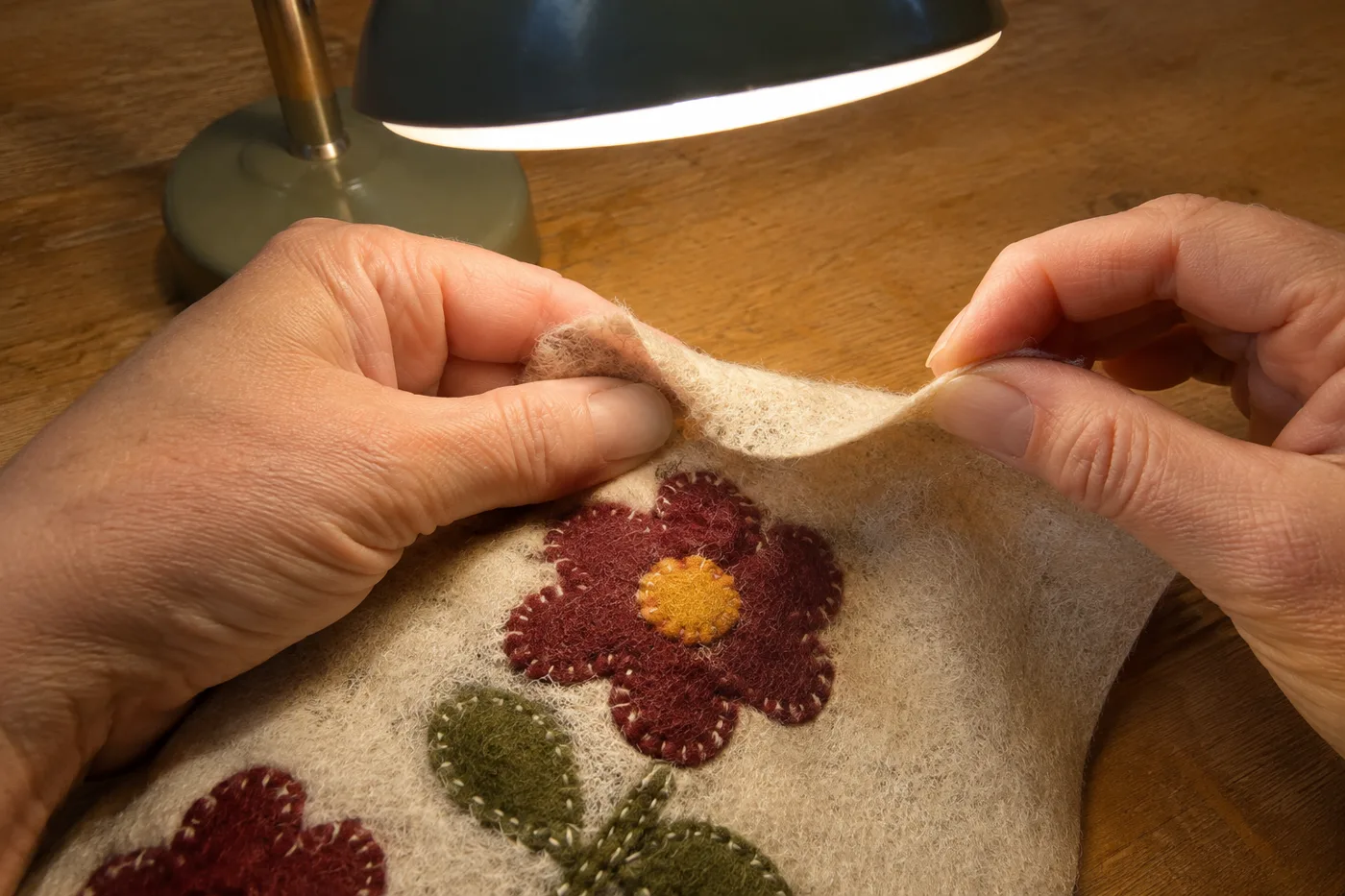
Here’s the good news: moths rarely eat plain cotton. Michael F. Potter, an extension entomologist at the University of Kentucky, says clothes moth larvae feed mainly on wool, fur, silk, feathers, felt and leather. Cotton and synthetics “are rarely attacked, unless blended with wool or heavily soiled.”
So the shelf of quilting cotton is mostly safe. The places to check are the pieces you might forget:
- Wool felt for appliqué and wool batting
- Silk ties you’re saving for a memory quilt
- Wool sweaters set aside for felting
- Stained or heavily soiled cotton
That last one matters. UC IPM says stained fabrics are more likely to be damaged. Clean fabric attracts fewer insects than soiled fabric, so the habit that protects the whole stash is putting fabric away clean.
Silverfish are a separate concern. Clemson’s home and garden center lists their foods as “glue, wallpaper paste, starch in clothing, book bindings, linen, rayon, paper,” and says they “prefer damp, cool areas.”
How to tell who’s been in the bin:
| Pest | What it goes for | What it leaves |
|---|---|---|
| Clothes moth | Wool, silk, felt, fur, feathers | Threadbare spots, silky webbing or tubes, a small cigar-shaped case about 3/8 inch long, tiny pellets |
| Carpet beetle | Wool and other animal fibers | Holes chewed right through |
| Silverfish | Starch, linen, rayon, paper | Irregular chewed patches, usually somewhere damp and cool |
This week, open the bins you never open and look closely along seams, folds and creases, where Potter says to check.
If you find a suspect piece, freeze it. Here’s Potter’s method:
- Seal the piece in a plastic bag.
- Hold it at 0°F or colder for at least a week.
- Let it come back to room temperature, about 24 hours, before you unwrap it.
Then shake and brush it, and put it back clean.
Keep reading
 15 Things Hiding in Grandma’s Sewing Box That Could Be Worth Real MoneySee all 15 →
More you’ll enjoy
 17 Sewing Room Gadgets Most ’60s and ’70s Moms Had
 17 Old Needlework Skills You Inherited But Never Learned
 17 Quilting Mistakes Even Experienced Quilters Still Make
The bottom line
Pick the tote you’ve gone longest without opening. Lift the lid, and before you look at anything, breathe in. A musty smell is a sign of mold, and that’s your cue for #7.
Nearly every kind of damage here grows during the years when nobody lifts the lid. Mold, moth larvae and fading all work quietly.
So think about the piece you’ve been saving for a quilt good enough to deserve it. How many years has it been folded the same way, in the same bin? It might be time to take it out and cut it.
Bonus: four habits for fabric that isn’t in a bin yet
- Take new fabric out of the shop bag the day it comes home. A plastic bag traps condensation the same way a sealed tote does, and bags are where fabric gets forgotten.
- Keep fabric from an estate sale, a thrift store or someone else’s sewing room bagged and apart from your stash until you’ve looked through every fold. The Canadian Conservation Institute advises quarantining incoming textiles.
- If you keep wool or silk, set a pheromone glue trap nearby. Kentucky’s entomologist says the traps can catch early infestations that are hard to see.
- If you hang yardage, borrow the institute’s rules for hanging costumes: pad the hanger so the weight spreads, skip thin wire hangers, don’t hang knits or bias cuts, and keep pieces at least 4 inches (10 cm) apart under a cotton sheet. They were written for costumes, and we’re applying them to yardage.
Questions people also ask
Is it bad to store fabric in plastic bins?
It can be, because sealed plastic traps condensation that leads to mold and mildew. The International Quilt Museum still accepts new HDPE or polypropylene bins, as long as they’re lined against moisture. Put fabric in only when it’s completely dry, line the bin with washed cotton, and add silica gel packets, which University of Missouri Extension says absorb moisture in closed spaces.
Can you store fabric in cardboard boxes?
Only with a barrier, because cardboard can yellow fabric. Gaylord lists cardboard among household materials that damage textiles, and NC Historic Sites calls lignin the acid-producing agent in wood pulp, an acid that causes textiles to yellow. If you use a box, line every wall the fabric touches with a washed pillowcase or sheet (our suggestion). Gaylord advises lining any box, whatever its material, with acid-free tissue.
How do you get old fold lines out of stored fabric?
Sometimes they won’t. The Canadian Conservation Institute warns that sharp creases “have the potential to fracture,” so a line that has already weakened may not fully recover. To keep new ones from forming, refold along different lines from time to time, as the International Quilt Museum does, and pad the folds.
How do you keep moths and bugs out of a fabric stash?
Store fabric clean and check the folds regularly. Clothes moths go mainly for wool, silk and felt and rarely attack plain cotton unless it’s soiled or blended with wool. If you suspect a piece, seal it in plastic and freeze it at 0°F or colder for at least a week, then let it warm up for about a day before unwrapping.
Should you wash fabric before you store it?
Store it clean, because the Canadian Conservation Institute says textiles should be clean when stored and dirt attracts insects. Whether to pre-wash quilting cotton is your choice, but the National Quilters Circle rule is to wash every piece for a quilt or none of them. Mark the washed ones so you can tell later, and don’t pre-wash precuts.
Where can I donate fabric I don’t want?
Project Linus volunteers make blankets for children, so ask your local chapter whether it can use fabric. Creative reuse shops often take fabric but set their own rules, and Connecting Threads lists such shops around the US. Expect conditions: SCRAP in Portland, for example, turns away fabric that is musty, stained or pinned.