Hexagon gardens, feed sack Dresden Plates, folded Cathedral Windows and tied double knit: find the quilts you grew up under, then make a pillow-size version this week.
Stay for #1, a 1934 pattern so rarely sewn that researchers have found about two quilts from its day.
It’s folded over the end of a bed in a room nobody uses much, and the green paths between the hexagons have gone soft as an old dish towel. You’ve seen one like it all your life. Maybe you slept under one. Nobody ever told you what it was called.
These are old quilt patterns and styles you may remember from the beds of your childhood. Every one of them had a name. Some had five.
#17 Grandmother’s Flower Garden hexagons
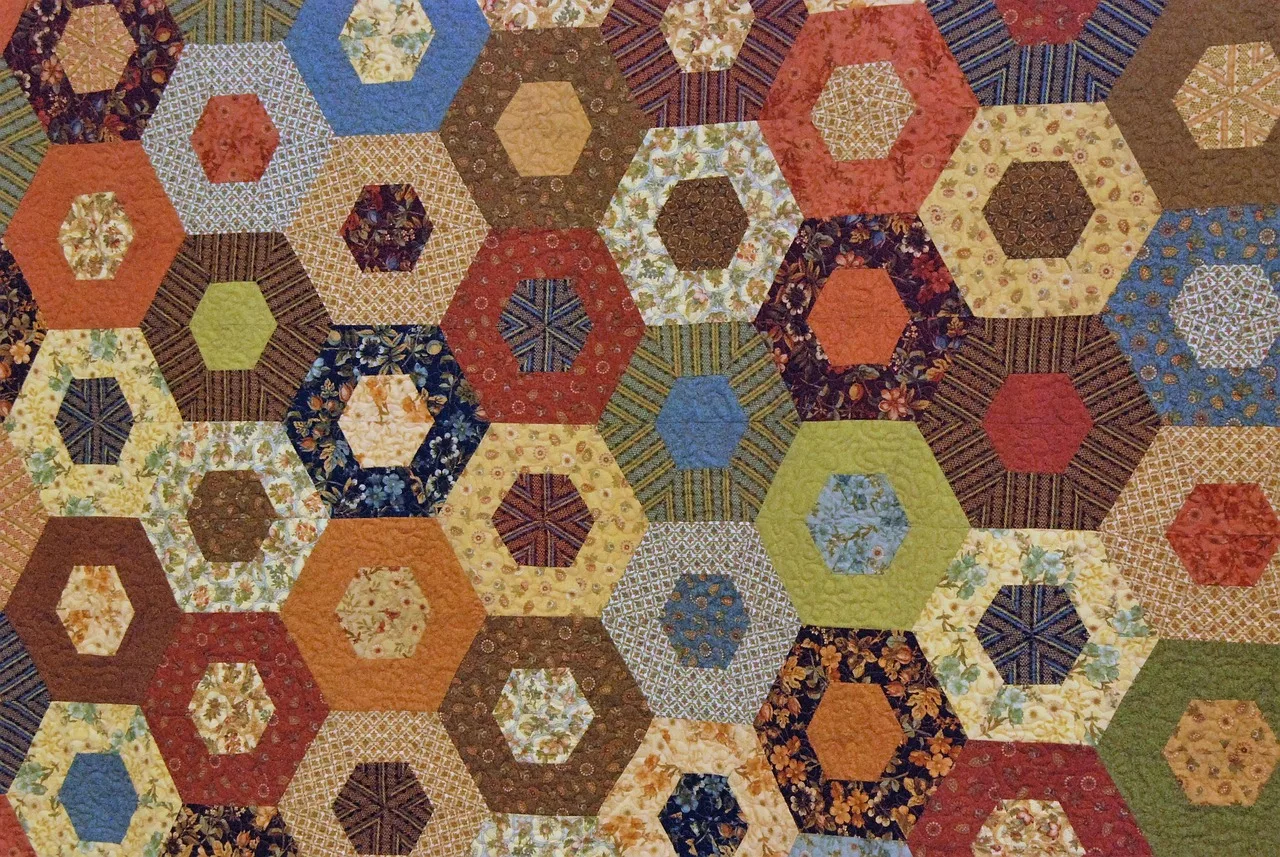
Yellow centers, pink petals and green paths winding between the flowers: if that’s the quilt you remember, it may be a 1930s Grandmother’s Flower Garden. Kris Driessen, a retired quilt appraiser, notes that 1930s quilts often have those colors. Pastel calicoes and feed sack prints point to the 1920s through the 1940s.
The hexagon itself is much older. Researchers have found a hexagon quilt made in England in 1770, and Godey’s printed paper-piecing directions in 1835. But the grandmother name belongs to the 1930s craze. The same quilt also went by Honeycomb, Mosaic and, from 1880 to 1940, Martha Washington’s Flower Garden. Sears, Roebuck sold precut kits for it.
Turn one over if you can. Tiny pinholes and little whipstitches along the seams point to English paper piecing. If the papers are still inside, whatever’s printed on them can date the quilt.
Carrie Stelzer of Geneva, Nebraska, spent 1931 to 1934 making one for her daughter from leftover dressmaking scraps. The International Quilt Museum says it was “conceived in thrift” and kept as an heirloom anyway. Hexagon quilts come up again and again on TikTok and Reddit as a grandmother’s or great-grandmother’s from the 1950s, sometimes worn thin from use.
To make one this week, Paper Pieces in Paducah, Kentucky, offers a free PDF for a single-ring Grandmother’s Flower Garden and sells the papers precut, so the fussiest step is done before you start. One flower, with a yellow center and pink petals from your scrap bin, makes a pillow front, and you can stitch it onto a plain square by machine. The hexagons themselves are handwork, the kind that suits an evening in a good chair.
If you have an unfinished hexagon quilt top that has gone puffy and uneven, Matt, a longarm quilter, presses old hand-pieced tops with light starch before he machine quilts them. “As the starch dries, it will actually shrink the fabric some and take in some of that fullness,” he explains in a TikTok video.
#16 Sunbonnet Sue and Overall Sam
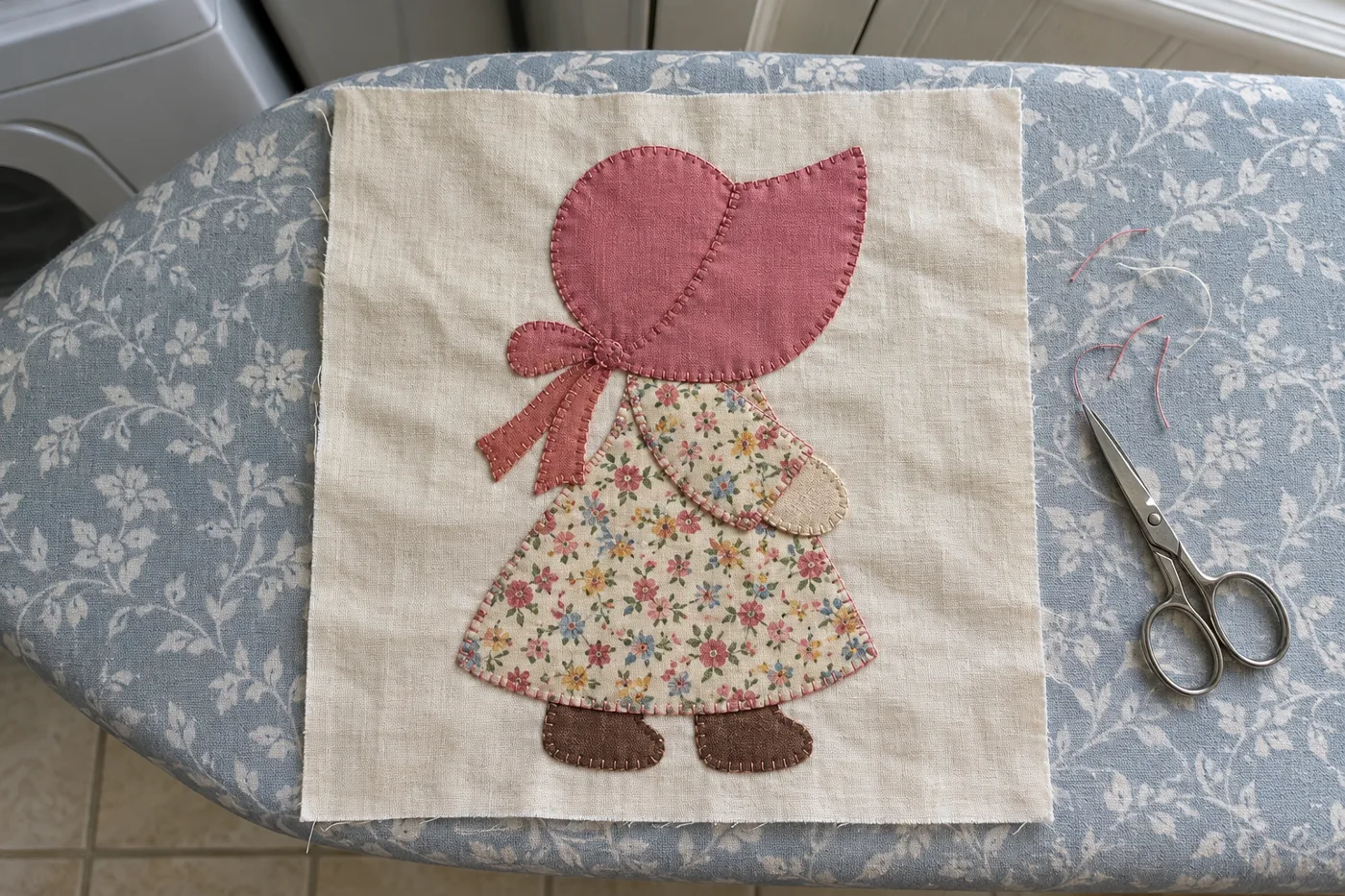
In 1979, a group of Lawrence, Kansas, quilters calling themselves the Seamsters Union Local #500 made a quilt called “The Sun Sets on Sunbonnet Sue.” In the quilt, Sue is killed off in different ways. In one block, she dies at Three Mile Island. The quilt now belongs to the Michigan State University Museum.
Sue came to stand for “female innocence and docility,” and critics later called her “insipid” and “over simplified to the point of being just plain dumb.”
She started as a drawing. Bertha Corbett, later Melcher, born in 1872, set up an illustration studio in Minneapolis in the late 1890s and drew the Sunbonnet Babies. Their book came out in 1900. “The babies were a hit from the very beginning,” historian Moira F. Harris has written. Quilters turned her drawings into blocks, and the Ladies Art Company was selling Sue appliqué patterns in the very early 1900s. Melcher never designed the quilt.
Her partner came from Melcher’s 1905 Overall Boys. He went by Overall Bill, Overall Andy, Sunbonnet Sam and other names. In the South, Sue herself often went by Dutch Doll until the 1970s.
Dr. Lori, an antiques appraiser, points to Sue as one of the motifs that, along with printed fabrics and brighter colors, mark a quilt from around the 1940s.
The quick way now is fusible appliqué. Trace Sue onto the paper side of HeatnBond Lite, a paper-backed iron-on fusible you can sew through. Fuse a calico scrap for her dress and a solid for the bonnet, then run a machine buttonhole or zigzag around every edge. One Sue on a square is a pillow. Whether she survives the week is up to you.
#15 Dresden Plate in feed sack prints
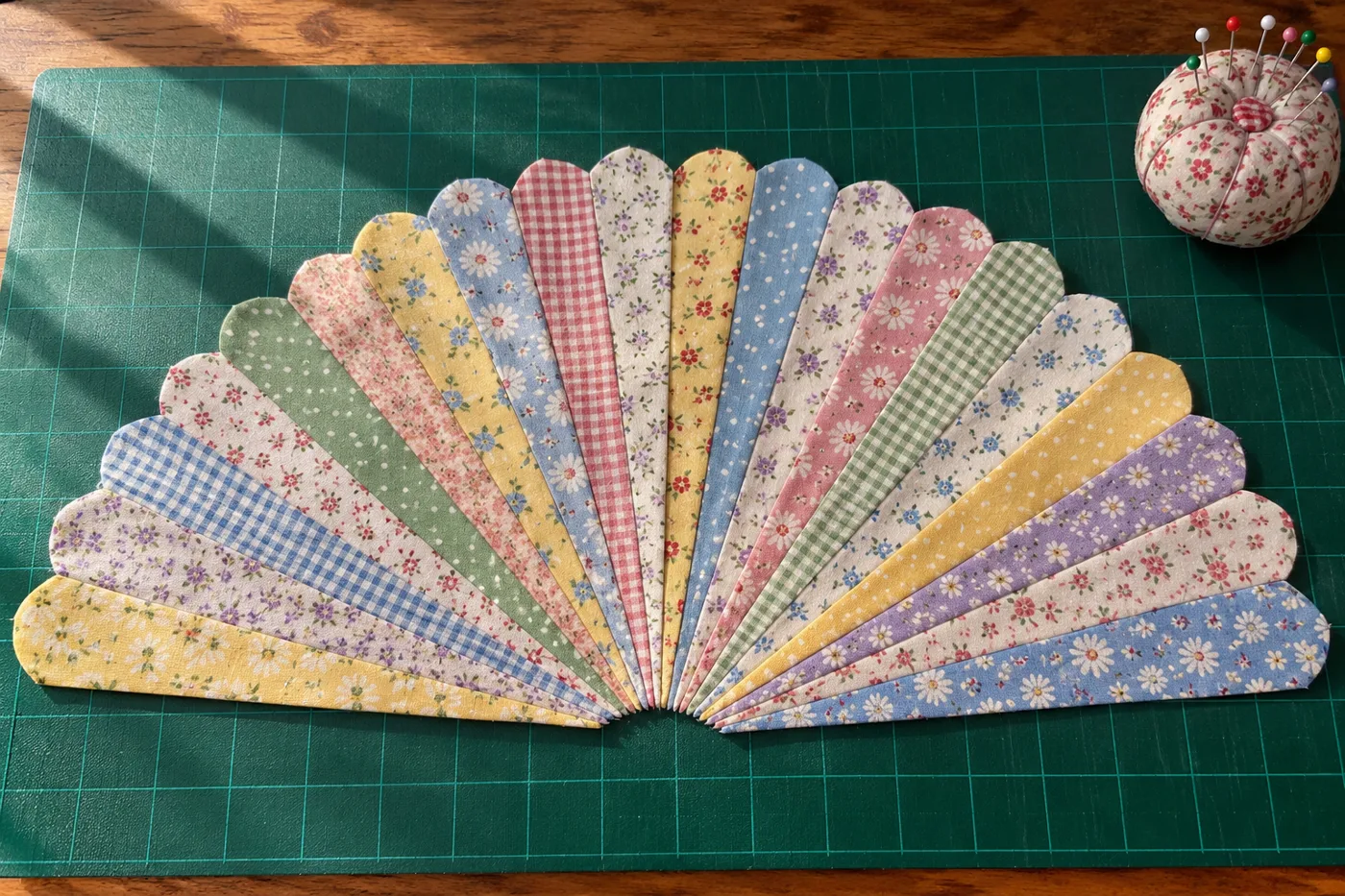
Before you pay extra for a “1930s feedsack” Dresden Plate, check the fabric edges where you can. A real feed sack usually shows a row of small, evenly spaced holes left by the chain stitching that closed the sack. QuiltHistory.com warns that many quilts sold as feedsack aren’t, and that a quilt is only as old as its newest fabric.
The Dresden Plate was one of the signature styles of the 1930s, right alongside the Flower Garden and Sunbonnet Sue. Anne Orr, needlework editor at Good Housekeeping for more than 20 years, designed a “Dresden I” quilt kit in 1932.
Printed sacks peaked during and just after WWII. A cotton sack cost 32 cents to make, against 10 cents for a paper bag, and by 1948 paper and plastic held more than half the bag market.
The prints never left people’s memories. On Reddit, quilters match prints in thrifted scraps to a great-grandmother’s 1924 quilt and wish somebody would bring them back. Somebody has: Moda’s “30’s Playtime” reproduction prints, credited to designer Linzee McCray, sell for about $12.48 a yard at Fat Quarter Shop.
For the shortcut, use the EZ Dresden, an 18-degree ruler, so 20 wedges close a full circle. Cut 20 wedges from 20 different prints, sew them into a ring, turn the outer points, and machine-stitch the plate onto a background square for a pillow. Bobkat Quilts listed the ruler with a wooden creaser at $12.50, but it was out of stock when we checked, so look around.
Did you know?
By 1942, published research estimated that three million women and children were wearing clothes made from printed feed sacks, according to QuiltHistory.com’s feed sack history.
#14 Yo-yo coverlets of gathered circles
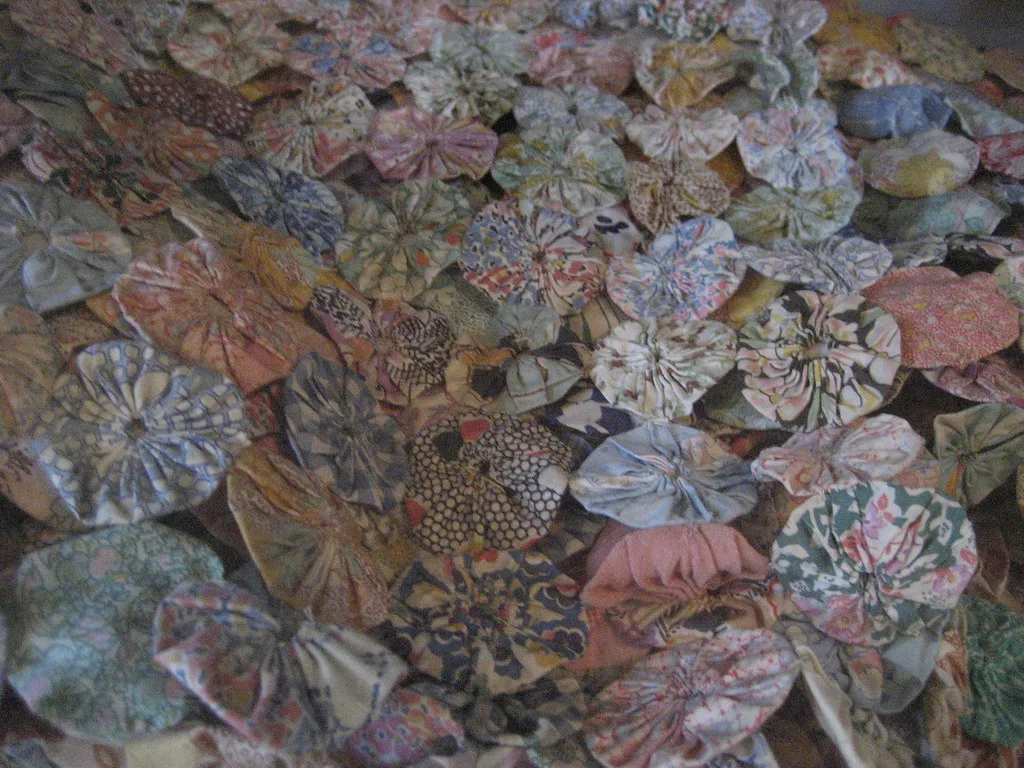
Here’s one to start an argument at guild: “Yo-yo quilts are not really quilts at all,” a quilting blogger points out. A yo-yo quilt has no batting, no backing and no quilting stitches. It’s just circles of fabric, gathered.
The earliest known ones date to the 1920s. By the 1930s, patterns were running in the women’s pages of weekly papers and kits were for sale. They suited the Depression because they needed only scraps, a circle template, a needle and thread, and you could carry the work anywhere.
This week, start with a Clover Quick Yo-Yo Maker. The same blogger started with 4-inch squares on the Large maker.
Pick your yo-yo size – Extra Small finishes at 0.75″ and Small at 1.25″ – Large finishes at 1.75″ and Extra Large at 2⅜” – Jumbo finishes at 3.5″ – 36 Large yo-yos make a square about 10″ across, and each maker runs about $4.99 to $7.99 at Moore’s Sewing
#13 Double Wedding Ring
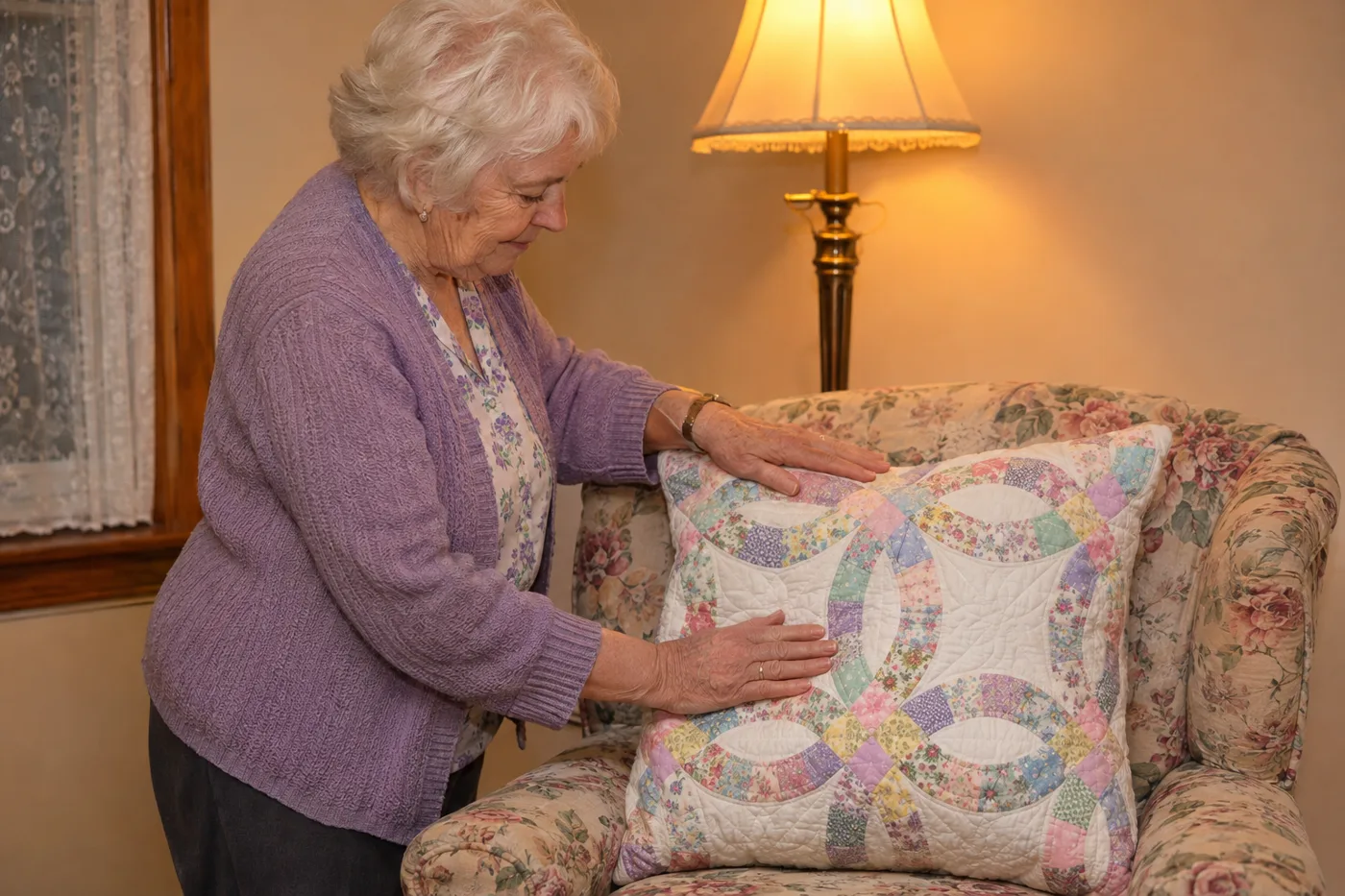
Every family seemed to know which woman would take on a Double Wedding Ring, and it was usually said with some awe. The pattern was first illustrated in Capper’s Weekly on October 20, 1928, according to quilt historian Barbara Brackman, citing researcher Wilene Smith. Of 1,579 Double Wedding Ring quilts on the Quilt Index, an online archive of quilts, most use the 1930s look: pastel arcs on white.
By 1932, Virginia Snow Studio’s catalog offered precut patches for it. Kits, the International Quilt Museum says, “saved the maker the time needed for tracing around templates and cutting out each design unit.”
Today’s shortcut skips curved seams entirely. Quiltsmart’s printed interfacing method uses 2½-inch strips and a machine zigzag to appliqué the arcs, which the company sums up as “No curved piecing, no needle turning!” Blocks finish at 11½ inches.
Start with the free pillow project on their site before you buy anything bigger. Instructions alone are $16, a twin pack of eight panels is $52 and the queen and king pack is $105. Pastel reproduction prints for the arcs and a white background give you the look most of those quilts share.
 You might also like15 Checks That Tell You What an Old Quilt Is Really Worth
#12 Tulip appliqué and the vanished green
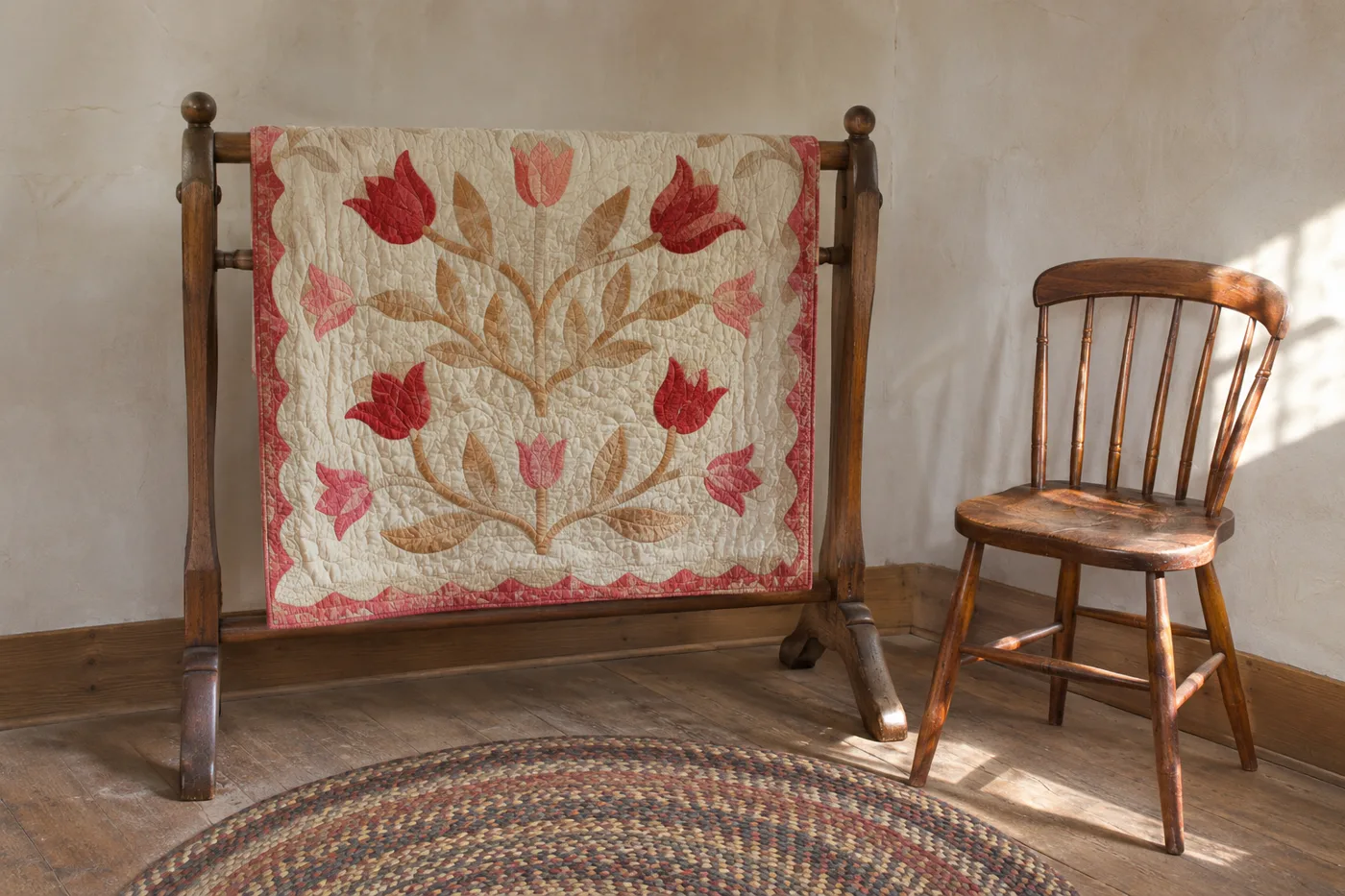
You’ve probably stood over one of those antique quilts and wondered why anybody would make tan leaves. Some of those leaves were once green. “The yellowish fabric probably used to be green, but the blue dye was fugitive,” a quilter answering an heirloom-quilt question on Reddit’s r/quilting wrote. Fugitive means the dye didn’t stay put.
Old greens took two dyes. Early on, cloth was dyed yellow and then blue; later, blue and then yellow. Green dyes were fugitive, which is why QuiltHistory.com notes that “faded blue or tan leaves may once have been green.”
Marie Webster offered “May Tulips” in her 1931 catalog, Quilts and Spreads, in pink and lavender, yellow and lavender, or two shades of one color. Needlecraft Magazine later in 1931 offered a stamped kit on unbleached muslin for $3.65 (twin) or $3.90 (full). Dr. Lori once looked at a 1938 tulip quilt in which every block was signed by the woman who quilted it. “Tulips are the symbol of prosperity,” she says.
This week, use the same paper-backed fusible as Sue. Cut one tulip and two leaves, fuse them to unbleached muslin the way the May Tulips kit came, and stitch the edges by machine. Three blocks in a row make a table runner. Pick your greenest green, and write the year on the back for whoever wonders about the leaves someday.
#11 State flower and state bird blocks
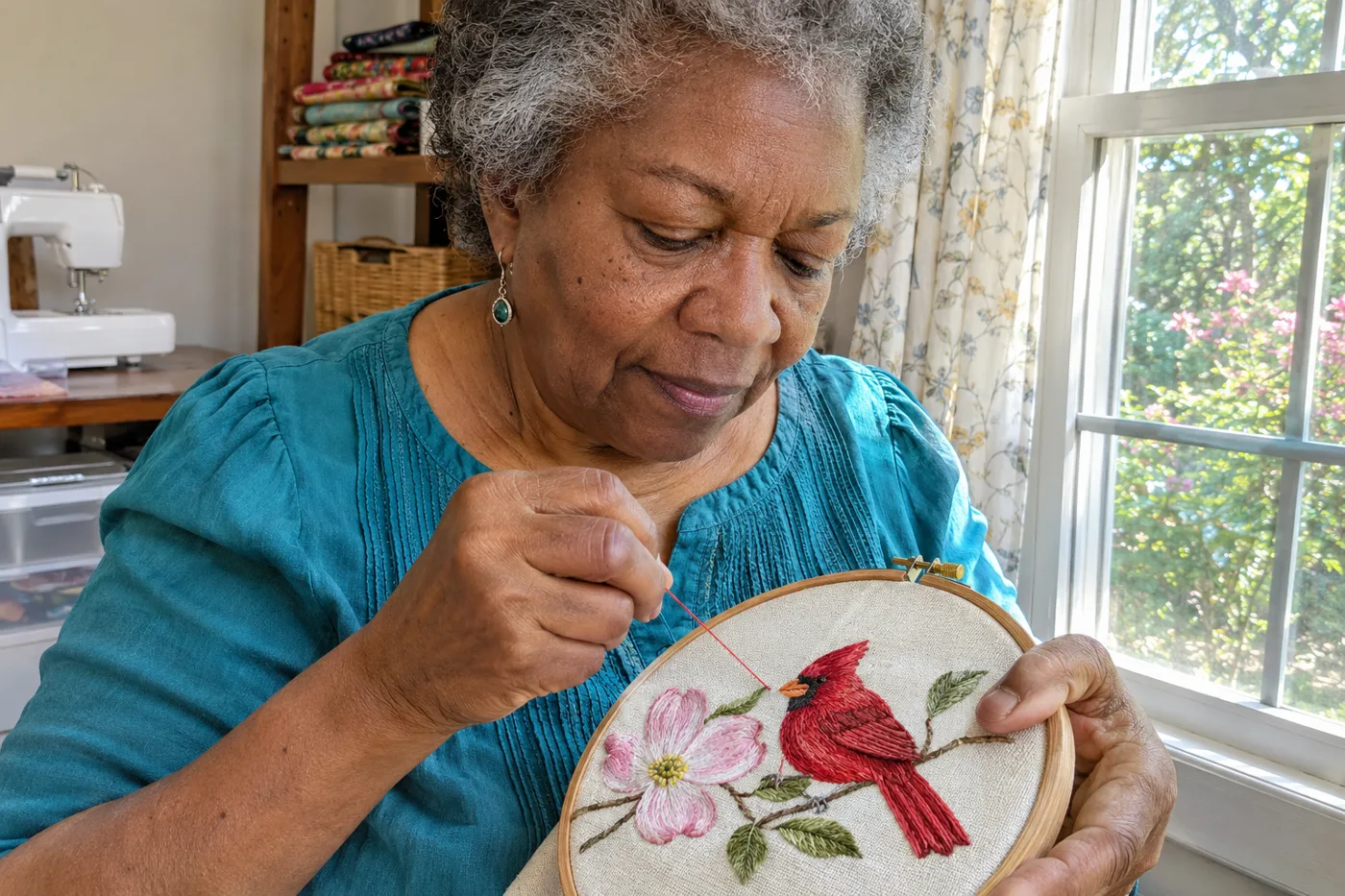
A drawer of embroidered state birds can tell you where it came from, if you know where to look. Brackman has sorted the clues:
| What you see | Likely source | When |
|---|---|---|
| A scroll behind bird and flower | Aunt Martha (Colonial) | 1930s |
| Signed “M. Lieb” | Omaha World-Herald series | 1938 |
| Alaska and Hawaii included | Anne Cabot sets | After 1959 |
| A shield | Laura Wheeler | 1960s |
| Stylized state initials | McKim | From 1931 |
Alice Brooks made a set for the Bicentennial in the 1970s, and one quilt Brackman features was embroidered by Lucy Smith during 1976.
Ruby McKim’s 48-block State Flower series dates to 1931, and it’s still for sale. McKim Studios sells the State Flowers Quilt book for $32.50, with 48 remastered patterns about 6 by 4 inches each.
On TikTok, one person embroidered a state-flower kit while pregnant and had it quilted for her daughter’s 50th birthday. Others show a relative’s blocks 30 to 100 years old and talk about finishing them, framing them or sending them out to be quilted.
This week, pick one state, yours or one you loved, and stitch one block. At about 6 by 4 inches, a McKim flower fits an 8-by-10 frame with room to spare.
#10 Signature quilts that raised the church roof
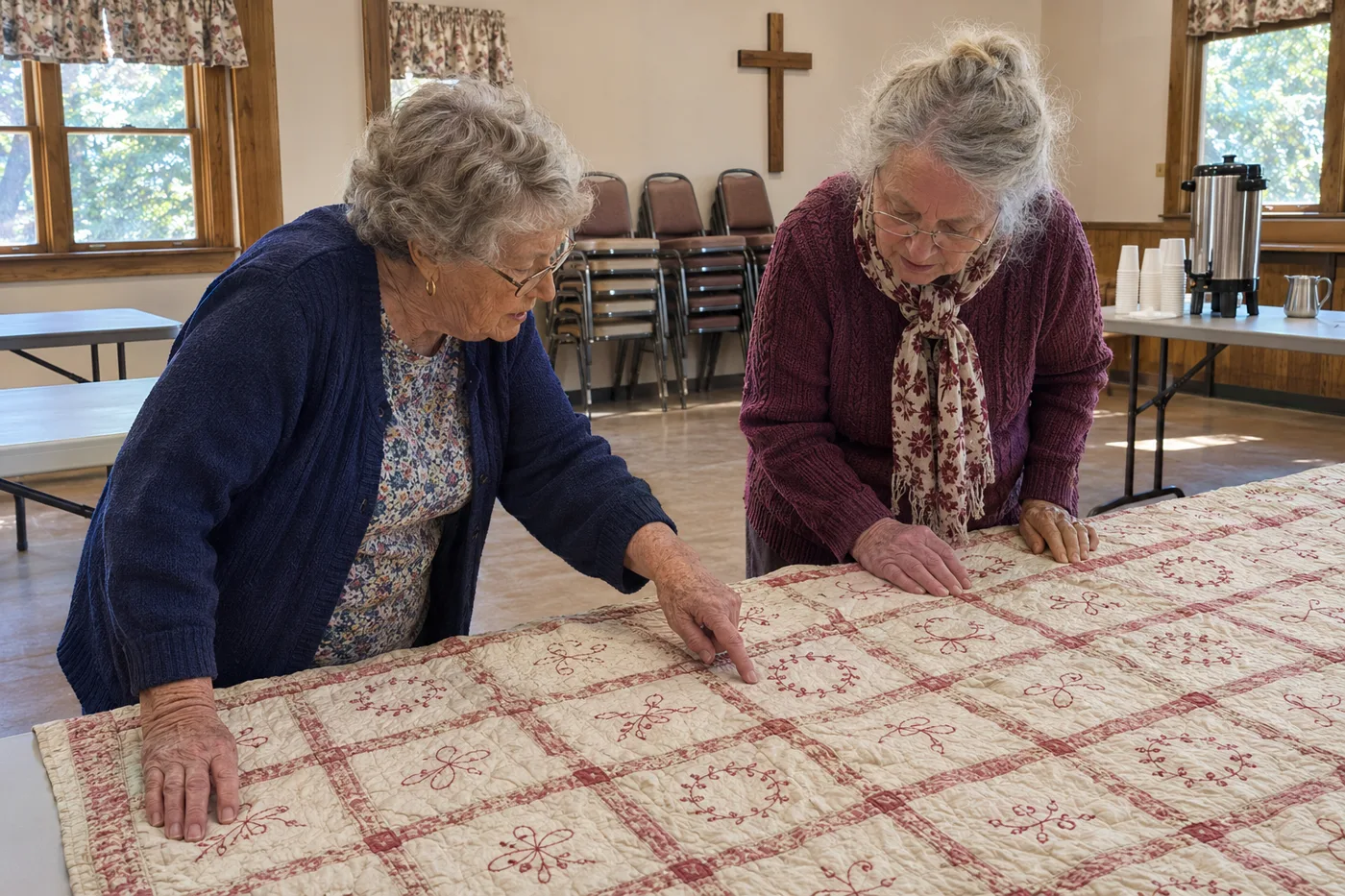
A dime bought your name. The 1889 Union Church quilt in Libertyville, Illinois, carries more than 680 signatures on 86 squares, and most people paid a dime each. Then the quilt was auctioned or raffled.
That’s why the custom worked: the church got paid twice. Once by everybody who wanted their name on it, and again by whoever took it home.
The Pingree Ladies Aid in North Dakota did the same in 1905, selling name squares for 10 to 50 cents to pay off a church debt, and the finished quilt went at auction for $40. By 1976 the rate had climbed: 496 people in Boone County, Indiana, paid $1 apiece to sign that county’s Bicentennial quilt.
The idea still works for a guild, a library or a church. Cut muslin squares and sell each name. Pick the pen with care: Sakura says its Pigma Micron is “not recommended for use on fabrics intended to be washed.” Test your marker on a scrap of the same muslin first.
#9 Bicentennial quilts of 1976
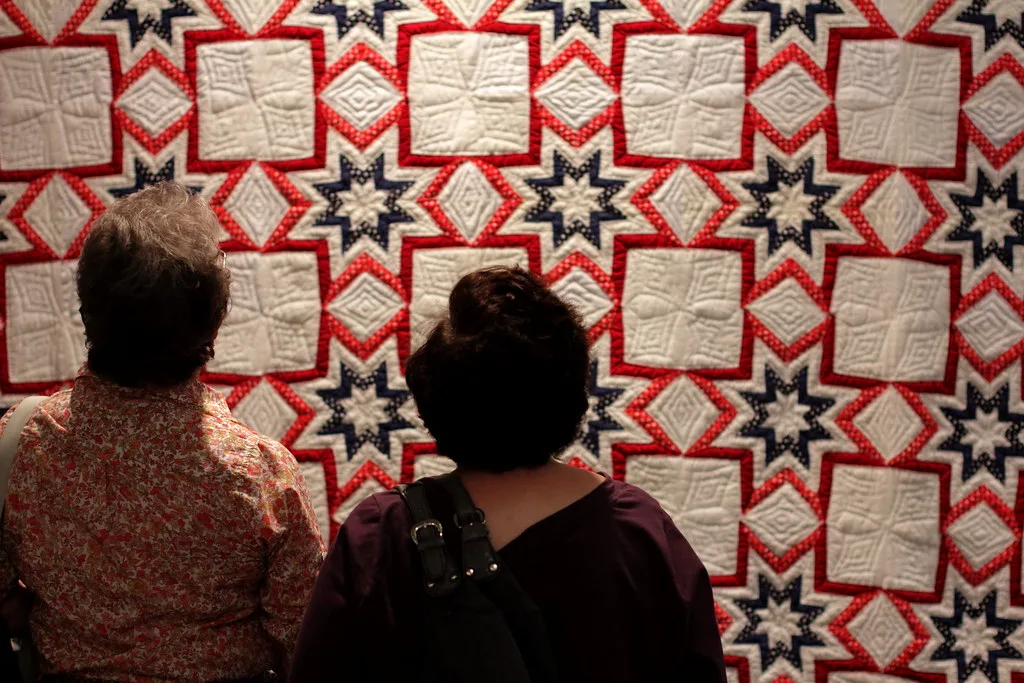
Patriotic fervor built throughout the ’70s. Patriotic quilts “were made by the thousands,” the International Quilt Museum says, and “many people who had never made a quilt before picked up the hobby.” The Great Quilt Contest drew 9,954 entries representing all fifty states.
Towns made them too, block by block, documenting local history and families. In Boone County, Indiana, about 2,500 residents worked on a 10-by-12-foot quilt that was unveiled on July 3, 1976.
A town quilt still starts the same way, with one block. For this week, print the free Quilts of Valor Star paper-piecing pattern from Carol Doak’s site (it’s for personal use only) and make one star in red, white and blue from your stash. Bring it to guild and ask who else will make one.
Did you know?
Boone County’s quilt took about 40,000 hours of work and cost $508.85, the county historical society says. It hung in the courthouse for 41 years and was rehung on April 29, 2026.
#8 Blue jean and corduroy patch quilts
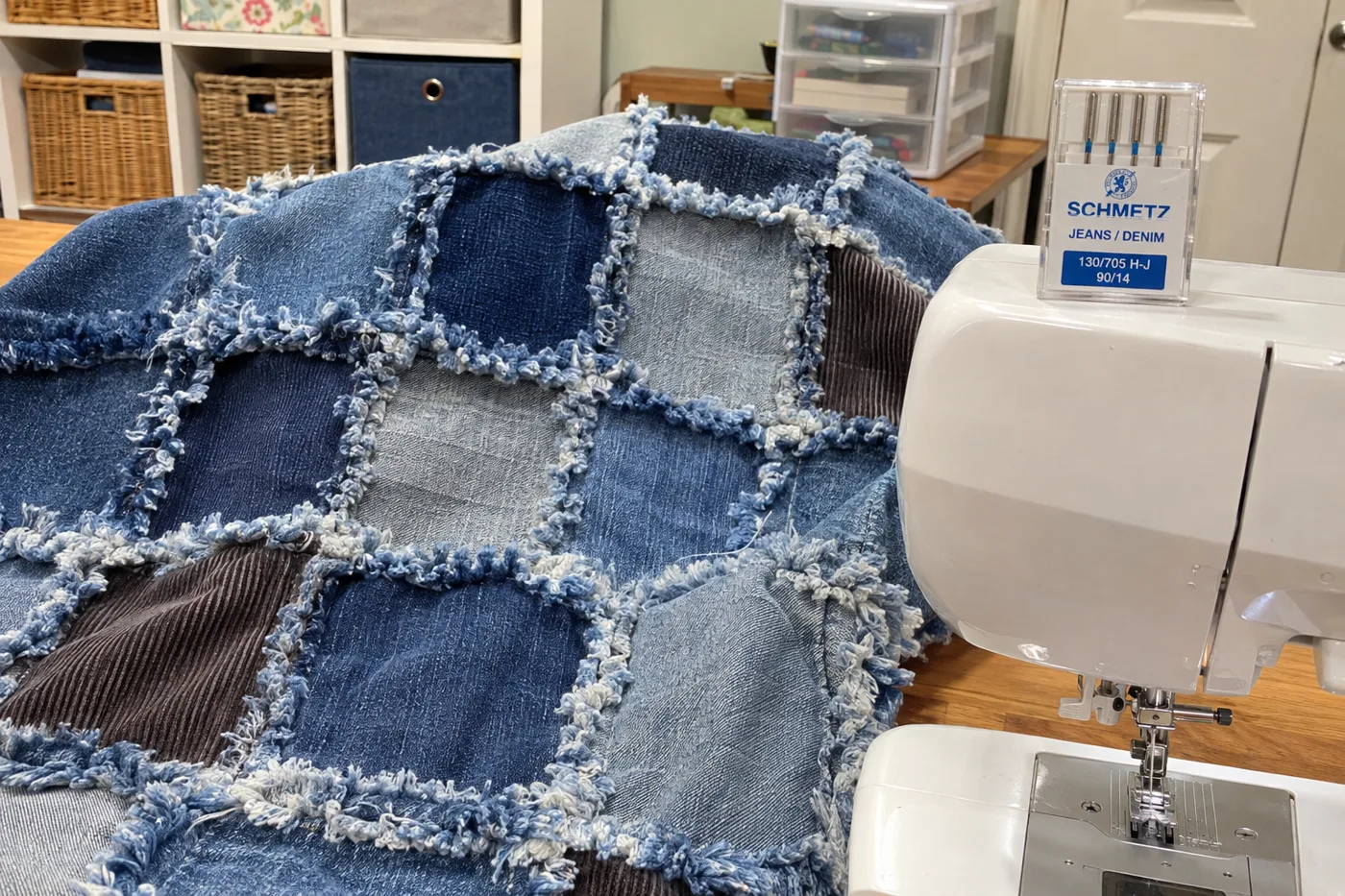
You remember the pile: jeans with the knees gone, a corduroy pair somebody outgrew, and squares cut from whatever was left. Those patch quilts were heavy enough to hold down a picnic in a breeze.
The needle for them is a Schmetz Jeans/Denim needle, the one with the blue color code. It comes in sizes 70/10 through 110/18 and has a “medium ball point and reinforced blade” made for thick woven fabric.
The faster modern version is a rag quilt, with the seam allowances clipped, then washed and dried so they fray soft. The recipe from Sew Can She is in the box below.
A pillow-size test takes nine squares and comes out about 21 inches across, which tells you fast whether you like the look. Denim and flannel fray the most, so back your denim with flannel. And expect a lint trap full of blue fuzz the first time through the dryer.
Denim rag quilt, by the numbers – Cut 8″ squares and sew with ½” seams, so each finishes at 7″ – Use a 90/14 or heavier needle and a walking foot – Clip the seam allowances about ¼” apart, then wash and dry to fray – 72 squares per layer make a quilt about 56″ by 63″
#7 String quilts on newspaper foundations
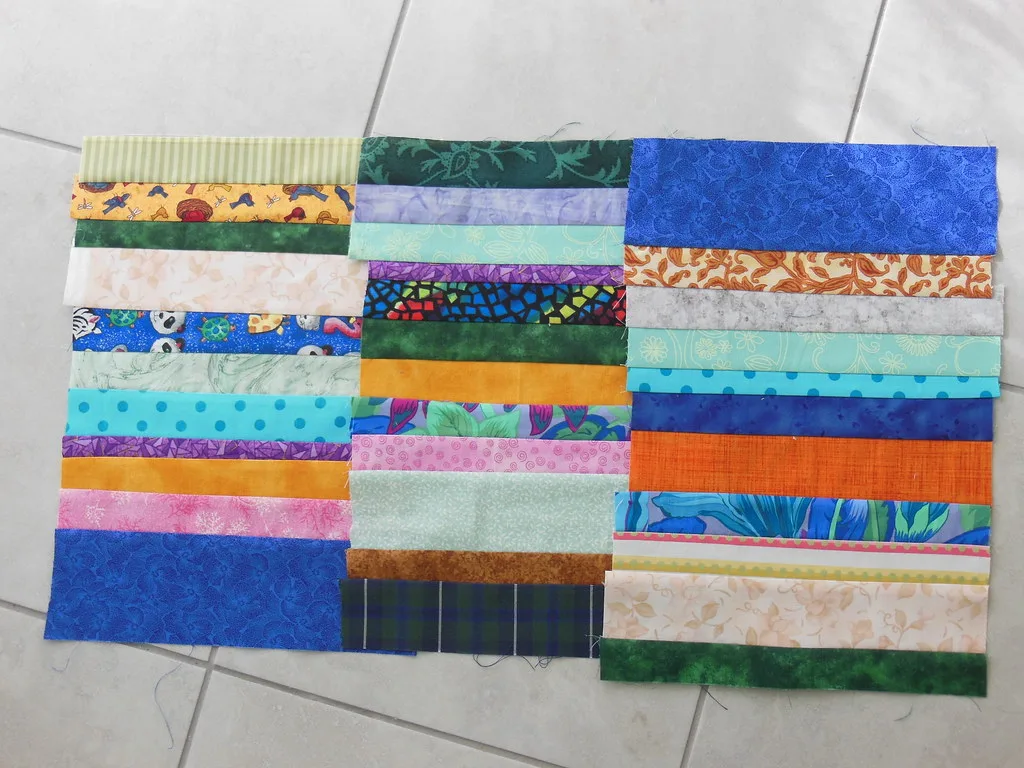
“With string quilts you ain’t got nothing to throw.” Pecolia Warner, Mississippi quilter, to folklorist William Ferris, as quoted by Barbara Brackman
Brackman calls the string quilt “the Cinderella of quilt history.” It’s built from narrow leftover strips, the strings, sewn onto a foundation of backing fabric or newspaper. The International Quilt Museum found them common among make-do quilters in New England, New Mexico and the rural South.
Willia Ette Graham of Oakland put the appeal plainly in Threads in 1988: “You don’t have to cut for a string quilt.”
Most makers tore the paper off when a block was done, but shreds sometimes stayed. If you own an old one, check the back for scraps of newsprint. Even the Kansas City Star printed a Six-Point String Quilt pattern, in 1940.
For this week, cut four 8-inch paper squares, lay a strip across each on the diagonal, and sew strips outward with a short stitch so the paper tears away clean. Trim, tear and join the four for a pillow top. If newsprint worries you near light fabric, a thin muslin foundation works the same way and simply stays in. These are scrappy quilt blocks in the truest sense: the narrower and odder the strips in your bin, the better they look.
 You might also like17 Things to Check Before You Sell (or Give Away) an Old Sewing Machine
#6 Make-do quilts from worn shirts and dresses
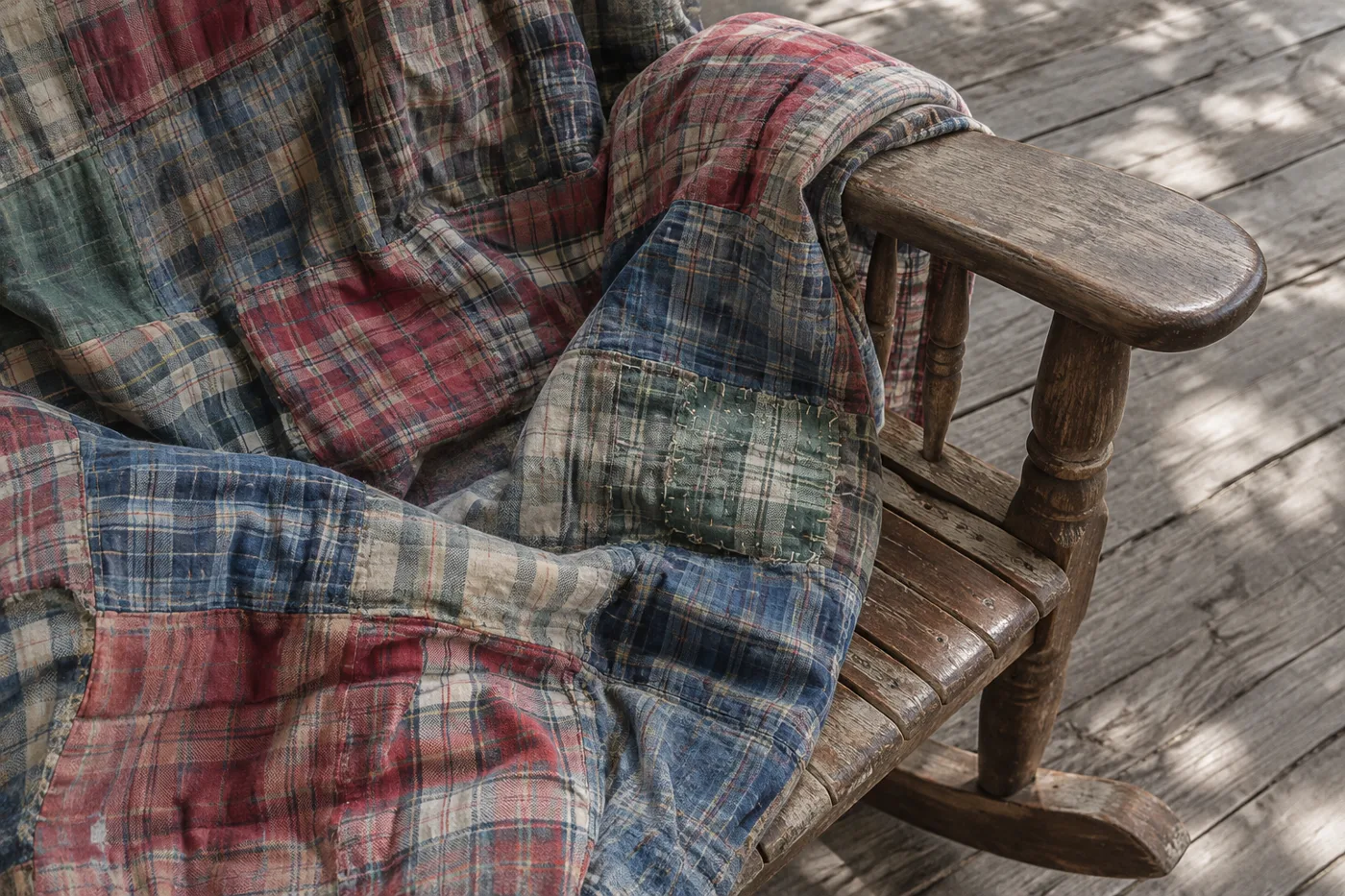
Some of the hardest-working quilts were the ones nobody thought to save. “Most quilts like this would have been well used, and subsequent generations would have discarded them as having little value,” a quilter wrote on r/quilting about an estate-sale utility quilt.
On Reddit, quilters describe make-do quilts from old shirts, dresses, aprons, jeans and corduroy. One was backed with an old blanket or stuffed with raw cotton from the fields. Several compare them to Japanese boro. Boro means “rags,” and it goes back to rural Japan in the Edo period, when cloth was costly and repairs were made with simple running stitches. The International Quilt Museum gave boro a full exhibition, curated by Dr. Yoshiko I. Wada, that ran through June 20, 2026.
The same museum notes that quilts were rarely made purely for use. In the Depression, many were made “to soothe souls” as well as to cover beds.
So keep the plain one. If it’s worn through, a few running stitches over a patch of old cloth is the same mend boro makers used. If you have a pile of worn shirts, cut the best parts into one size of square, sew them by machine, and tie it or quilt it in long straight lines. The collar points and frayed cuffs go in the string bin from #7.
#5 Kansas City Star newspaper patterns
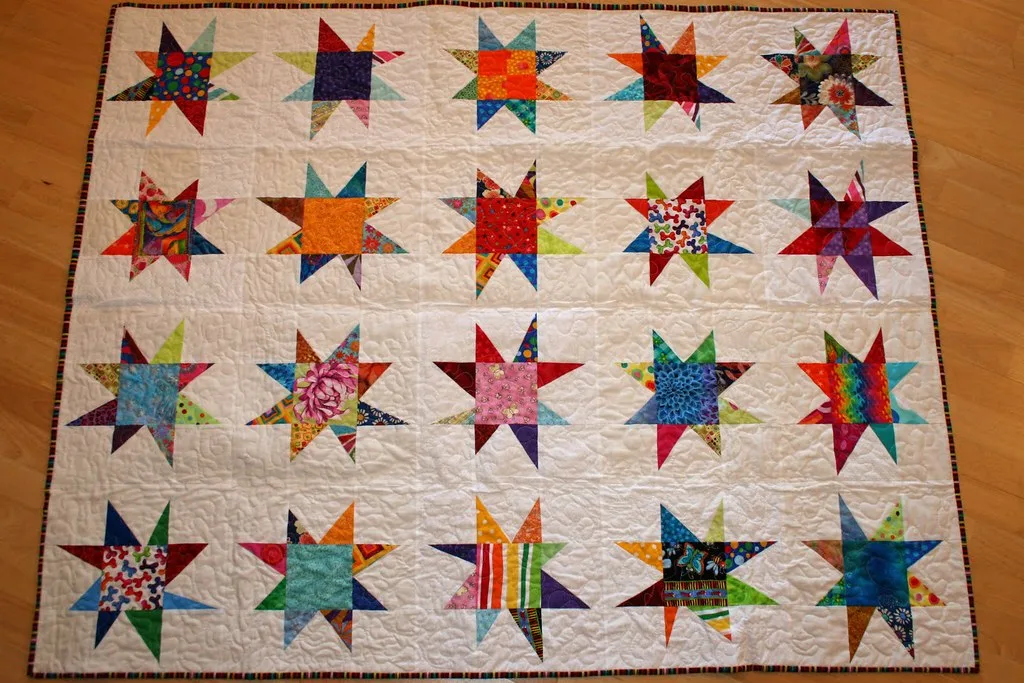
If you grew up near Kansas City, the quilt pattern came with the paper. The Star published more than 1,000 quilt patterns from 1928 to 1961. The My Stars books redraw the series, giving each pattern with templates alongside the original newspaper sketch and caption, so you see the block the way the paper printed it. The Quilt Index hosts Wilene Smith’s Kansas City Star research.
For this week, find a block in the My Stars books whose name you remember hearing at home, cut it from the templates and piece one for a pillow front.
#4 Drunkard’s Path curved two-patch
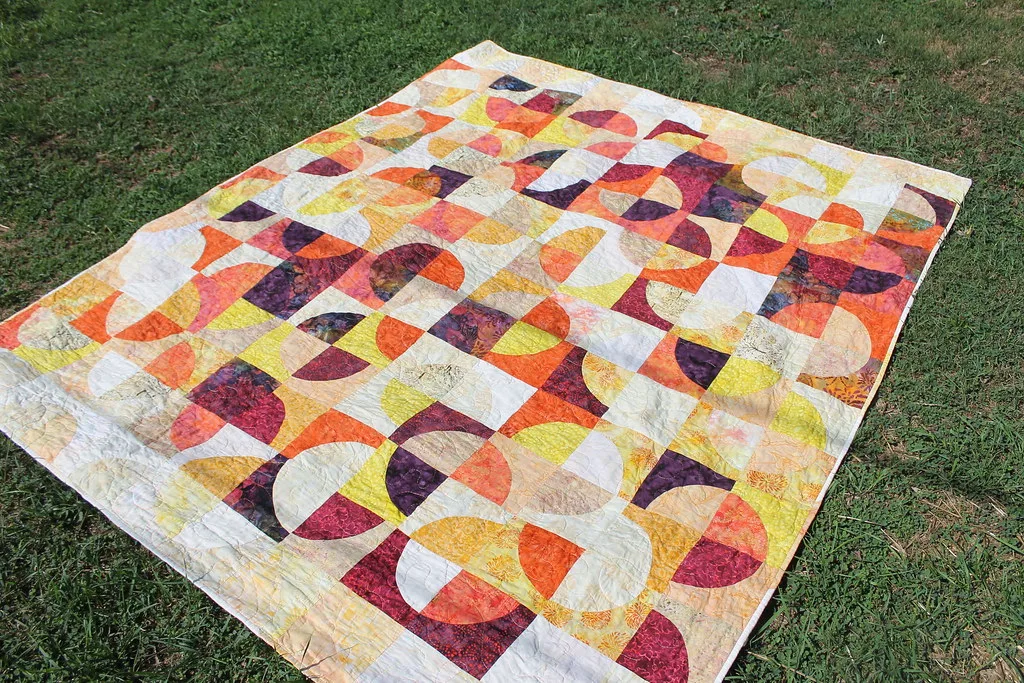
Drunkard’s Path has more than a dozen names. In 1933, Mae Wilford’s pattern booklets called it Trail of Friendship, Cleopatra’s Puzzle and Drunkard’s Trail, and Nancy Cabot called it Boston Trail. Whatever your family called it, nobody was wrong.
The story that the Woman’s Christian Temperance Union adopted it as a symbol “has never been documented.” The Underground Railroad code story is folklore, too: historian Giles R. Wright said, “What I think they’ve done is they’ve taken a folklore and said it’s historical fact.”
AccuQuilt’s GO! Drunkard’s Path 7-inch finished die cuts the pieces with the ¼-inch seam allowance included, and a yard of fabric gives you 16 sets. Set 4 by 4, that’s a table topper about 28 inches square.
The catch is the price: about $89.99 on sale and $104.99 regular. It’s worth it only if you plan more than one curved project. Otherwise a template, scissors and plenty of pins still work.
#3 Cathedral Window folded muslin squares
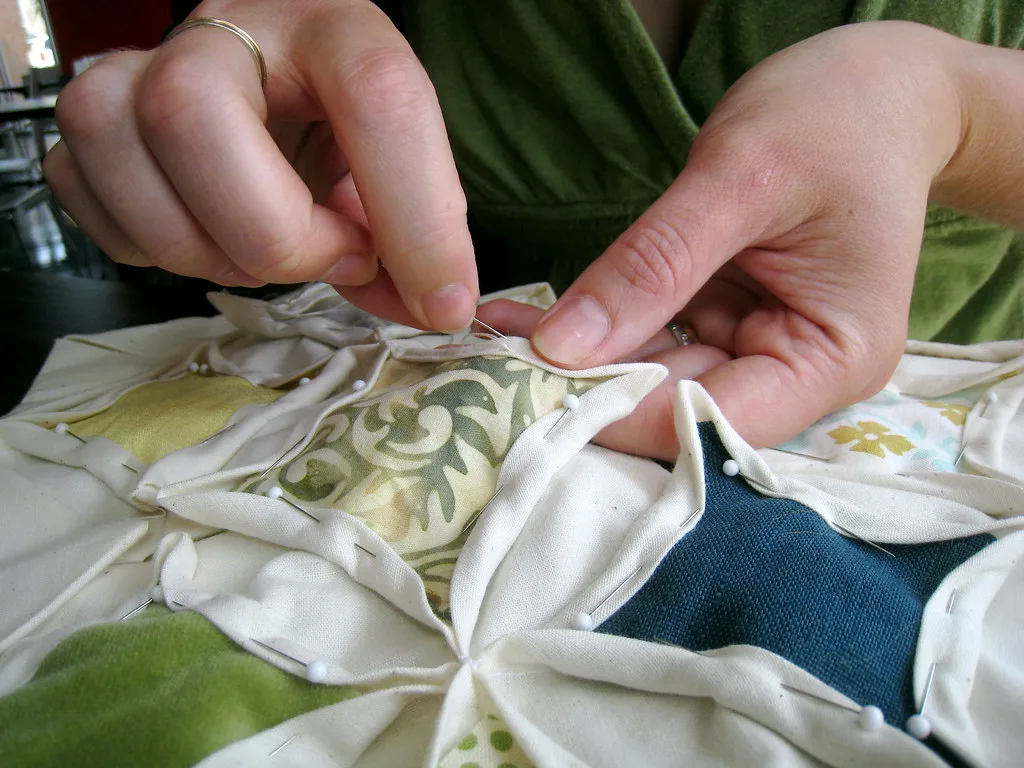
“The nice thing about this is it doesn’t have to be quilted,” a 1967 newspaper item said, and that was the whole charm. Brackman traces a newspaper flurry for the pattern starting in North Carolina in 1961, and it became a fad through the 1960s and 1970s.
The fad had unwritten rules: scrap prints in the windows with no light-and-dark plan, a white or unbleached muslin background folded around them, and no quilting. Brackman started one herself in the 1970s and finished it as a small pillow of 25 squares, an ending plenty of Cathedral Window makers would understand.
The Shiloh Museum of Ozark History has one from about 1970 by Charlotte Shepard of Fayetteville, Arkansas, who lived from 1890 to 1977. It’s “formed by folding and sewing squares of fabric together.” The Quilt Index lists 268 Cathedral Window quilts.
Jenny Doan of Missouri Star Quilt Co. has a machine version. “It doesn’t matter what size square you use, but all your squares need to be the same size,” she says. Her method gives up the no-quilting part: you layer with batting and backing, then quilt.
Doan’s machine Cathedral Window – Start with 5″ charm squares, prints plus background – Fold the squares – Roll the folds over a center square and stitch the curves by machine – Layer with batting and backing, then quilt
Did you know?
The earliest published Cathedral Window pattern Brackman found, called “Mock Orange,” ran in Workbasket in August 1944 and called for 22½ yards of white fabric.
#2 Tied polyester double knit quilts
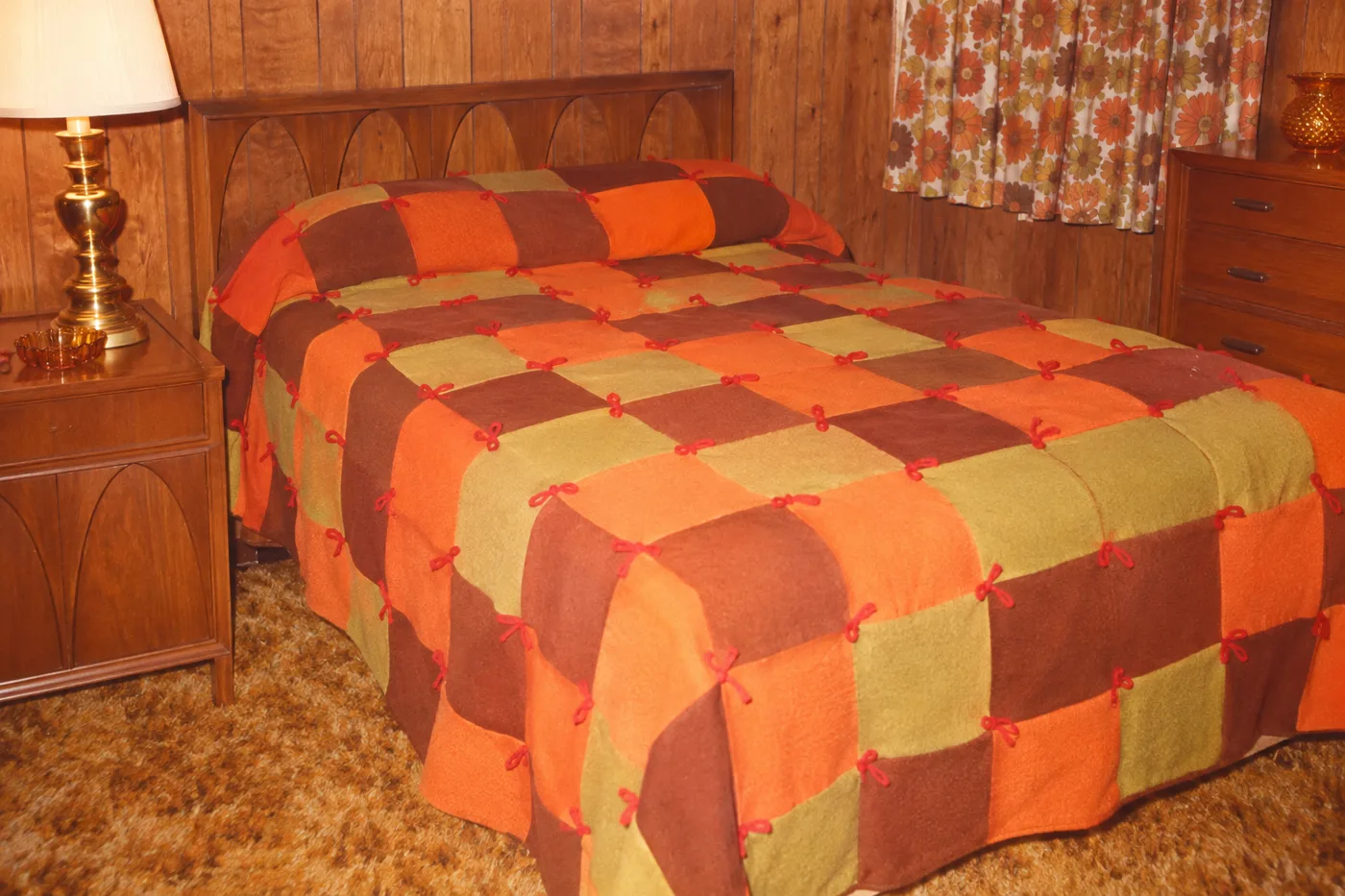
Slick, a little stiff, yarn ties every few inches, maybe a bed sheet for a back: you’d know one in the dark.
Collector Bill Volckening traces the story. DuPont showed reporters a Dacron polyester suit in 1951, and double knit clothes were on sale by 1960. In the 1970s, when quilting cottons were scarce, quilters used double knit instead. It held its color and resisted unraveling, so raw edges were fine. People who wore it found it scratchy and hot, and the clothes lost favor as cotton came back. One quilt he describes is “backed with a blue and white striped bed sheet, tied.”
Ask the people who grew up under them. Amelia Peck, a curator at the Metropolitan Museum of Art, said of a polyester Nine Patch: “I love this quilt because it reminds me of my childhood.” Quilter Victoria Findlay Wolfe grew up under her grandmother’s and remembers them keeping her warm in a house heated only by a wood stove. In 2013, several vintage polyester quilts were priced around $250.
Look for a basic polyester double knit such as Ponte di Roma at fabric retailers. For this week, sew double knit squares by machine into a table-runner-size top, back it with a piece of flat sheet the way the old ones were, and tie it with yarn through both layers. Skip the rag-quilt trick: polyester is one of the fabrics that fray least, which is exactly why it worked so well in the first place.
#1 Cleopatra’s Fan, the 1934 pattern nobody made
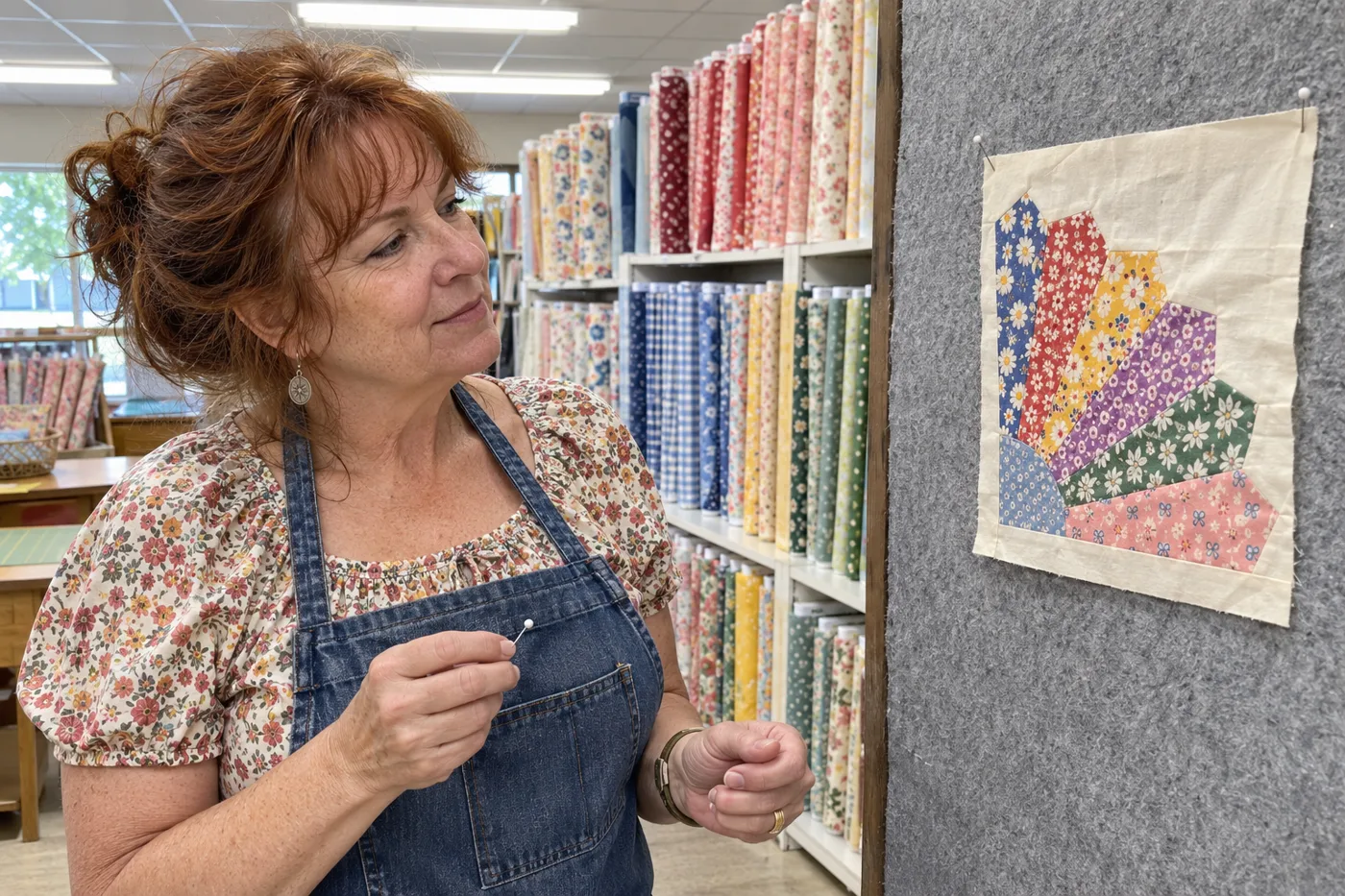
In 1934, somebody in Cincinnati opens the Enquirer to the pattern column and finds a new block under “Laura Wheeler Designs.” The copy begins: “Cleopatra herself once used palm-leaf fans as graceful as these…” The block is a palm-leaf fan, and it finishes at 9¾ inches.
Remember the shield on those Laura Wheeler state birds in #11? There was no Laura Wheeler. She was one of several made-up bylines used by a New York pattern syndicate.
And almost nobody sewed her fan. The quilt blogger behind Rebecca Grace Quilting went looking and found images of only two surviving quilts from the period. The International Quilt Museum, which holds the largest public quilt collection, has none. Ann Wasserman, an antique quilt expert, had never seen the pattern until she restored one in 2014. “Today we’re uncovering one most quilters have never even heard of,” Stitchin’ Heaven, a Quitman, Texas, quilt shop, told its followers.
Plenty of patterns get called forgotten. This one never got remembered in the first place.
You can make it this week, with either of two shortcuts. AccuQuilt makes a 12-inch Cleopatra’s Fan die for its GO! cutters; check the current price on its site. Inklingo’s 12-inch shape collection is a download of about $35 that you print yourself on an ordinary inkjet printer, and Inklingo sells sizes from 4½ to 12 inches if you’d like it smaller or closer to the 9¾-inch original. Use 1930s reproduction prints for the fan on a muslin background, and make one block for a pillow. Finish it and you’ll own a Cleopatra’s Fan, something almost no quilter in 1934 did.
Keep reading
 15 Things Hiding in Grandma’s Sewing Box That Could Be Worth Real MoneySee all 15 →
More you’ll enjoy
 17 Sewing Room Gadgets Most ’60s and ’70s Moms Had
 17 Old Needlework Skills You Inherited But Never Learned
 17 Quilting Mistakes Even Experienced Quilters Still Make
The bottom line
The names go first. A quilt can outlast everybody who slept under it and still lose what it was called within a generation, until it’s just “Grandma’s quilt” and nothing more.
That part you can fix with a pencil. When you finish a block this week, write on the back every name you know it by, plus the year and your own name. Sunbonnet Sue and Dutch Doll. Drunkard’s Path and Trail of Friendship.
And if there’s an old quilt in a closet you can reach, go take another look. You may know its name now.
Bonus: four quick checks for any old quilt you pick up
- Look for faint printed lines. Stamped outlines and marked quilting lines that never washed out help identify a kit quilt, and kits stayed popular through the 1980s.
- A hexagon print with no seams may be “printed patchwork,” which Brackman says seems to be the late-19th-century name. “Cheater” and “faux patchwork” are modern terms, and Riley Blake reproduced a hexagon print in 2016.
- If somebody tells you a fan quilt is Colonial, Brackman’s answer is “Fans are NOT a Colonial pattern.” The earliest dated fan quilt she found is from 1882 to 1883.
- Look at how the appliqué edges were stitched. A Boise Art Museum guide to its quilt exhibition notes: “The buttonhole stitch is stronger than the blanket stitch.”
Questions people also ask
What is the hardest quilt pattern to make?
No authority names one hardest pattern. Double Wedding Ring is built from curved arcs. By 1932, kit makers were selling it with precut patches, which saved the maker the time needed for tracing around templates and cutting out each design unit. Today’s printed interfacing method avoids curved piecing altogether.
Should I finish my grandmother’s unfinished quilt top?
You can, but go gently, because old fabric often can’t stand the pulling of quilting. A textile conservator told quilter Amy Friend that hand tying is the better choice since it uses the fewest stitches, and that machine quilting should use a longer stitch that follows the existing seams. Once it’s finished, treat it as vintage and display it rather than sleep under it.
How can you tell how old a quilt is?
You can narrow it down by fabric, dye and style, but unless a quilt is dated and its history is proven, the honest answer is “circa.” Retired appraiser Kris Driessen dates quilts this way: improved dyes after World War I gave 1930s and 1940s quilts deeper color and brought pastels back. A row of small, evenly spaced holes along a fabric edge marks a real feed sack, and a quilt is only as old as its newest fabric.
Are feed sack prints still made or reproduced?
Yes, reproduction feed sack prints are sold. Moda’s “30’s Playtime” line, credited to designer Linzee McCray, sells for about $12.48 a yard at Fat Quarter Shop.
Where can I find old quilt patterns for free?
Paper Pieces offers a free Grandmother’s Flower Garden PDF. If you’d rather have printed reprints, McKim Studios sells its series books for $22.50 to $32.50, which aren’t free but come ready to use.
How should I store an old quilt?
Store it flat if you can, with acid-free tissue or washed muslin cushioning any folds, away from light, attics and basements. The International Quilt Museum refolds its own on new lines and warns that “cedar chests and closets may have almost no value as moth or carpet beetle repellents.” Dr. Lori agrees: “I don’t want you to put your quilt into a cedar chest.”